1961
Luiz Carlos Cintra Gordinho de Carvalhosa was born on December 11th in São Paulo, Brazil, to Margarida Cintra Gordinho and Carlos Barros de Carvalhosa. He was the middle child, between siblings Zita and Fernando.
1977
He enrolled at Colégio Equipe, a private high school known for encouraging critical and creative thinking and nurturing artists and intellectuals.
He also contributed to Papagaio, a comic magazine created by students and printed at the school, which had published three issues by 1979.
1980
He began studying at the Faculdade de Arquitetura e Urbanismo at Universidade de São Paulo (FAU USP). Around the same time, he started learning metal engraving at Sérgio Fingermann’s studio, which he attended until 1982, alongside Antônio Malta, Fabio Miguez, Paulo Monteiro, and Rodrigo Andrade—artists who would later become his partners at the Casa 7 studio.
1982
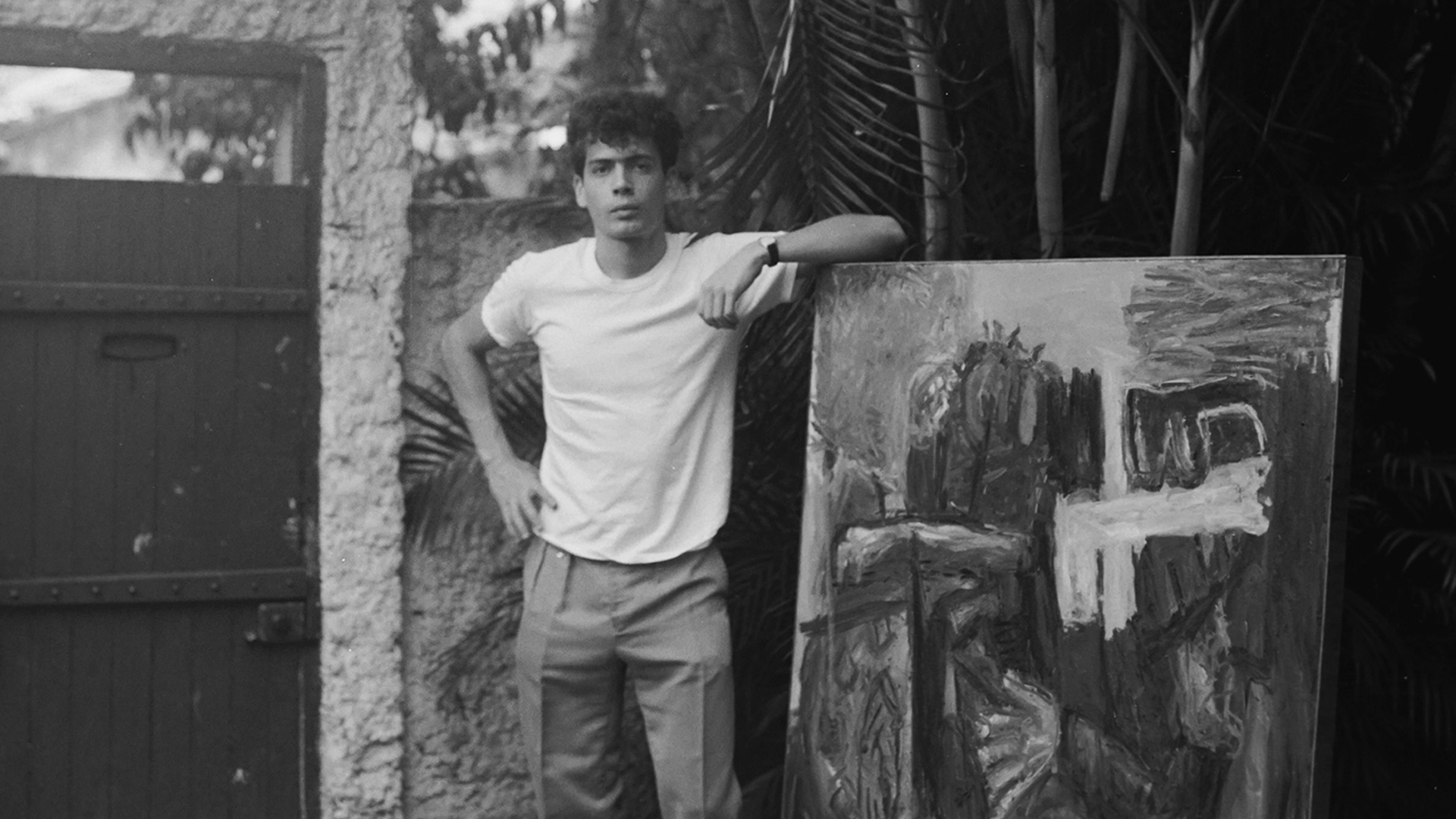
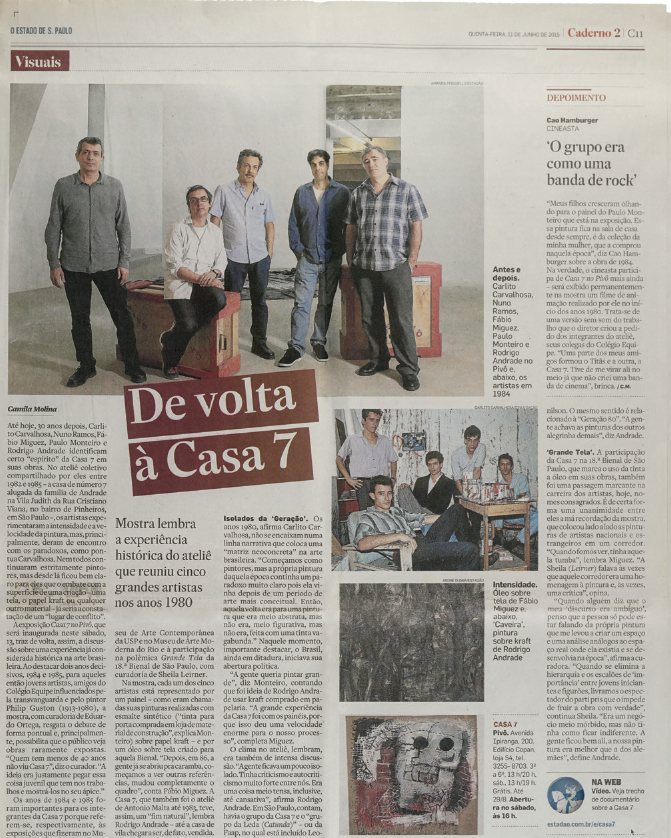
He co-founded the Casa 7 studio in São Paulo with Fabio Miguez, Nuno Ramos, Paulo Monteiro, and Rodrigo Andrade, all former Colégio Equipe students. Casa 7 played a pivotal role in the resurgence of painting in Brazil during the 1980s.
1983
He participated in the 16th Contemporary Art Salon of Piracicaba alongside the other Casa 7 members. At Casa 7, he created large-scale geometric abstraction panels using synthetic enamel on kraft paper, which were displayed unmounted [p. 101].
1984
In addition to the panels, he created
abstract figurative paintings using oil
paint on canvas. His use of simple,
accessible materials, combined with
a gestural painting style, defined
this period. Carvalhosa participated in the
group exhibition Arte na rua 2 [Art on
the Street 2], hosted by the Museu de
Arte Contemporânea da Universidade
de São Paulo (MAC USP), where
paintings were displayed on billboards throughout the city.
He also exhibited his work in
Pintura [Painting] at Centro Cultural
São Paulo (CCSP), the first group
show featuring Casa 7 artists, alongside Sérgio Fingermann.
He took part in the 47th São Paulo
Fine Arts Salon and the 7th National
Salon of Fine Arts.
Carlito Carvalhosa won the
Acquisition Prize at the 2nd São
Paulo Salon of Contemporary Art
for his work A bela máquina [The
Beautiful Machine], which became
part of the Pinacoteca do Estado de
São Paulo Collection [p. 105].
At FAU USP, he worked on a
research project focused on offset
and graphic language. For his final
dissertation, he analyzed design elements and typographic relationships
in works from the Bauhaus school.
He graduated with a degree in
Architecture and Urbanism from
FAU USP.
Urbanismo pela FAU USP.
1985
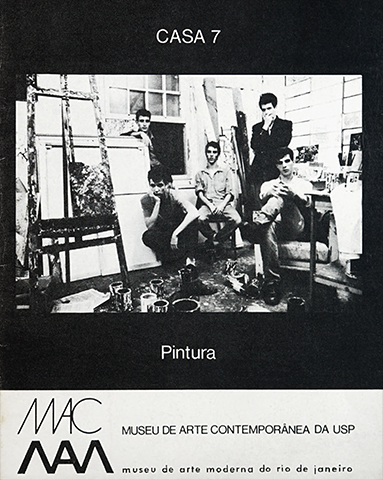
At Casa 7, he created expressive paintings featuring bold, structured brushstrokes, enriched with chromatic patches that added complexity to the pictorial space, using oil paint on canvas [pp. 106–07]. He took part in the exhibition Casa 7 at MAC USP and Museu de Arte Moderna do Rio de Janeiro (MAM–RJ), Brazil, curated by Aracy Amaral. He participated in the 8th National Salon of Fine Arts and won the Acquisition Prize at the 3rd São Paulo Salon of Contemporary Art. He also took part in the 18th Bienal de São Paulo, where Casa 7 artists presented paintings in the “Grande tela” [Large Canvas] section, curated by Sheila Leirner. The display, which was heavily criticized, juxtaposed works by various artists under the label “neo-expressionism.” The paintings were hung so closely together that it created a continuous corridor of art, making the individual pieces difficult to distinguish.
1986
The evolution of their work led to a creative divide among the Casa 7 members, prompting them to pursue their artistic paths more independently. Carvalhosa started using encaustic, a wax-based paint, to create monochromatic panels. The combination of wax and turpentine with minimal pigment resulted in rich textures and layers, enhancing the color and transparency of the wax [pp. 113–15]. He took part in the 4th São Paulo Salon of Contemporary Art and exhibited at the 2nd Bienal de La Havana in Cuba, as well as the Latin American Biennial of Art on Paper, at CAYC, in Buenos Aires, Argentina. Carlito Carvalhosa won the Travel Abroad Prize at the 9th National Salon of Fine Arts.
1987
Casa 7 came to the end with the demolition of the building that served as its studio. Carvalhosa designed and began constructing a house with a studio on Rua Simpatia in the São Paulo neighborhood of Vila Madalena. He continued creating monochromatic encaustic paintings on wood. Melted and diluted wax was applied with a spatula or his fingers, using a technique that shaped the material while expanding the pictorial space [pp. 118–21]. He exhibited at the Cuenca Biennial in Ecuador. His first solo exhibition, Pintura com cera [Wax Painting], took place at Subdistrito Comercial de Arte gallery in São Paulo, featuring a text by Lorenzo Mammì. He also held an exhibition titled Pintura [Painting], where he presented monochromatic encaustic paintings at the Santa Luzia Chapel, then part of Universidade Federal do Espírito Santo in Vitória, Brazil.
1988
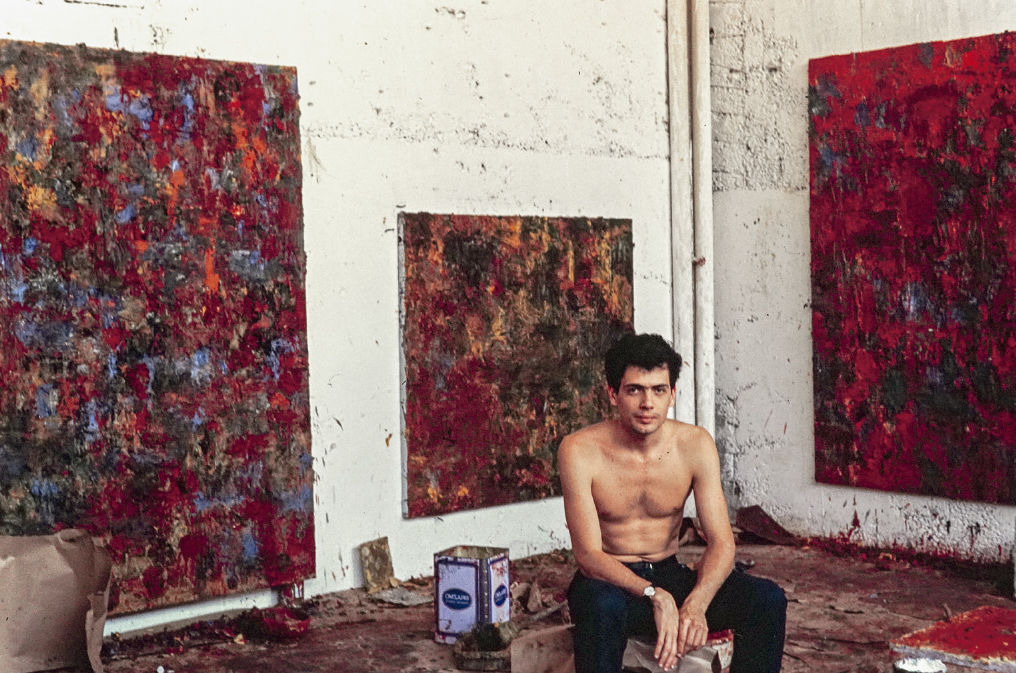
Through the use of various pigments, his encaustic paintings evolved to include a greater density of pictorial material and plastic fragmentation. The polychromatic works consist of layered overlays, a process that evoked collage while also creating volume [pp. 122–25]. He applied for a scholarship to the German Academic Exchange Service (Deutscher Akademischer Austauschdienst—DAAD) for an artistic residency in Germany.
1989
Carvalhosa received the DAAD scholarship. He created large-format horizontal panels using oil, wax, pigment, and resin on wood. By leveraging the contrasting characteristics of these materials, he produced surfaces that alternately reflected or absorbed light, suggesting dry and wet spaces, composed through gestural techniques [pp. 128–29]. He participated in the 20th Panorama da Arte Brasileira at Museu de Arte Moderna de São Paulo (MAM–SP), dedicated to painting, under the technical direction of Denise Mattar. He had a solo exhibition at Paulo Figueiredo gallery in São Paulo and his first solo exhibition in Rio de Janeiro at Funarte’s gallery. He traveled to Germany, where he witnessed the fall of the Berlin Wall.
1990
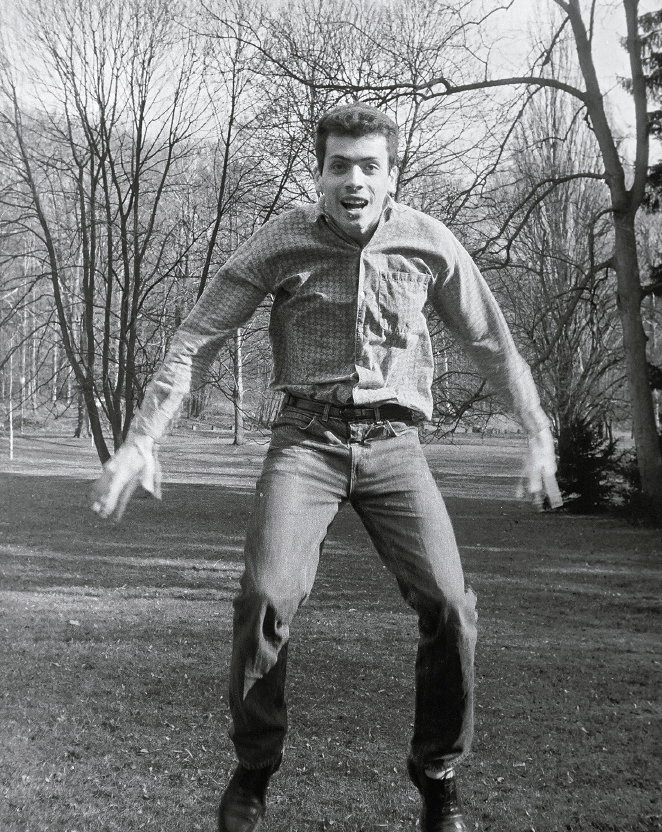
He settled in Cologne, Germany, establishing both his home and studio. He created drawings using oil pencil and charcoal, as well as paintings with wax and collage. The wax paintings were less material-heavy than his earlier encaustic works. He used fine canvas as a support, incorporating more oil paint and pigment into the wax, while placing greater emphasis on the drawing rather than the materiality. The transparency of the wax allowed for printed collages to be placed underneath, recalling techniques he had previously employed [pp. 132–33].
1991
He created small-scale wax works (30 × 30 cm), which became a hallmark of this period [pp. 138–41]. The wax paintings gained a sculptural dimension, featuring reliefs and the incorporation of materials such as clay and oil, while the size of the support became smaller in the Dedinhos series. The reliefs, created from the artist’s finger molds, protruded from the canvas, adding movement. Materials embedded beneath the wax, such as oil paint bubbles and clay, caused ruptures in the surface. The translucent wax revealed what lay beneath, with internal volumes partially emerging as the material dried or expanded over time. The organic colors and shapes suggested the artist’s bodily actions, resulting in what he referred to as “paintings made with sculptural means.” [pp. 142–47]. He participated in a group exhibition at Kunsthandlung Maeder in Berlin.
1992
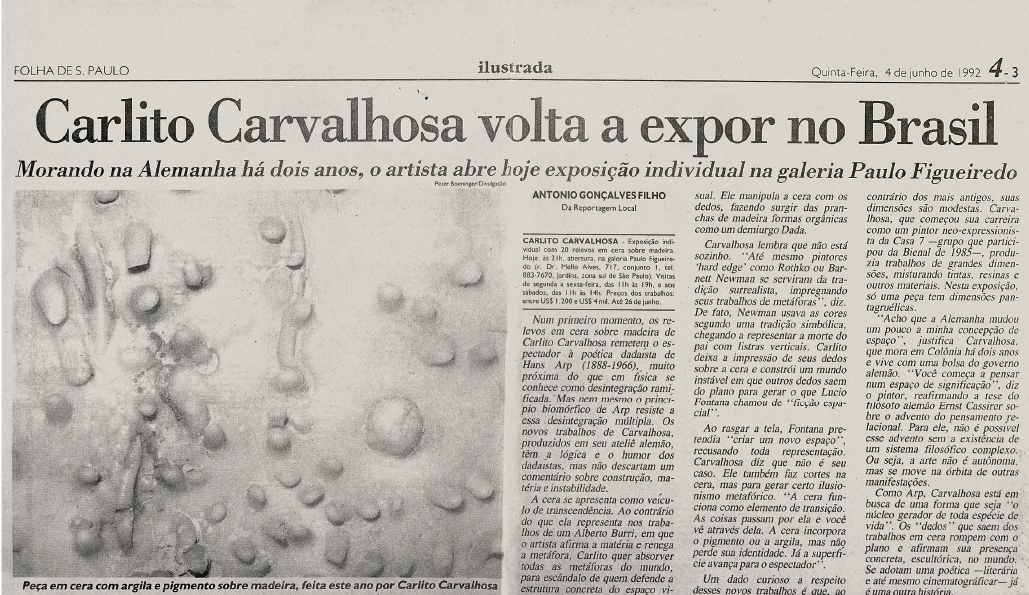
He experimented with new formats in his wax paintings, using supports measuring 40 × 40 cm and 50 × 40 cm, to create works where his fingers, instead of protruding outward, left traces in the wax in low relief [pp. 148–49]. He returned to Brazil after three years in Cologne, Germany. His first exhibition in Brazil of the works produced in Germany took place at Paulo Figueiredo gallery in São Paulo.
1993
He established his studio on Rua Simpatia in São Paulo, in the house he designed in 1988. He created large wax panels using clay, resin, and oil, measuring 222 × 122 cm. These wax panels continued the process of isolating bubbles of oil, clay, resin, and cement beneath the translucent wax, but now the plates were flat and turned inward [pp. 153–55].
1994
He continued creating wax panels, now also in the format of 160 × 150 cm [pp. 156–57]. He participated in the Bienal Brasil Século XX at Fundação Bienal de São Paulo, coordinated by Nelson Aguilar and curated by Agnaldo Farias. Carvalhosa held a solo exhibition at Gabinete de Arte Raquel Arnaud, in São Paulo, showcasing a series of wax paintings. He created his first sculptural series, later called Ceras perdidas [Lost-Wax Castings] [pp. 158–63]. These hollow, twisted works, made from wax, paraffin, and clay, emerged from unstructured molds and hardened as they cooled, with the artist supporting them during the process. They range in size from 60 to 170 cm. Ceras perdidas marked the beginning of a period dedicated to sculpture, spanning from 1995 to 2002, during which the artist embraced the three-dimensionality he had previously explored in his wax painting panels.
1995
He participated in an artist residency at the Escola Superior de Desenho Industrial at Universidade Estadual do Rio de Janeiro (ESDI UERJ), where he created sculptures from the Ceras perdidas series and wax panels measuring 220 × 122 cm [pp. 150–51]. His first exhibition of sculptures brought together Ceras perdidas and wax paintings at Centro Cultural Banco do Brasil do Rio de Janeiro (CCBB–RJ) and Centro Cultural São Paulo (CCSP). The sculptures seem to emerge from the wax panels, while the paintings, oriented inward, are composed of layers of wax, clay, cement, and pigment [pp. 164–65].
1996
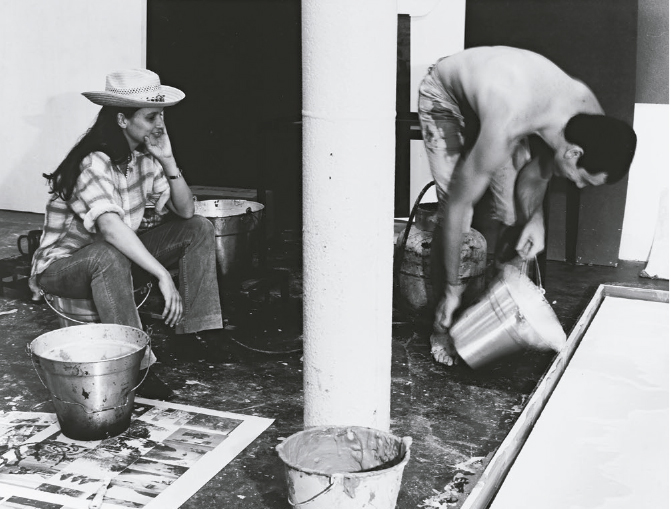
He created sculptures in white porcelain in collaboration with sanitary ware factories. Building on his earlier sculptural work, these hollow pieces expose their interiors through round openings, sometimes pierced by porcelain tubes. The sculptures feature complex, ambiguous forms with rough surfaces, while the glossy white glaze shines, capturing and dazzling the viewer [pp. 174–79].
1997
At Gabinete de Arte Raquel Arnaud in São Paulo, he exhibited porcelain sculptures and monotypes made from oil paint on waxed paper, which, according to the artist, serve as “mirrors” of the sculptures. He also exhibited at Galería David Pérez McCollum in Guayaquil, Ecuador. He created the trophy for the É Tudo Verdade [It’s All True] International Documentary Film Festival. He presented his first ephemeral work in the group exhibition Arte/ Cidade [Art/City], an urban intervention curated by Nelson Brissac Peixoto, held between 1994 and 1997 in São Paulo. Vazador consists of five large blocks of asphalt arranged on the site of the former Matarazzo factory in São Paulo [pp. 166–69].
1998
He created medium-sized plaster sculptures, which were exhibited for the first time at the 5th Week of Art in Londrina, Paraná, alongside painted glass made with the same material, reflecting the shapes of the sculptures. The plaster used in the molds for the porcelain pieces was incorporated as a final material to shape the sculptures, which were assembled in layers through overlapping, interlocking planes [pp. 180–85].
1999
He held his first exhibitions of large-scale site-specific ephemeral plaster pieces, which incorporated the chance effects produced by the material. The use of plaster allowed him to amplify the paradox between mass and volume seen in the porcelain works and, previously, in the wax sculptures. The exhibition Duas águas [Two Waters] was held at Museu Brasileiro da Escultura e da Ecologia (MuBE) in São Paulo [pp. 186–89] and at Paço Imperial in Rio de Janeiro.
2000
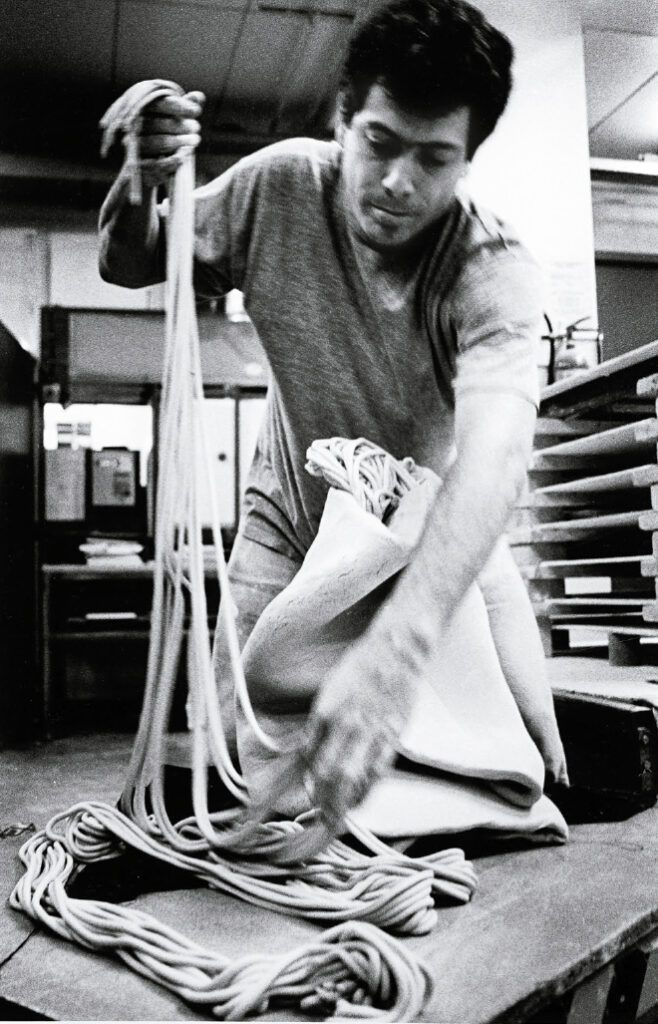
He participated in an artist residency at the Europees Keramisch Werkcentrum (EKWC) in the Netherlands. The stoneware works he produced there feature organic shapes and small dimensions, contrasting with the large plaster blocks he created earlier. These pieces result from the intertwining of wires, forming a complex and delicate texture between the interior and exterior [pp. 190–201]. He had an exhibition at Galeria Raquel Arnaud featuring Meia verdade [Half Truth], an ephemeral work in plaster. Two parallel, slightly undulating structures form sinuous walls with a narrow opening between them, created by a chainsaw cut that divides the piece in half. The sculpture reveals an interior distinct from the exterior as one passes through it. The same technique is replicated in other works from this period [pp. 204–09]. He installed the sculpture Malacara in Jardim da Luz, part of the collection of the Pinacoteca do Estado de São Paulo. He published his first self-titled, monographic book, organized by Lorenzo Mammì, with texts by Rodrigo Naves and Alberto Tassinari, published by Cosac & Naify.
2001
Birth of his first daughter, Maria Stockler Carvalhosa, from his relationship with Mari Stockler. He exhibited Surda [Deaf], an ephemeral plaster work, at the 3rd Mercosul Biennial in Porto Alegre, Brazil, a larger-scale replication of Meia verdade. He exhibited Gibraltar, an ephemeral plaster work, at the international group exhibition Côte à côte at the Centre d’Arts Plastiques Contemporains (Capc—Musée d’Art Contemporain) in Bordeaux, France. The work followed the same principles as Meia verdade and Surda [pp. 204–09]. He exhibited the sculptures created during his residency at EKWC alongside plaster drawings at Casa da Imagem in Curitiba, Brazil, alongside Fabio Miguez. In his studio, Carvalhosa created white monotypes using oil paint and plaster on paper.
2002
He moved with his family to Rio de Janeiro, where he set up a studio on Rua Alice in Laranjeiras. He presented his first sculpture in optical glass, Maluco beleza, a reference to the song by Raul Seixas [p. 228]. The work was exhibited in the group show A imagem do som [The Image of Sound] at the Museu da Imagem e do Som (MIS) in Rio de Janeiro. The project, conceived by Felipe Taborda, spanned eight editions (1998–2007) and paid tribute to Brazilian composers through visual creations by contemporary artists.
2003
After nearly seven years dedicated primarily to sculpture, he returned to painting, this time using mirrors as a support. Grease, paraffin, plaster, and pigment were applied to the central area of the mirror’s surface, which was then pressed onto glass [pp. 222–27]. The mirror disrupts the painting’s two-dimensionality by interacting with both the space and the viewer, preventing it from settling into a defined plane. He exhibited the Espelhos graxos [Greasy Mirrors] series, named after the nature of the material used, at Raquel Arnaud gallery in São Paulo.
2004
He won the Jabuti Prize in the Editorial Project/Production category for the book Et eu tu, a collaboration with Arnaldo Antunes and Márcia Xavier. He took part in Casa 7, an exhibition at the Museu de Arte Contemporânea de Niterói (MAC– Niterói) curated by Guilherme Bueno. He also participated in a residency as a guest artist at the printmaking studio of Fundação Iberê Camargo in Porto Alegre, where he produced a series of black-and-white prints, characterized by geometric forms.
2005
Birth of his second daughter with Mari Stockler, Cecília Stockler Carvalhosa. He exhibited the ephemeral plaster work Favor não tocar [Please Do Not Touch] at Centro Universitário Maria Antonia/Universidade de São Paulo. An irregularly shaped plaster block was suspended from three columns, constructed on-site, then tilted and lowered until it locked into place, contained by the exhibition space itself [pp. 210–13]. In his studio, he created a new series of mirror paintings with more extensive paint coverage on the reflective surface, vibrant colors, and the inclusion of striking phrases [pp. 234–37]. He exhibited the painted mirrors at Silvia Cintra Galeria de Arte in Rio de Janeiro. He created the Lentes [Lenses] series, sculptures made from optical glass based on the Maluco Beleza prototype from 2002. These works feature curved, concave, and convex forms, layered in different compositions and diameters, resulting in optical instruments with no defined function [pp. 230–31].
2006
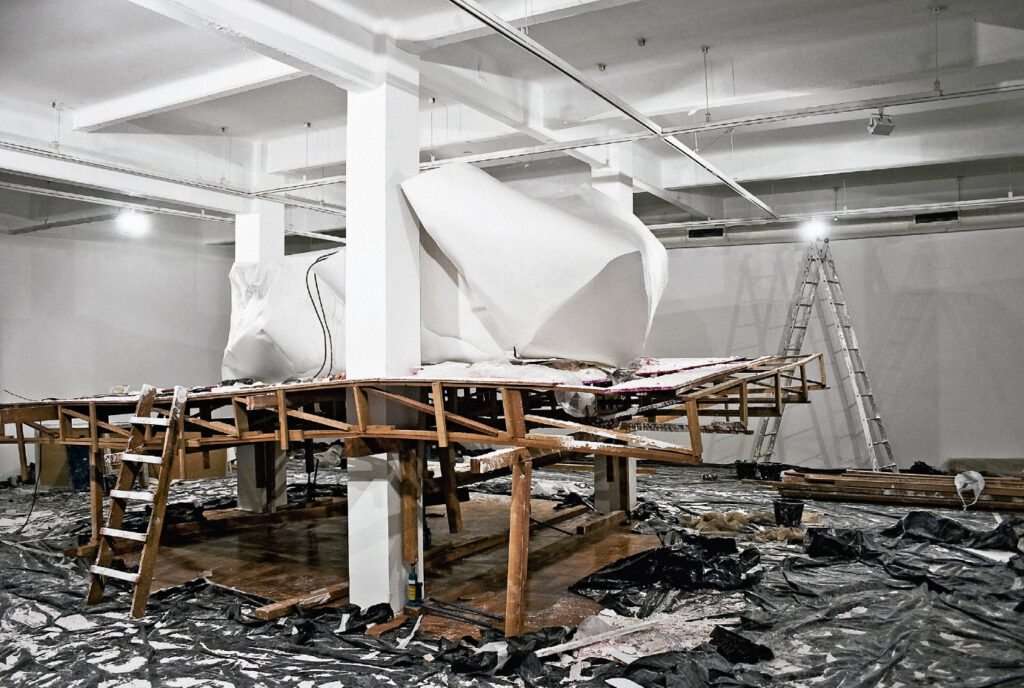
He exhibited Já estava assim quando eu cheguei [It Was Already Like This When I Arrived], an ephemeral plaster sculpture, at the Museu de Arte Moderna do Rio de Janeiro (MAM–RJ), as part of Projeto intervenções. The sculpture is a reproduction of the Sugarloaf Mountain, inverted and suspended from the ceiling. The landscape visible through the museum’s windows was brought into the foyer, like a souvenir or a projection [pp. 214–20]. He also exhibited Já estava assim quando eu cheguei at Paralela, a contemporary art exhibition at Oca, Ibirapuera Park, in São Paulo, held alongside the São Paulo International Biennial and curated by Daniela Bousso. In his studio, he continued painting on mirrors.
2007
He created paintings using spray paint, paraffin, and plaster on mirrors. The use of spray paint coincided with the international recognition of Brazilian graffiti artists. This resulted in fluid and dynamic forms in vibrant colors that interacted with the space. The exhibition Fora da casinha [Outside the Box] took place at Silvia Cintra Galeria de Arte in Rio de Janeiro. He exhibited Flor e espinho [Flower and Thorn] [p. 41], his first work incorporating sound elements, in the group show A imagem do som at Paço Imperial in Rio de Janeiro, curated by Felipe Taborda. The work consisted of a mirror painting with one half painted matte black and the other half left reflective. The mirrors emitted the same music, blending the normal version of the song with its reverse playback.
2008
He participated in the Parede [Wall] Project at MAM–SP with the installation Quem vê pensa [Who Sees, Thinks], which lined the museum’s entrance corridor with parallel painted mirrors, creating an illusion of the “infinite mirror” that dissolved the perception of space. He created his first installation using TNT (nonwoven fabric), fluorescent lights, and sound elements as a spatial intervention. The work Apagador [Eraser] was installed in the chapel of Solar do Unhão, home to the Museu de Arte Moderna da Bahia (MAM–BA), as part of Funarte’s “Art and Heritage” project call. It was accompanied by a text by Fernando Cocchiarale. The TNT, which covered the walls, windows, and doors, created the impression that the building and the surrounding landscape were fading away, disrupting the viewer’s perception of the space. The sound component, featuring participation from Arto Lindsay, transmitted sounds from one room to another, intensifying the sense of disorientation [pp. 246–47]. He then began creating works that enveloped spaces with TNT and fluorescent lights, combined with sound devices, which he called “apagadores.” These installations appeared in exhibitions with different configurations at Solar do Barão in Curitiba (Meus olhos [My Eyes]), Paço Imperial in Rio de Janeiro (Estou lá [I’m There]), and in the Millan and Raquel Arnaud galleries in São Paulo (Faz parte [It Happens]). The repeated use of sensory devices in different locations ensured that each experience, though similar, remained unique. In the studio, he created a series of monotypes using oil on wax paper and continued painting on mirrors.
2009
The installation Você tem razão [You Are Right] was the first to use old, suspended wooden lamp posts and was featured in the group exhibition Experimentando espaços [Trying Out Spaces], curated by Agnaldo Farias at the Museu da Casa Brasileira (MCB) in São Paulo. The lamp posts, installed in the museum’s outdoor area, established a connection between landscape and architecture by creating a suspended horizon, marked by white-painted stripes at the tops of the posts [pp. 266–67]. In his studio, he produced a series of paintings on fabric [pp. 244–45] and continued to paint on mirrors [pp. 240–41].
2010
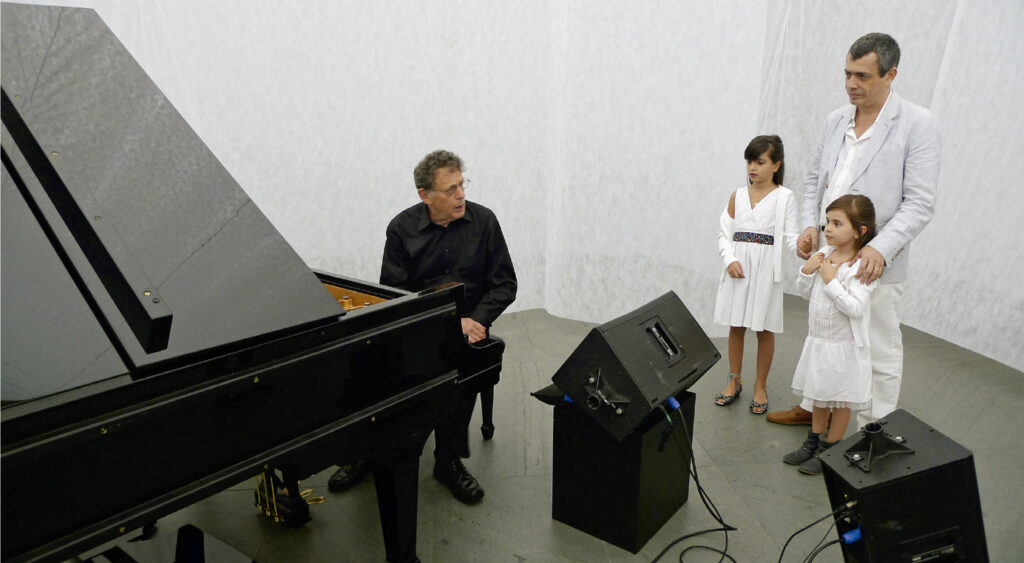
The exhibition Roteiro para visitação [Visiting Itinerary] was held at Palácio da Aclamação, Salvador, as part of the Ocupas Program, organized by the Museum Directorate of the Institute of Artistic and Cultural Heritage of Bahia, and featured a text by Daniel Rangel. A suspended tree was installed in the entrance hall, and wooden lamp posts along with hundreds of eucalyptus stakes occupied the 19th-century neoclassical building, highlighting elements displaced from their original architectural context [pp. 268–69]. Arnaldo Antunes collaborated on a sound piece. He participated in MAM–SP’s Print Club with the work Regra de dois [Rule of Two], a sheet of aluminum struck with small reliefs. This was his first time using aluminum as support. He exhibited his first installation using only fluorescent lights, titled Melhor assim [Better This Way], at the cultural space Soso+ in São Paulo, curated by Daniel Rangel [pp. 296–97]. In the studio, Carvalhosa began using mirrored aluminum as a support for paintings. The installation A soma dos dias [Sum of Days], featuring participation from American composer Philip Glass, was part of the Projeto Octógono Arte Contemporânea, held in the Octagon Hall of Pinacoteca do Estado de São Paulo, curated by Ivo Mesquita. The work consisted of a spiral structure made of nonwoven fabric that enveloped the entire space, with recorders and speakers hanging from it to capture and reproduce the ambient sounds [pp. 254–59].
2011
Sum of Days, featuring Philip Glass, was exhibited in the atrium of the Museum of Modern Art (MoMA) in New York, United States, curated by Luis Pérez-Oramas and Geaninne Gutiérrez-Guimarães. This version of the work was previously exhibited at Pinacoteca de São Paulo and adapted for the MoMA space [pp. 260–61]. Regra de dois [Rule of Two] was exhibited at Fundação Eva Klabin in Rio de Janeiro as part of the project Respiração [Breathing], curated by Márcio Doctors. For this work, Carvalhosa utilized glass cups, fluorescent lights, posts, and suspended trees to reconfigure the viewer’s experience of the exhibition space [pp. 298–99]. The exhibition Lugar comum [Commonplace] was held at the Centro Cultural Laura Alvim in Rio de Janeiro, curated by Fernando Cocchiarale, featuring eucalyptus stakes, aluminum sheets struck with reliefs, fluorescent lights, and paintings on mirrored aluminum. Exhibition Qualquer direção [Any Direction] at Silvia Cintra+Box4 gallery, Rio de Janeiro [pp. 294–95]. His second monographic book, Nice to Meet You, was published by Charta and Cosac & Naify, organized and designed by the artist, with texts by Arto Lindsay, Beatriz Bracher, Ivo Mesquita, João Bandeira, Juliana Monachesi, Luis PérezOramas, Paulo Herkenhoff, and Paulo Venancio Filho. In the studio, he began creating monochromatic paintings on aluminum [pp. 286–93].
2012
He received a diagnosis of metastatic cancer. Carvalhosa moved his studio to Rua Frolick in São Cristóvão, Rio de Janeiro, which he designed himself. The work Vulgo [Alias] was part of the 11th Havana Biennial in Cuba, consisted of a nonwoven fabric structure installed at the entrance of the Gran Teatro de La Habana. The installation included a sound collaboration with Cuban pianist Juan Piñera [pp. 262–63]. He held the exhibition Shift at the Sonnabend Gallery in New York. He participated in the St. Moritz Art Master in Switzerland with the installation Bulbs End, curated by Reiner Opoku, at the Chesa Planta Samedan. In the studio, he resumed the Espelhos graxos [Greased Mirrors] series and continued painting on aluminum.
2013
The exhibition Sala de espera [Waiting Room] coincided with the inauguration of the new headquarters of the Museu de Arte Contemporânea da Universidade de São Paulo (MAC USP) and was curated by Tadeu Chiarelli. The installation, planned since 2010 and delayed due to construction setbacks, occupied the central hall. It featured wooden lamp posts arranged horizontally, forming an entangled structure in suspended balance with the columns of the space. This arrangement created a sense of the surrounding landscape invading the museum [pp. 272–73]. Sala de espera was exhibited at Kukje Gallery in Seoul, South Korea. He participated in the exhibition 30x Bienal, curated by Paulo Venancio Filho, featuring artists and works from the Brazilian representation at the São Paulo Biennials from 1951 to 2021.
2014
He presented the performance Rio [River] at MoMA New York, as part of the exhibition dedicated to the work of Lygia Clark. This involved printing text from Clark’s 1975 book Meu doce rio [My Sweet River] on a 360-meter-long ribbon, which was passed from hand to hand while the audience read it simultaneously, creating a polyphonic effect. The exhibition Possibility Matters took place at the Sonnabend Gallery in New York [pp. 276–77]. The exhibition Precaução de contato [Contact Precaution] took place at Galeria Nara Roesler in São Paulo [pp. 300–01]. In the studio, he created paintings using the drypoint printmaking technique on monochromatic aluminum thickened with wax and blue and red pigments [pp. 302–07].
2015
He created a series of wooden sculptures using sections from the wooden lamp posts employed in installations since 2009. The pieces, designed to be mounted on walls, create the illusion of passing through them, much like the posts featured in the exhibitions [pp. 264–65]. The exhibition Casa 7, curated by Eduardo Ortega, was held at Pivô Arte e Pesquisa in São Paulo, as part of the Fora da caixa [Outside the Box] program. In the studio, he expanded the color palette used in his monochromatic works on aluminum.
2016
In the studio, he created monochromatic paintings using mirrored aluminum as a support [p. 305].
2017
He revisited wax as a pictorial material in a series of paintings that repeated the 30 × 30 cm format used in Germany between 1991 and 1992. These works feature reliefs that resemble fingers but do not include any additional materials beneath the wax. This creates a stable surface on which the artist paints geometric figures with oil paint. The pieces are displayed in acrylic boxes [pp. 326–31]. He also produced paintings in various colors, using aluminum as the support. The installation Linha de sombra [Shadow Line], featuring wooden posts, was presented at MuBE in São Paulo as part of the exhibition Pedra no céu [Stone in the Sky], curated by Cauê Alves. The exhibition Faço tudo para não fazer nada [I Do Everything to Do Nothing] took place at Nara Roesler São Paulo, accompanied by a text written by Maria do Carmo Pontes.
2018
In the studio, he created paintings on aluminum and began assembling groups of wax panels cast from molds, each painted with colorful geometric motifs known as Esquemas [Schemes]. The groups consisted of two to sixteen panels, arranged in compositions that allowed for spaces between them [pp. 335–43]. The exhibition Há sempre uma terceira vez [There is Always a Third Time] was held at the pavilion housing the collection of Fernanda Feitosa and Heitor Martins in São Paulo, curated by Maria do Carmo Pontes.
2019
The exhibition Comércio das coisas [The Trade of Things] was held at the Silvia Cintra + Box 4 gallery in Rio de Janeiro. The exhibition I Want to Be Like You opened at Nara Roesler New York. The permanent installation of Já estava assim quando eu cheguei [It Was Already Like This When I Arrived] was installed at Sesc Guarulhos in São Paulo. In the studio, he began working on pieces from 2014 and 2015, adding geometric motifs over drypoint paintings on aluminum.
2020
Carvalhosa created the ceramic work A disciplina do sexo [The Discipline of Sex] in collaboration with Bordallo Pinheiro from Portugal. In the studio, he continued painting Esquemas using oil paint on wax. During the Covid-19 pandemic, due to his health condition, he remained in isolation with his family.
2021
In the studio, he created paintings on aluminum and worked on Esquemas using oil paint on wax. He designed the long-term installation Área de propriedade [Property Area] at FAMA Campo (Fábrica de Arte Marcos Amaro) in Mairinque, São Paulo. While undergoing intensive medical treatment, he moved to São Paulo with his family. He began organizing his personal archive of notebooks and documents. He passed away on May 13 in São Paulo at the age of 59. His family established the Acervo Carlito Carvalhosa [Carlito Carvalhosa Estate].
2022
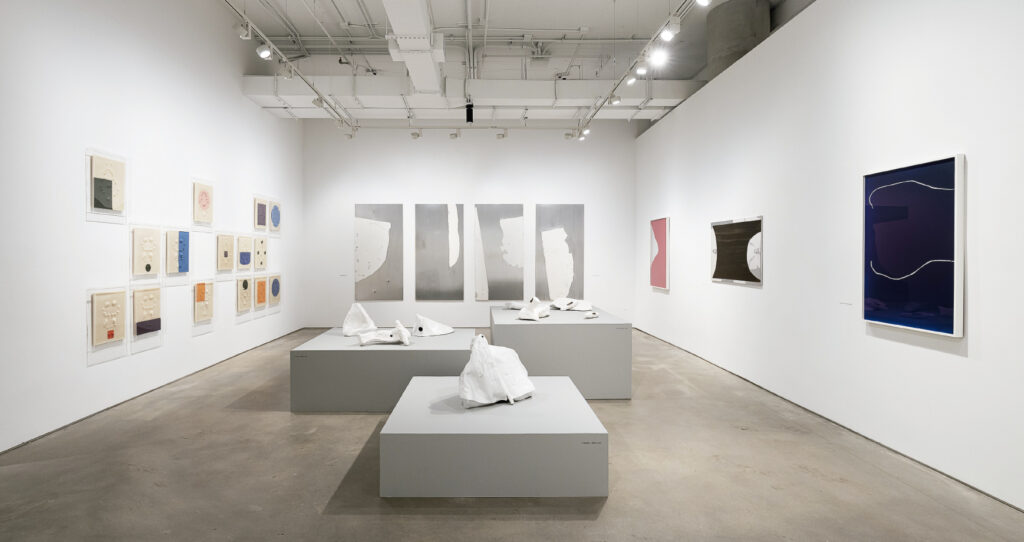
The exhibition Carlito Carvalhosa: Matter as Image. Works from 1987 to 2021 opened at Nara Roesler New York, curated by Luis Pérez-Oramas in collaboration with the Carlito Carvalhosa Estate. The exhibition Linhas do espaço tempo [Space-Time Lines] took place at Instituto Ling in Porto Alegre, Brazil, curated by Daniel Rangel.
2024-25
The exhibition A metade do dobro [The Half of the Double] opened at Instituto Tomie Ohtake in São Paulo, curated by Ana Roman, Lúcia K. Stumpf, Luis Pérez-Oramas, and Paulo Miyada, with associate curators [pp. 364, 374–77]. The exhibition A natureza das coisas [The Nature of Things] opened at Sesc Pompeia in São Paulo, curated by Daniel Rangel and Luis Pérez-Oramas, with associate curator Lúcia K. Stumpf [pp. 369–73].