Década: 2010

Passado/futuro/presente
Ateliê de gravura: da tradição à experimentação
Tinta sobre tinta: acervo do MAM no Instituto CPFL
O jardim
I Want To Be Like You
Frieze Solo Project
O comércio das coisas
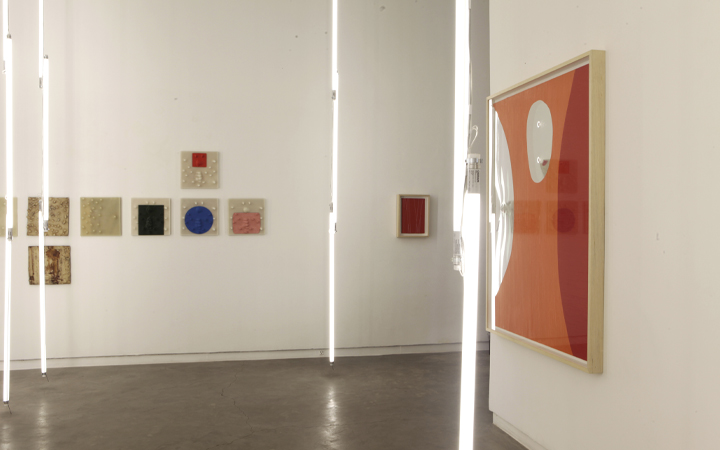
Oito décadas de abstração informal
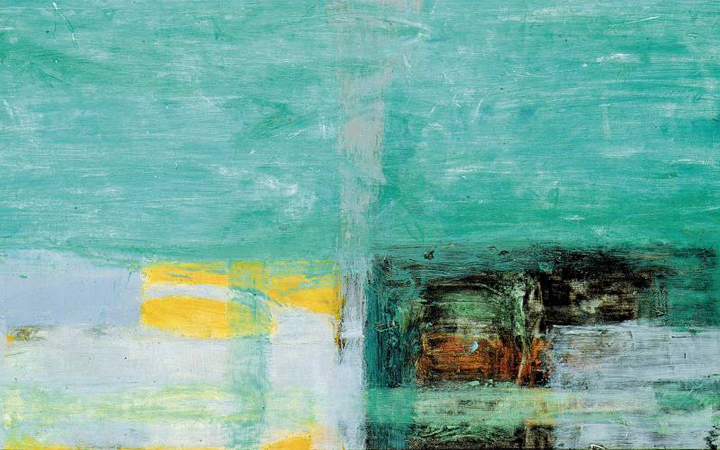
Há sempre uma terceira vez
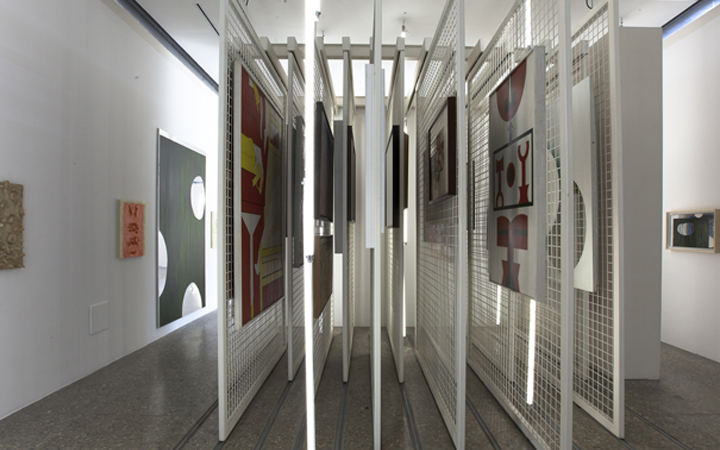
Pedra no céu
Modos de ver o Brasil: Itaú Cultural 30 anos

Past/Future/Present: Contemporary Brazilian Art
Aã, Fundação Vera Chaves Barcellos
Ready Made in Brasil
Theory Of The Inevitable Convergence
Troposphere – Chinese and Brazilian Contemporary Art
Faço tudo para não fazer nada
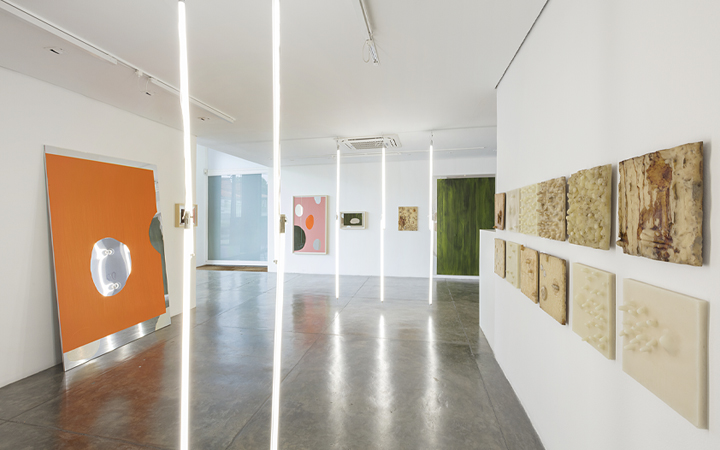
Cromofilia vs. cromofobia: investigações da cor
O corpo e a obra de arte
Do clube para praça
Everything You Are, I Am Not
Auroras: pequenas pinturas
Transparência e reflexo
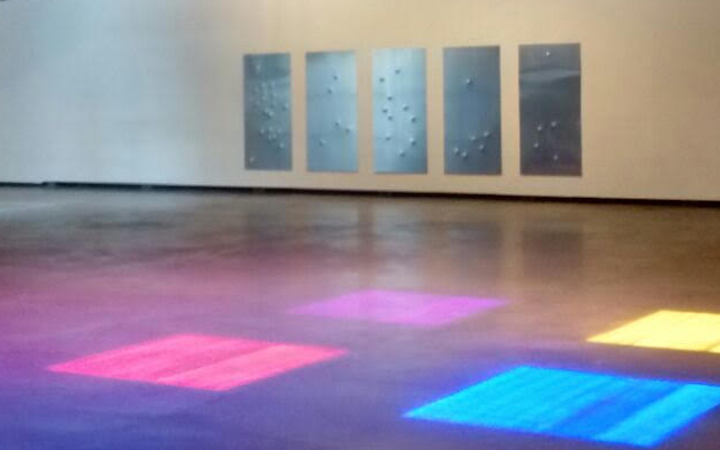
Atlas abstrato: um olhar sobre a Coleção de Arte da Cidade de São Paulo
Exposição inaugural
Em polvorosa
Afetividades eletivas
Releituras da natureza-morta
Imaterialidade
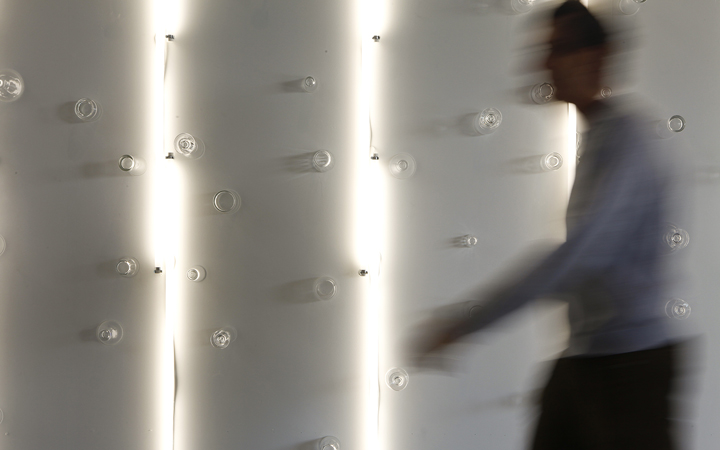
Casa 7

Luz do mundo
A arte que permanece: Coleção Chagas Freitas
Made by Brazilians
Prática portátil
Cidade poética
O artista e a bola
Precaução de contato
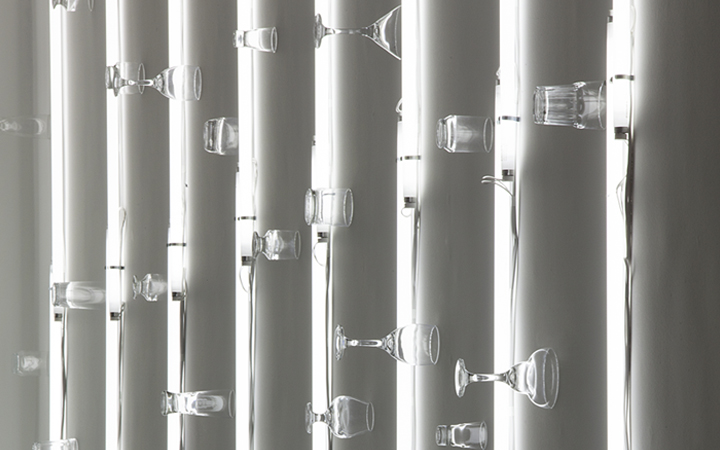
Possibility Matters
Rio de imagens
As tramas do tempo na arte contemporânea: estética ou poética?
Brasil vívido, S|2
Trienal no Alentejo
30 x Bienal
Sala de espera, MAC USP
Sala de espera, Seoul
11ª Bienal de Havana
Más allá de la xilografía

Bulb’s End St. Moritz Art Masters
Volta ao mar
Shift
Arte brasileira e depois
Qualquer direção
Lugar comum
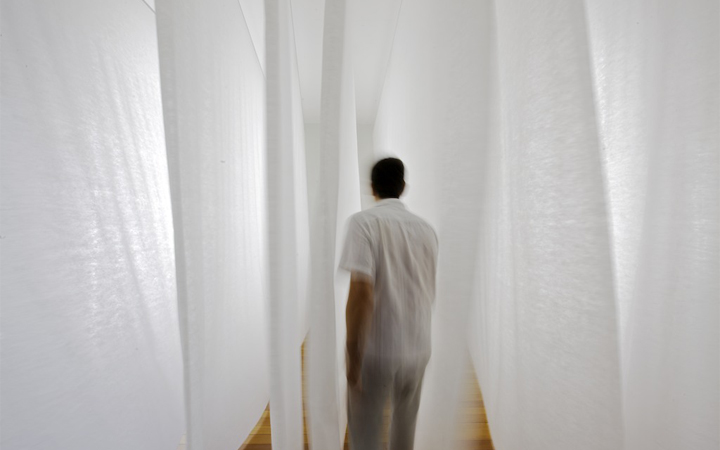
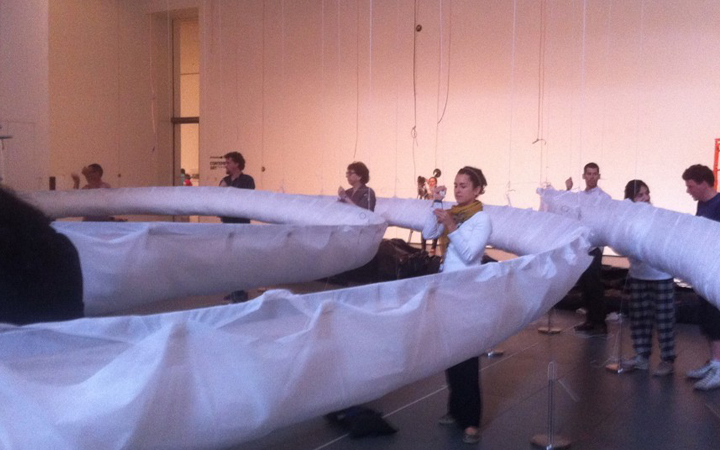
Sum of Days
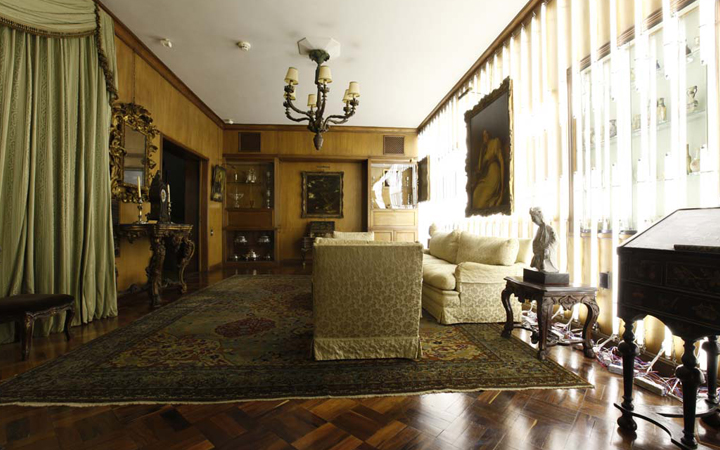
Regra de dois
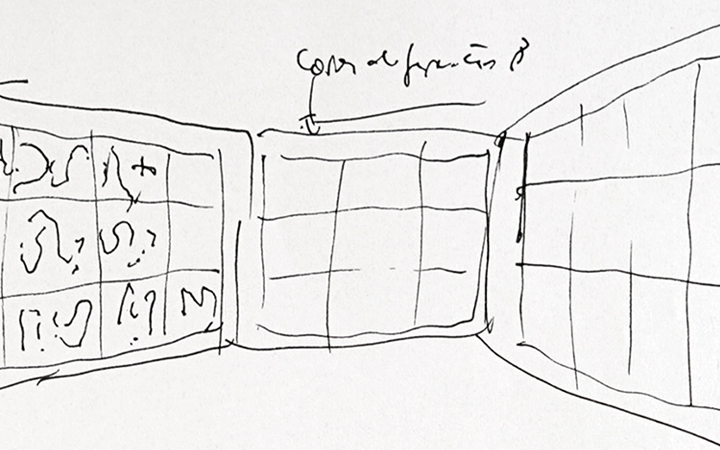
Faço tudo para não fazer
Acrílico Pasta Preta
Já estava assim quando eu cheguei
Rio
Pinturas Azuis
Bienal La Habana
Prosa e verso
Espelhos Graxos

SKT SONNABEND 2
Sala de espera
Originais Sum of Days
Untitled
Untitled
Untitled
Untitled
Untitled
Untitled
2020
1º Semestre
Dez 18-Jul 19
Encontro com Filo Dia dos pais Cecilia Atelier
Jul 17-Mar 18
Abr-Jul 17
2016-Jun-Set
Jan-Abril 2015
Precaução de contato
Dr Benetta LC Bienal Cartagena Faz Barra Frolick
Havana
MoMA 2
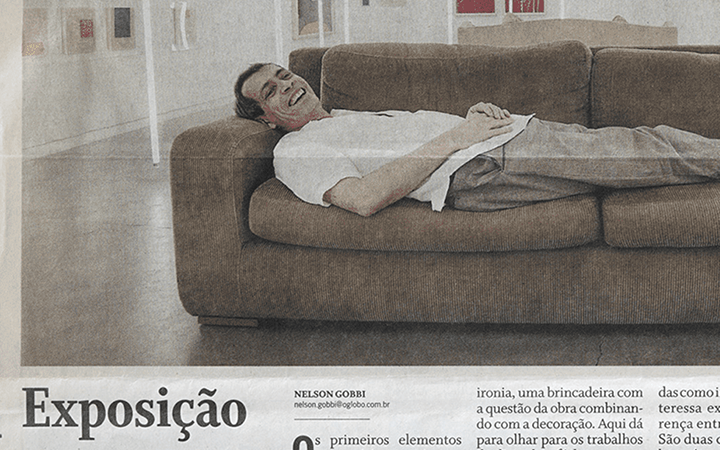
Exposição para se sentir em casa
De volta à Casa 7
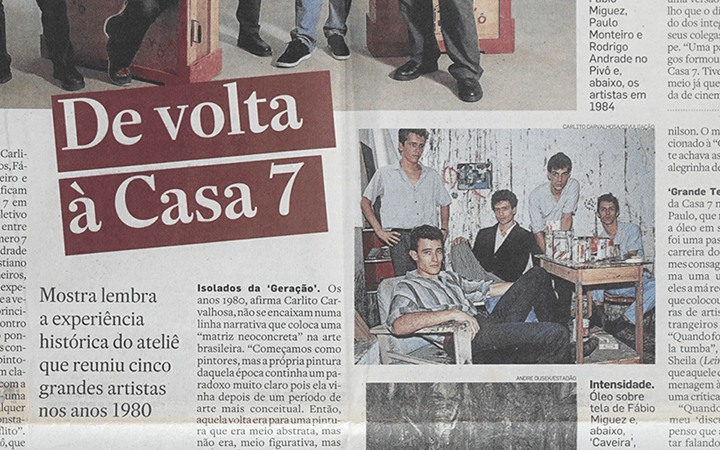
Casa 7 revisitada
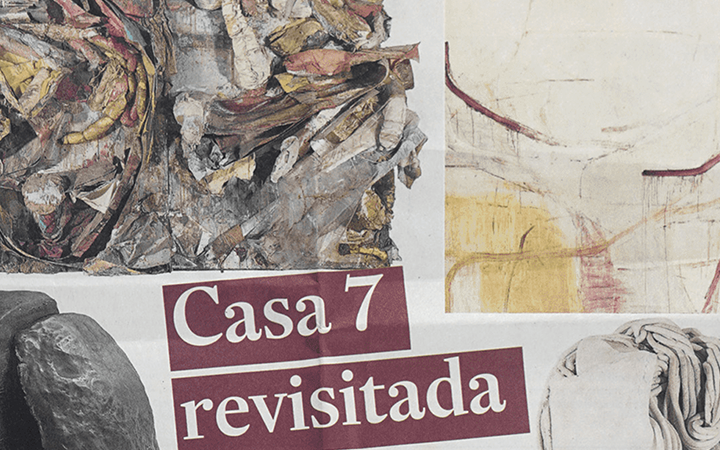
O Doce Rio
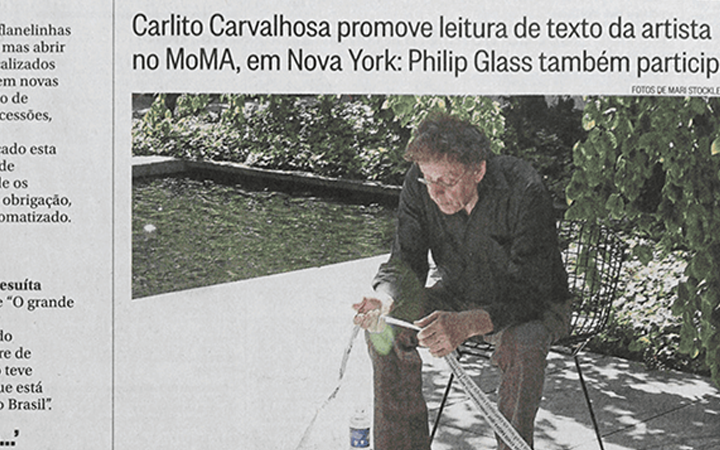
Diaphanously Draped In Yards of Art
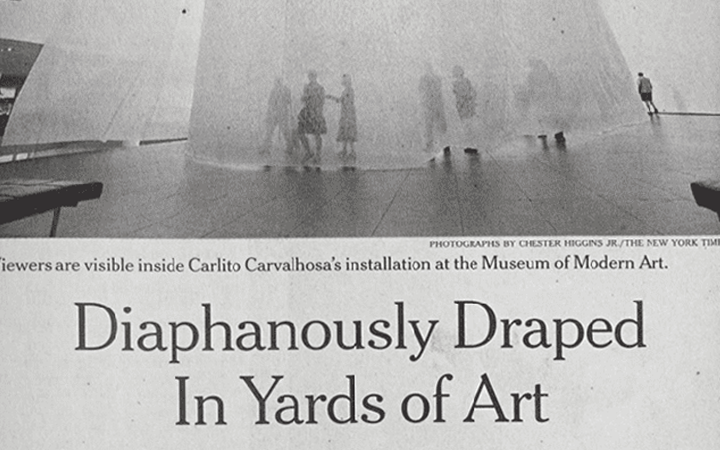
Nas frestas do mundo
A Labyrinth of sensations in New York
A paisagem e sua relação com a arte
Sala de espera
Kukje
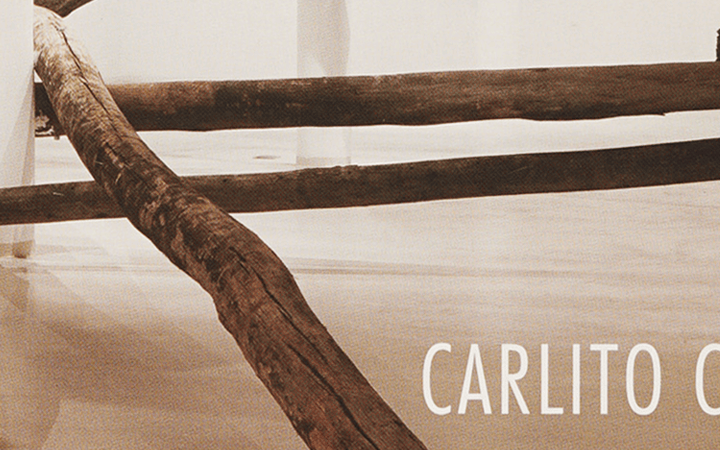
Lugar comum
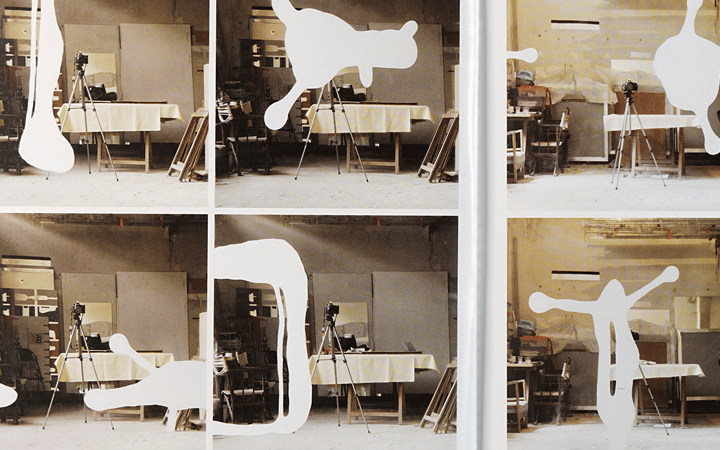
Já estava assim quando eu cheguei
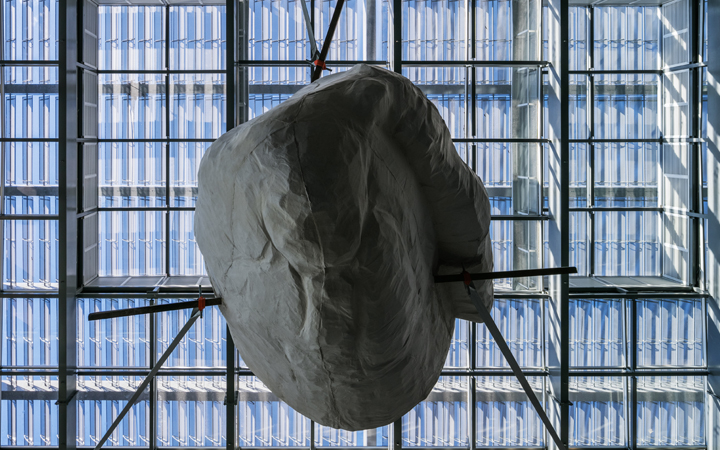
Linha de Sombra
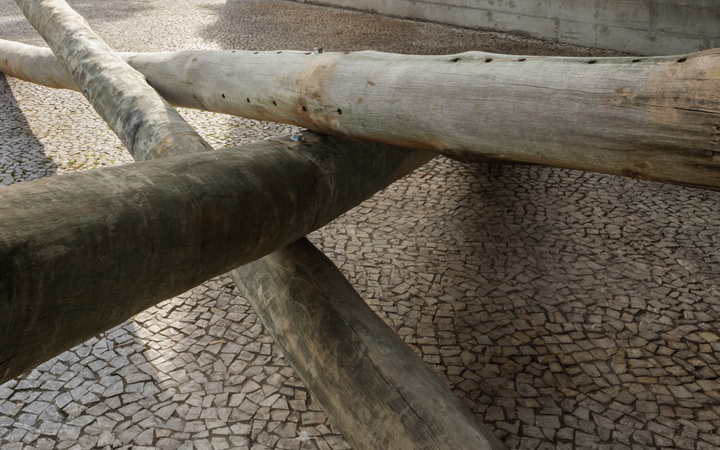
Imaterialidade
Rio
Sala de Espera
Vulgo
Melhor Assim
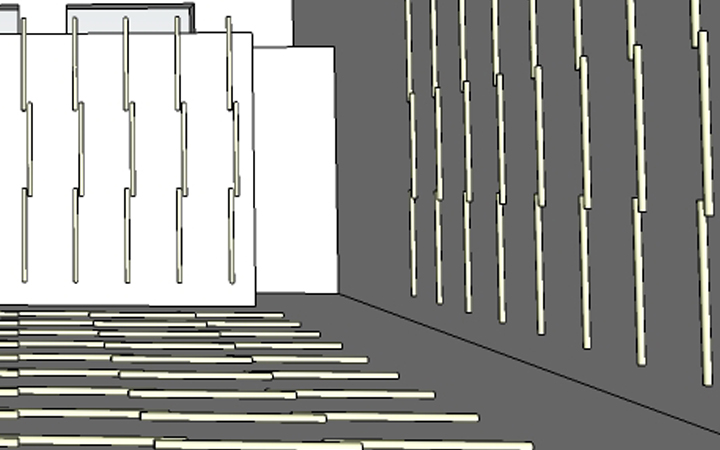
F 01/10
Há sempre uma terceira vez
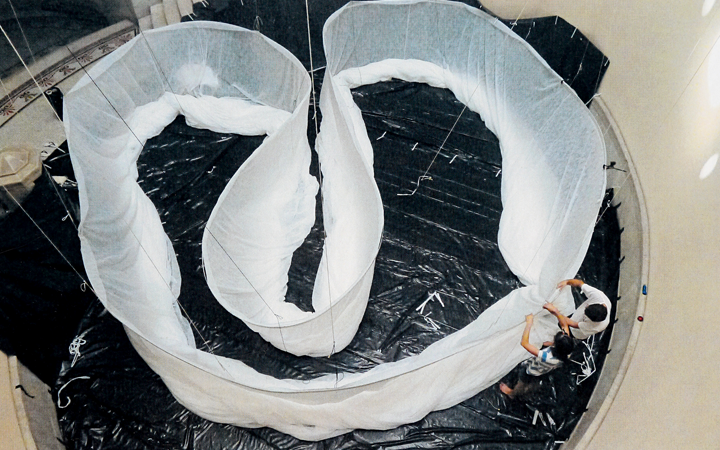
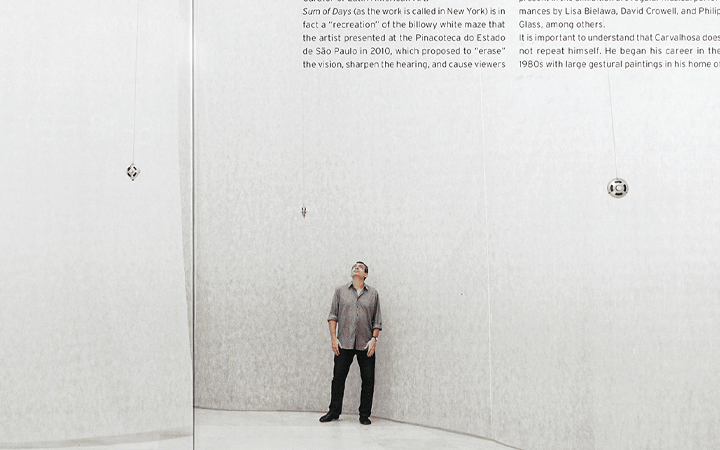
There is Always a Third Time is the second collaboration between myself and Carlito Carvalhosa, a Sao Paulo born, Rio based artist. It dialogues with I Do Everything To Do Nothing, an exhibition that we conceived jointly at Sao Paulo’s Galeria Nara Roesler in November 2017, expanding equations that we proposed ourselves on that occasion. The majestic fabric that hangs from the ceiling, which in the aforementioned show had some of its parts suspended in such way as to form inverted mountain-like shapes, reemerges with a new choreography, more labyrinthian. It is an emblematic work within Carvalhosa’s vocabulary, one which has been shown several times throughout his career, each of which anew – among these, in A soma dos dias (2010) at Pinacoteca do Estado de São Paulo and Sum of Days (2011) at MoMA in New York. That is to say, there’s nothing ‘third’ about this situation.
The pataphysics present in the title of the exhibition aims to direct the spectator not towards the lack of logic – for that we have in abundance – but to a blend of lightness and seriousness that essentially shapes the artist’s practice in whichever form it materialises itself. And throughout his career, there’ve been several. After studying Architecture at Sao Paulo’s USP, Carvalhosa began his artistic experiments as a painter towards the end of the 1980s, subsequently exploring nearly every language recognised as art – either by himself or through collaborations, such as the ones with musicians Phillip Glass and Arto Lindsay.
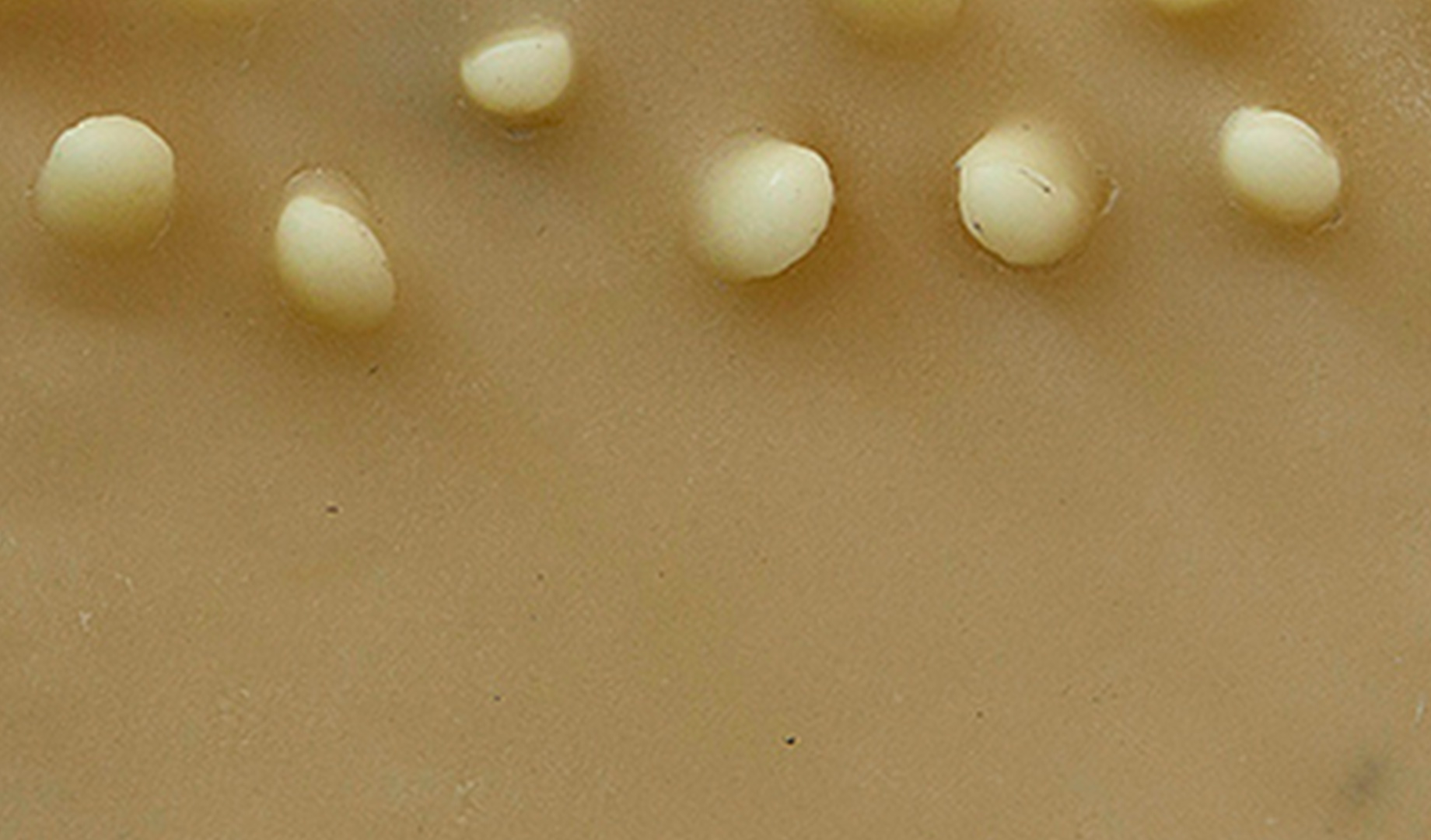
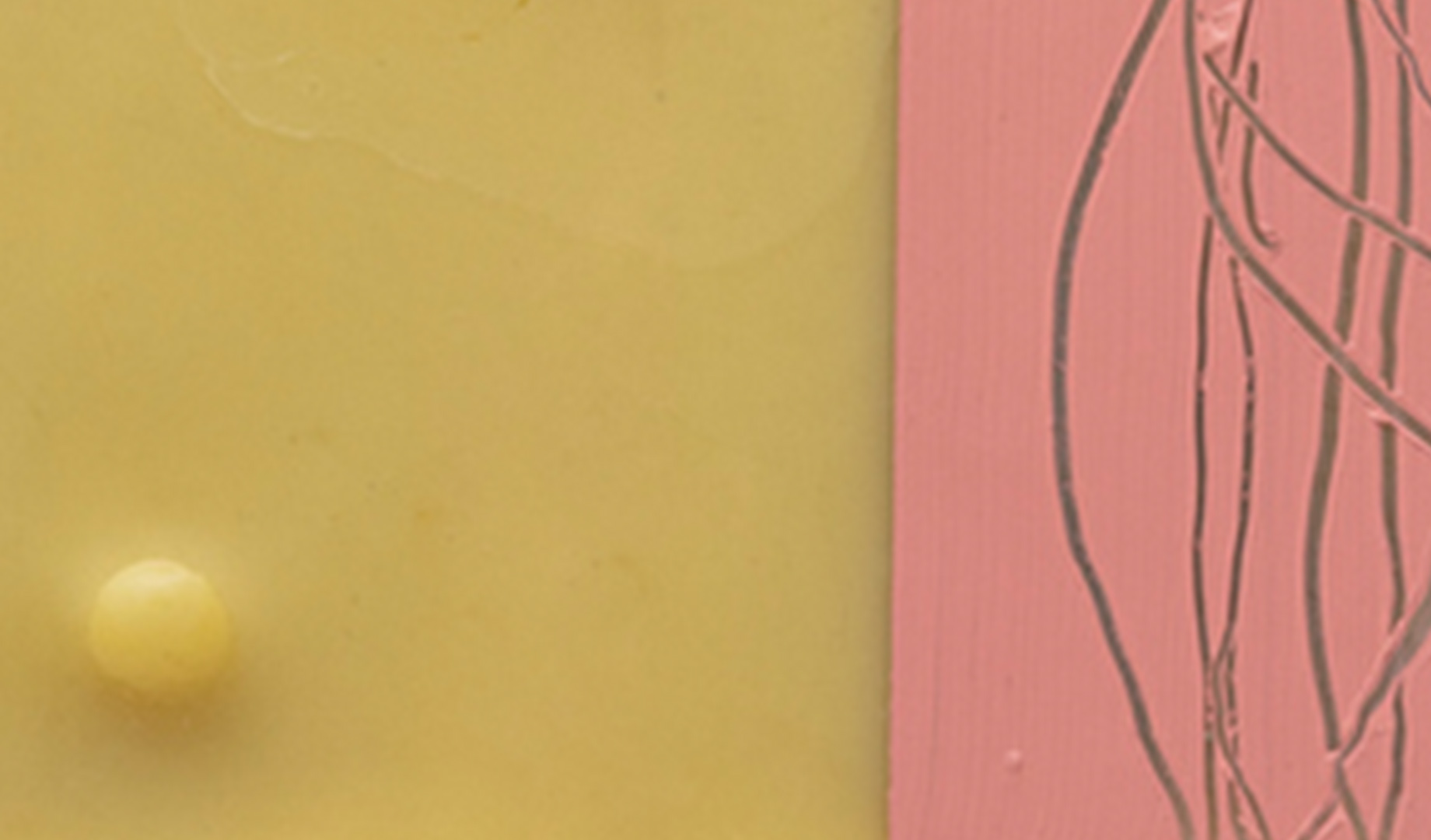
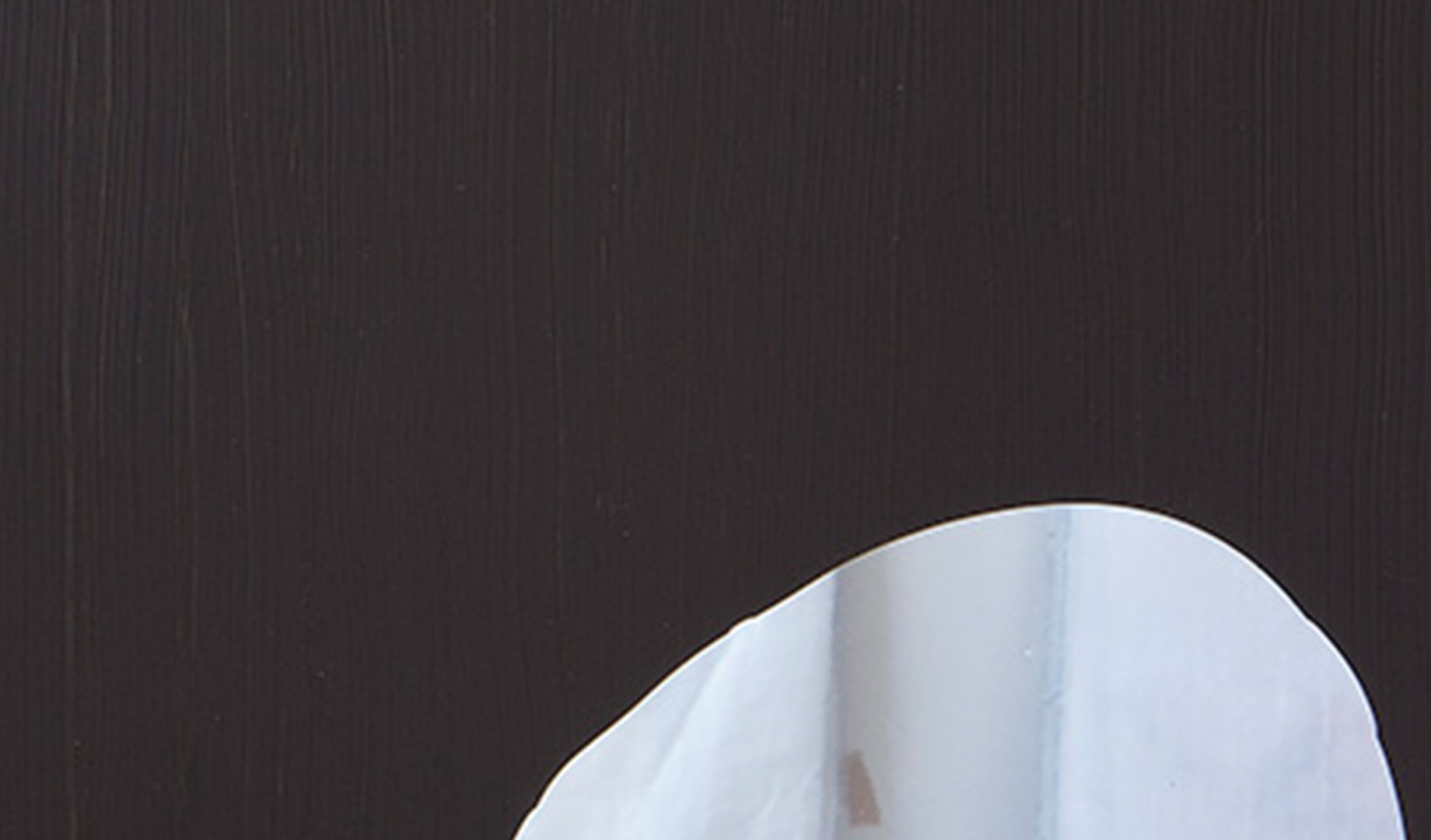
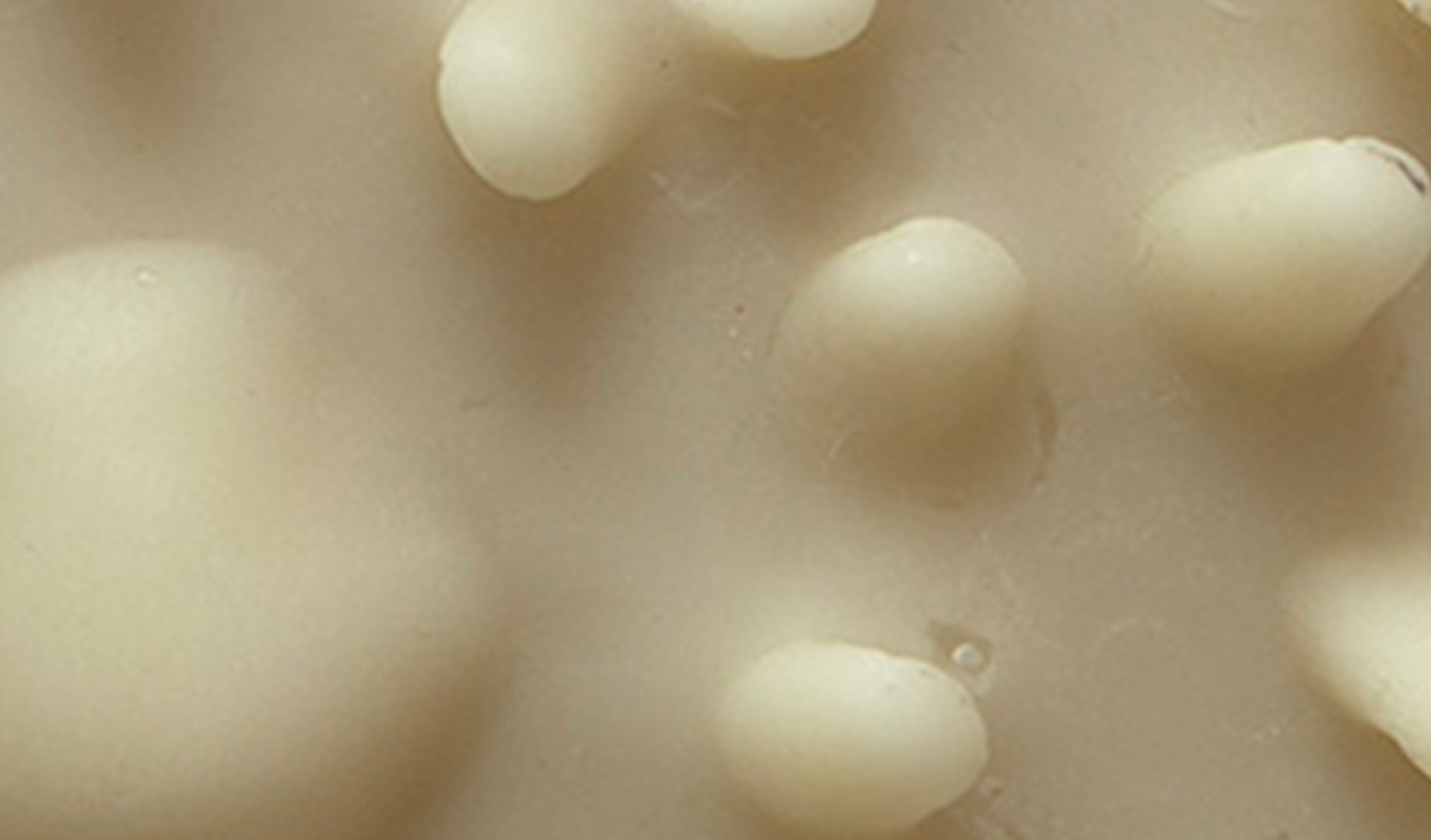
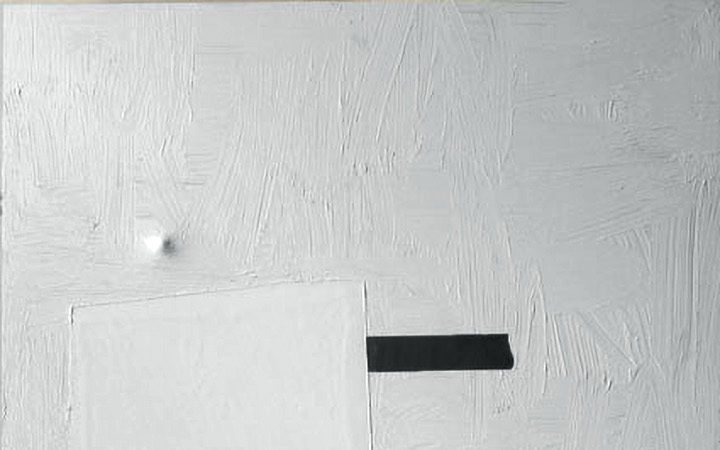
As of IDETDN, here we emulate the will to exhibit artworks that reflect the artist’s myriad interests, as well as different moments from his career – the older artwork on show is from the early 1990s whereas the most recent was made earlier this month. The intention is to establish atemporal narratives, given that Carvalhosa’s trajectory cannot be told in linear terms of cause and effect – where one interest leads directly towards another – but rather through crooked paths, where elements disappear and reemerge after a time gap, even if the river is never the same. Illustrative of this logic is the wall immediately to the right of the entrance door, where we see a large wax-based piece (Untitled, 1993) whose yellowish colour, together with a few creases on its surface, are indexes of its age. Hung to its left is a small 2018 wax work, intensely white; its fairness will likely be perpetrated by the fact that the piece is concealed by an acrylic box.
If at Nara Roesler such non-linearity was reinforced by the very display of the works, where pieces were hanged on different heights, at times one on top of the other, the challenge here was to seek this non-chronology through a cartesian display. All works share a same axis, forming two long lines on the main walls; such axis is maintained even when the ceiling becomes taller, in the room with the fabric installation. Eventually, in different moments in each of the walls, the lines simply cease to exist.
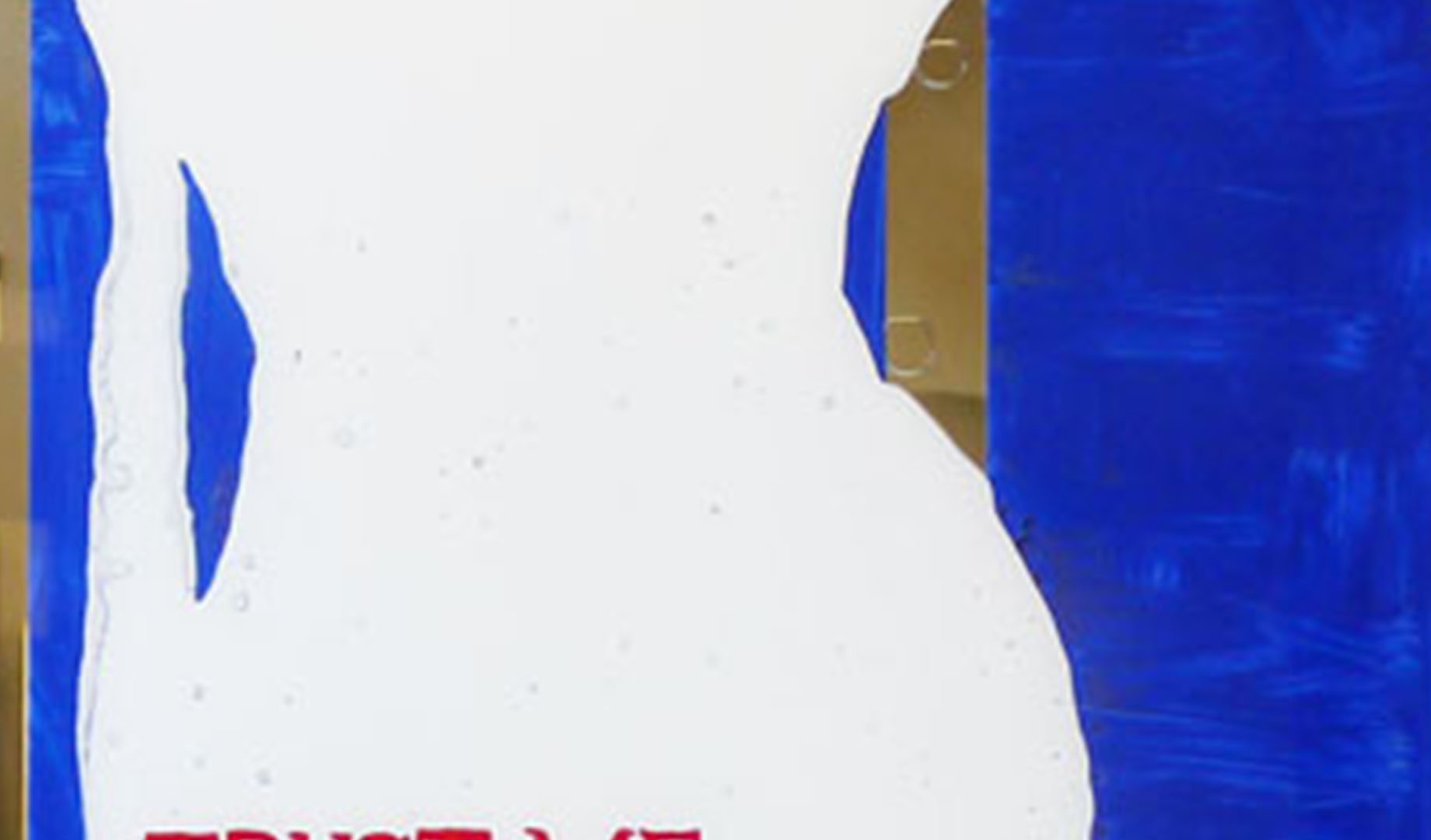
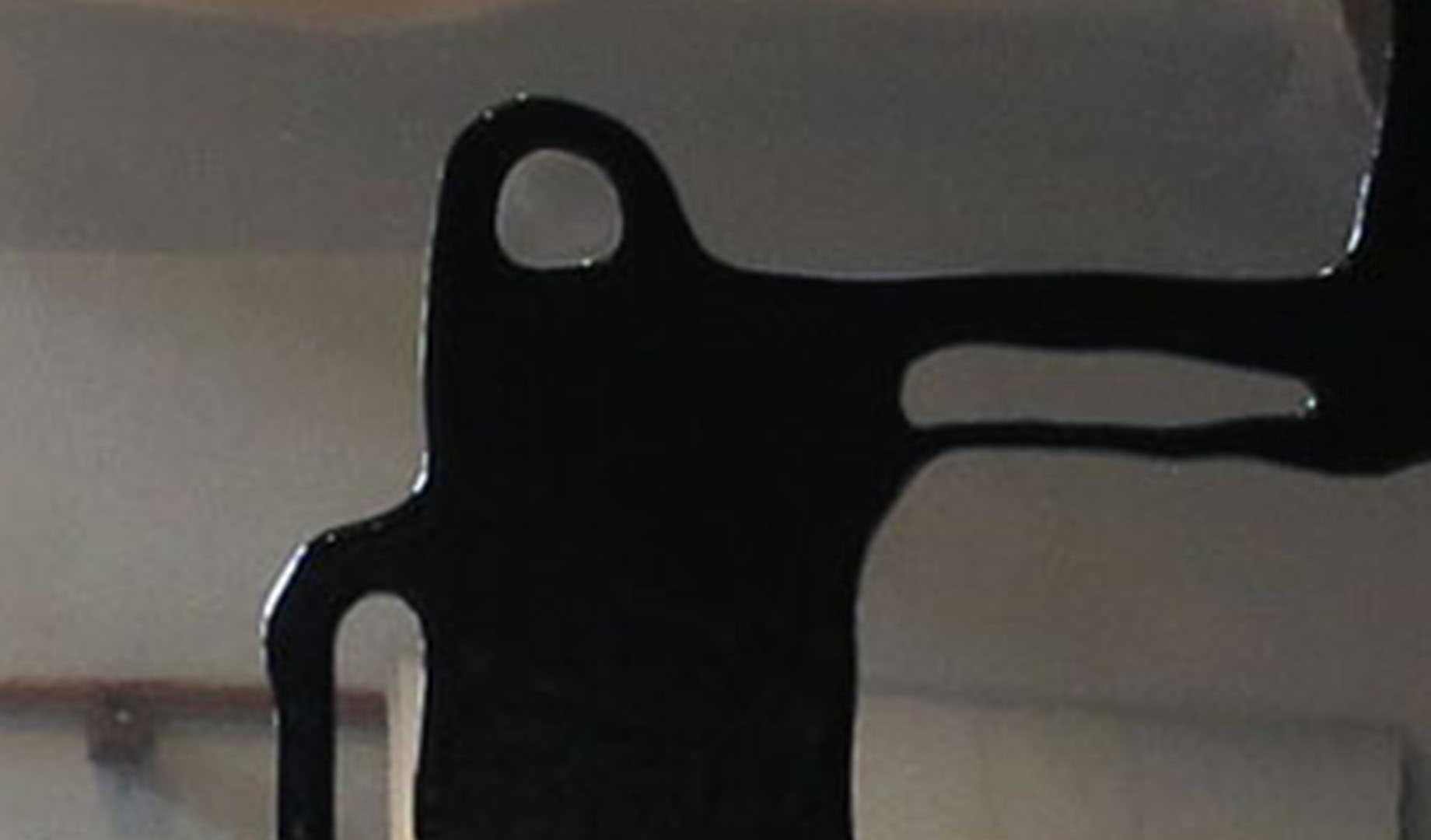
This immense horizontality aims to counterpart the intrinsic verticality of the fabric, as well as of the lamps installation – which is equally pending from the ceiling. That’s another signature work of Carvalhosa, which is present here, was presented then and also in several other occasions, each time with a unique disposition. Likewise, artworks that were exhibited at IDETDN are also displayed in this show, such as a mirror painted with white plaster, simulating the silhouette of a human’s bust, thus impeding the narcissistic reflex of the figure. Whereas there it was placed in one of the most crowded walls of the show, dictating its pace, here it is hung alone and imposingly, dominating one of the surfaces.
Considering the exhibition is set in a domestic environment, we took as our motto the notion of contamination, that is, to infiltrate ourselves in a given situation. For instance, the technical reserve that hosts some of the collection’s artworks temporarily gained three lamps hanging from the ceiling, as well as a small painting by the artist. Also our display remits to our motto, since the internal walls of the space always cut off the works on the outer walls, partially concealing its view, prioritising occupation to contemplation. Added to the fact that most of the works on show make use of reflective surfaces, that enables them to constantly reshape the space, as if things were in permanent motion, analogously to the Stalker ’s ‘Zone’. Objects reveal and shelter themselves as the spectator strolls through the venue.
___________________
A 1979 film directed by Andrei Tarkovsky. The narrative basically unfolds inside this area called ‘Zone’, a military protected land which presents great dangers. Inside it lies the ‘Room’, which grants a wish to those who reach it. However, in the path that leads there – where the safest way is never the obvious one – the surrounding is in permanent motion.
Faço tudo para não fazer nada
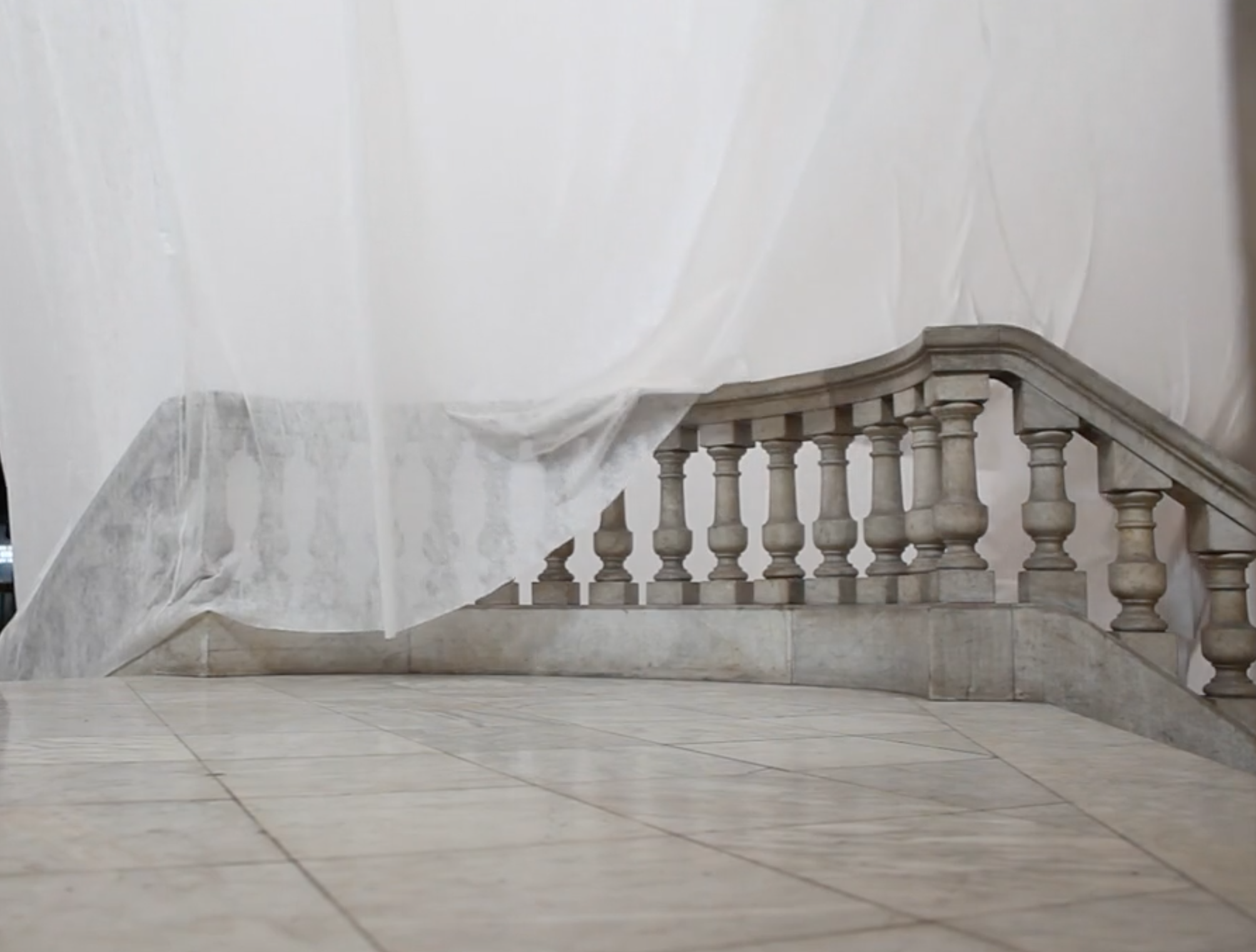
In his second solo exhibition at Galeria Nara Roesler, Carlito Carvalhosa presents works produced in different moments of his practice, from the early 1990s onwards. The main room of the show houses a large-scale installation, made up of white fabrics, ropes and tubular fluorescent lamps – noteworthy, recurring elements within his vocabulary. Unlike some of his fabric works – such as Sum of Days (2011) –, here the material does not extend to the ground, but is tied up, forming figures that resemble inverted mountains. This shape, by its turn, is reminiscent of other of his pieces, such as Já estava assim quando cheguei (It Was Like This When I Got Here) (2006), a monumental sculpture in plaster that mirrors the curves of Rio de Janeiro’s Sugarloaf. The similarity between the two, however, is purely formal, since the weight of plaster structurally opposes the malleability of the fabrics. This metalinguistic will to revisit his own oeuvre, coupled with notions of trompe-l’oeil and the recurrent investigation of space that characterises his production, guide the exhibition.
Emphasising the monochrome structure of this large installation, also in the main room is a series of wall pieces, which consists of aluminium plates shaped with percussion, resin, and white paint. Produced between 2011 and 2017, the plates are aligned in a fairly high height, dialoguing with the theatricality of the fabrics. The semi-reflective surface of the aluminium echoes defining works of the artist’s production, in which he uses mirrors as the basis for painting. Carvalhosa’s fascination with reflective materials is intrinsically linked to the relationship they establish with the surrounding space: a break in scale is necessarily at stake, since what we see on these surfaces is much wider than their physical dimensions.
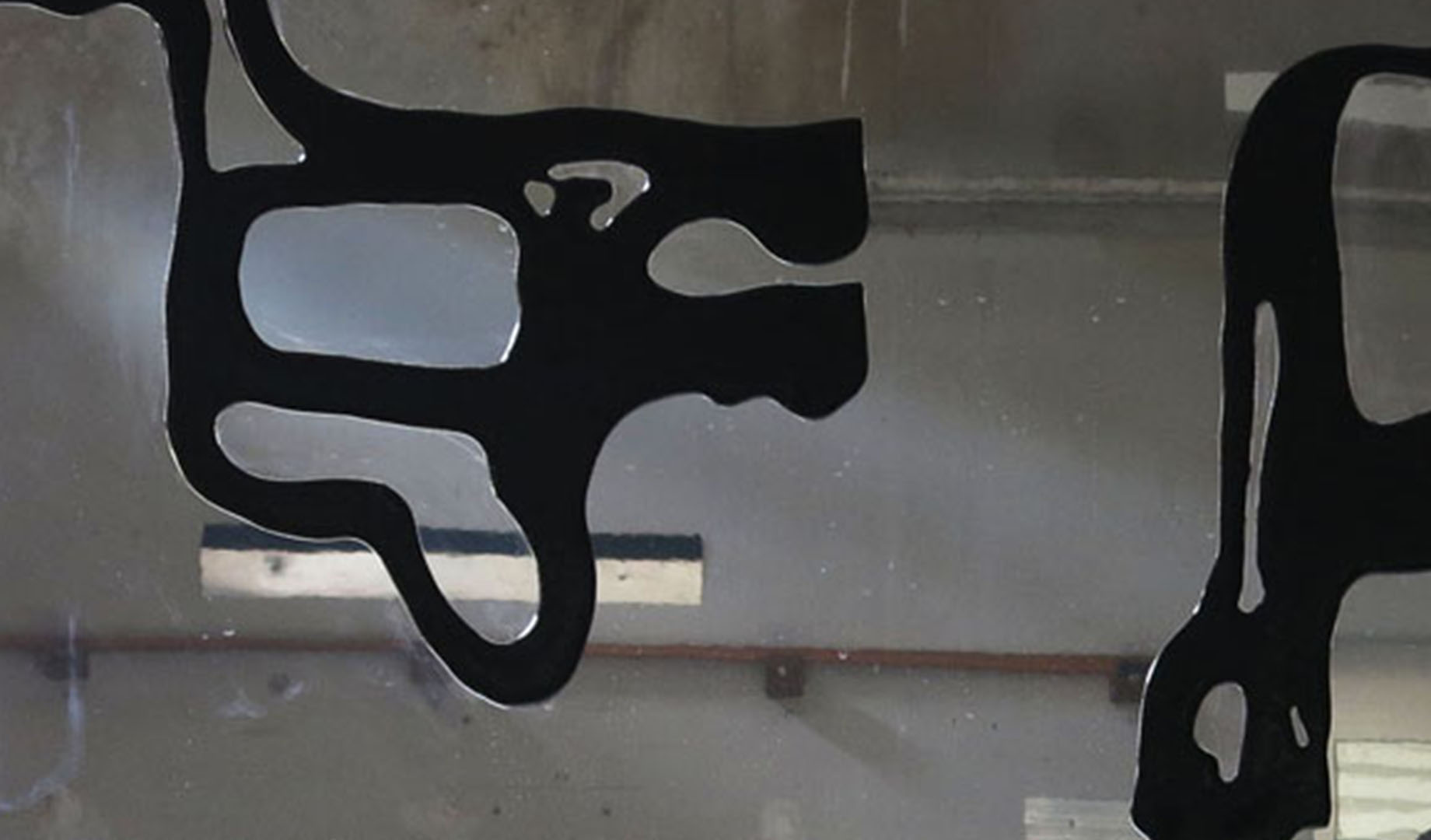
Some of the works with mirror, that the artist has been developing for years, are exposed in the two front rooms of the gallery. The mirrors appeared in Carvalhosa’s vocabulary at a time when he felt the urge to paint again – painting was the technique that first brought him recognition in the 1980s –, but not on canvas. He says, “the mirror was a fugitive surface, which is nowhere; it allowed a type of painting that was ‘in’. And it was spatial, in a certain way, it approached the subject of the work absorbing the space. But it’s just the opposite, it’s really the space that absorbs the work.” The artist’s intervention on reflective surfaces oscillates between sparse strokes and almost complete coverage; in one form or another, the ink is here employed as matter, an obstructing artifice, rather than painting itself. Through his long-term interest in these plates, the artist has produced dozens of pieces with the most varied colours, inks, formats, and techniques.
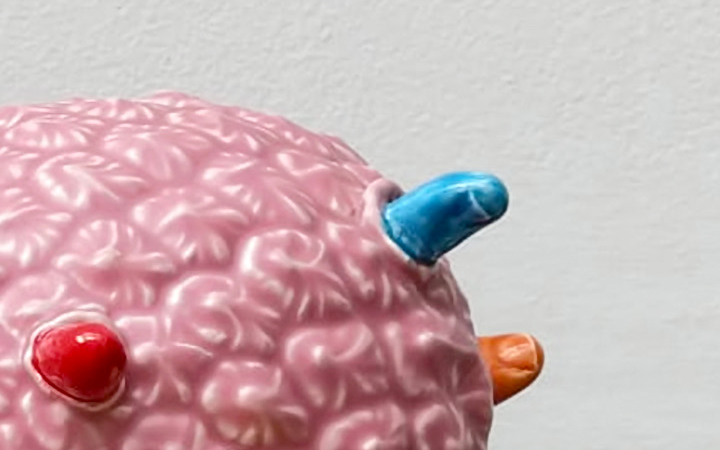
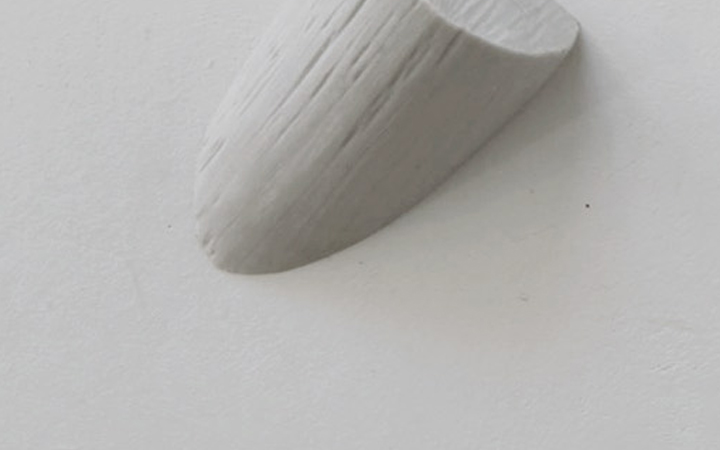
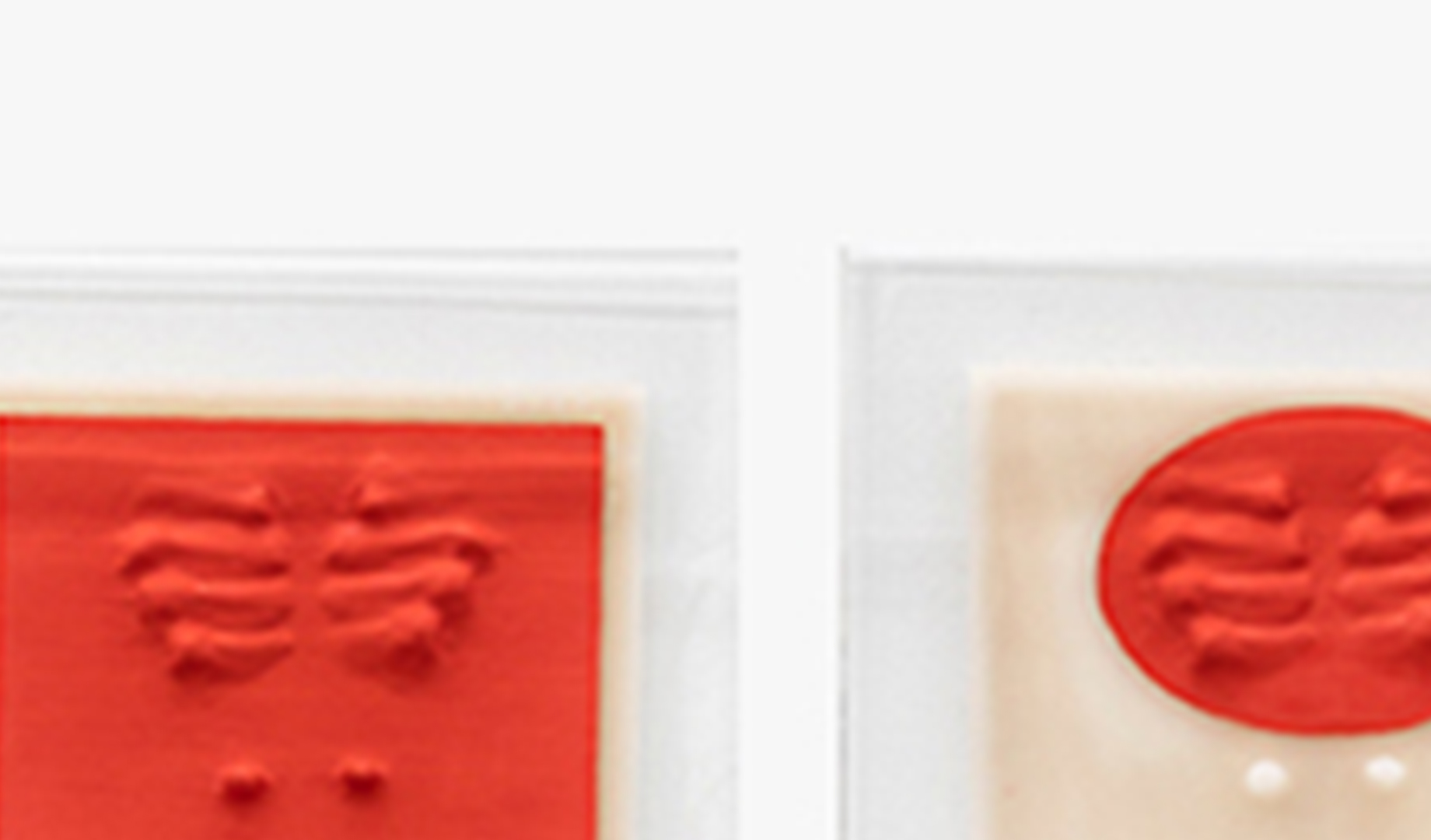
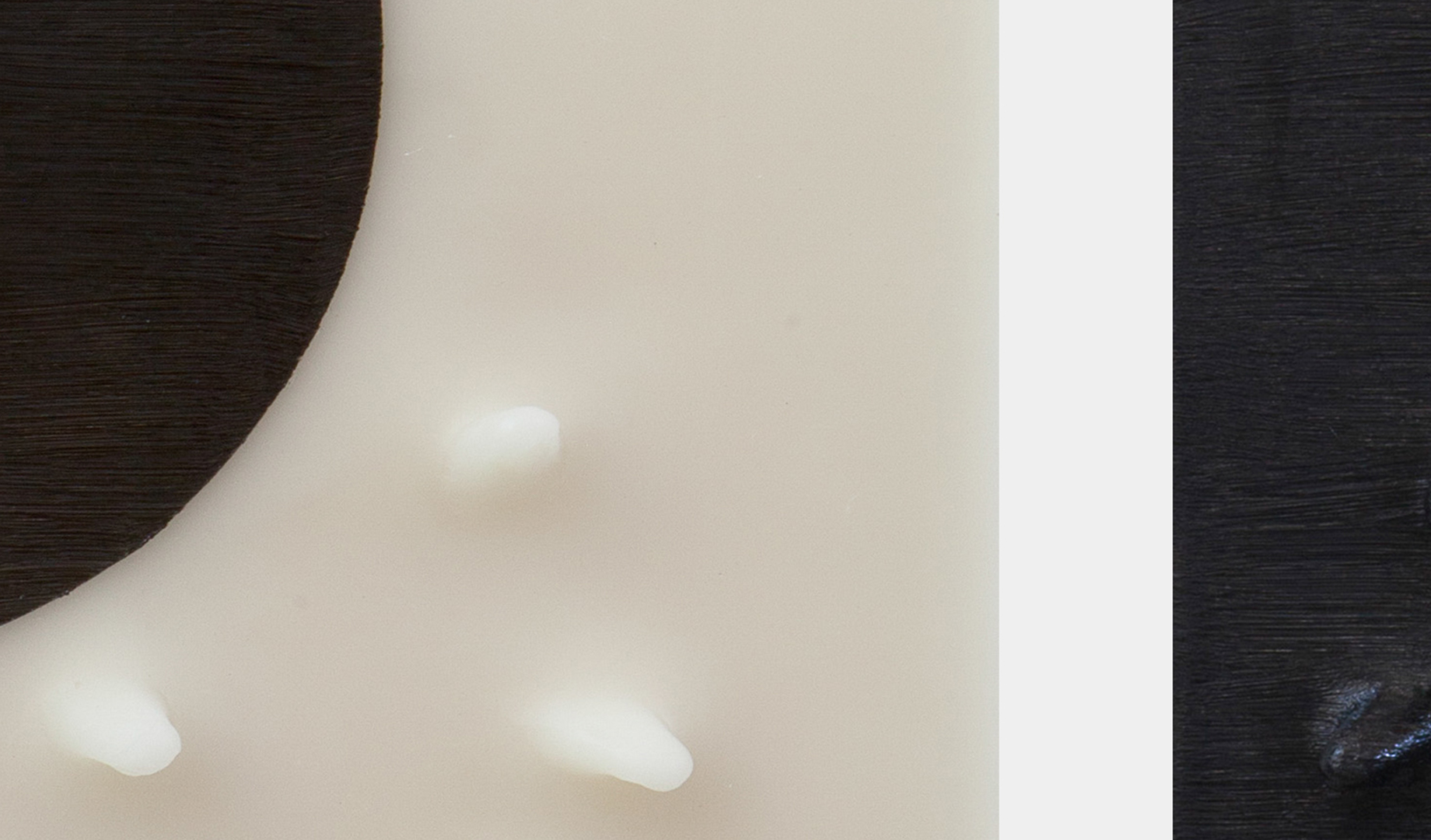
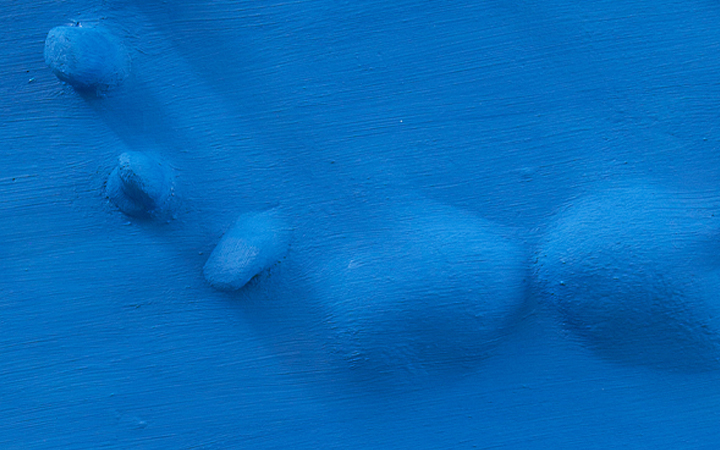
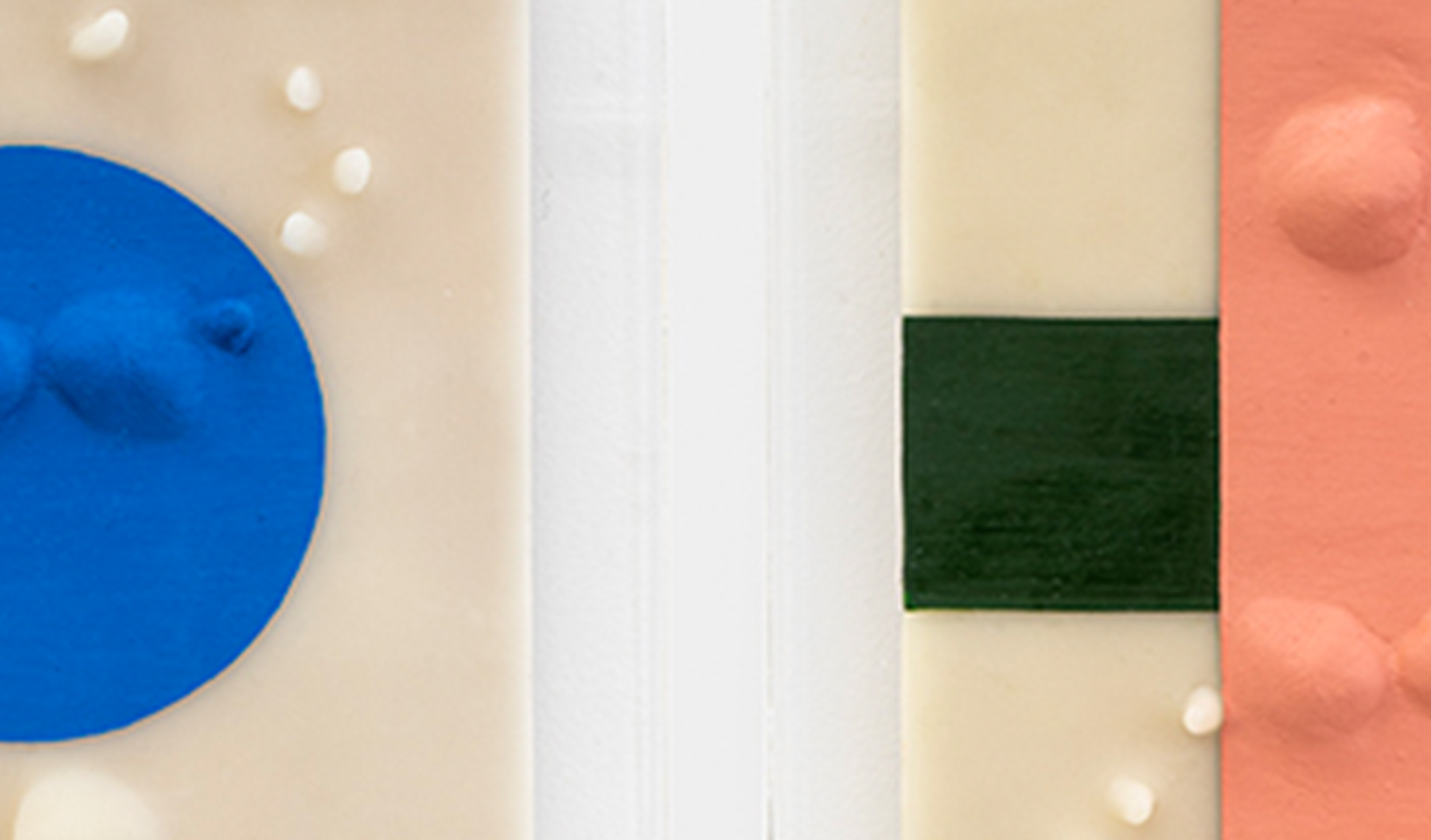
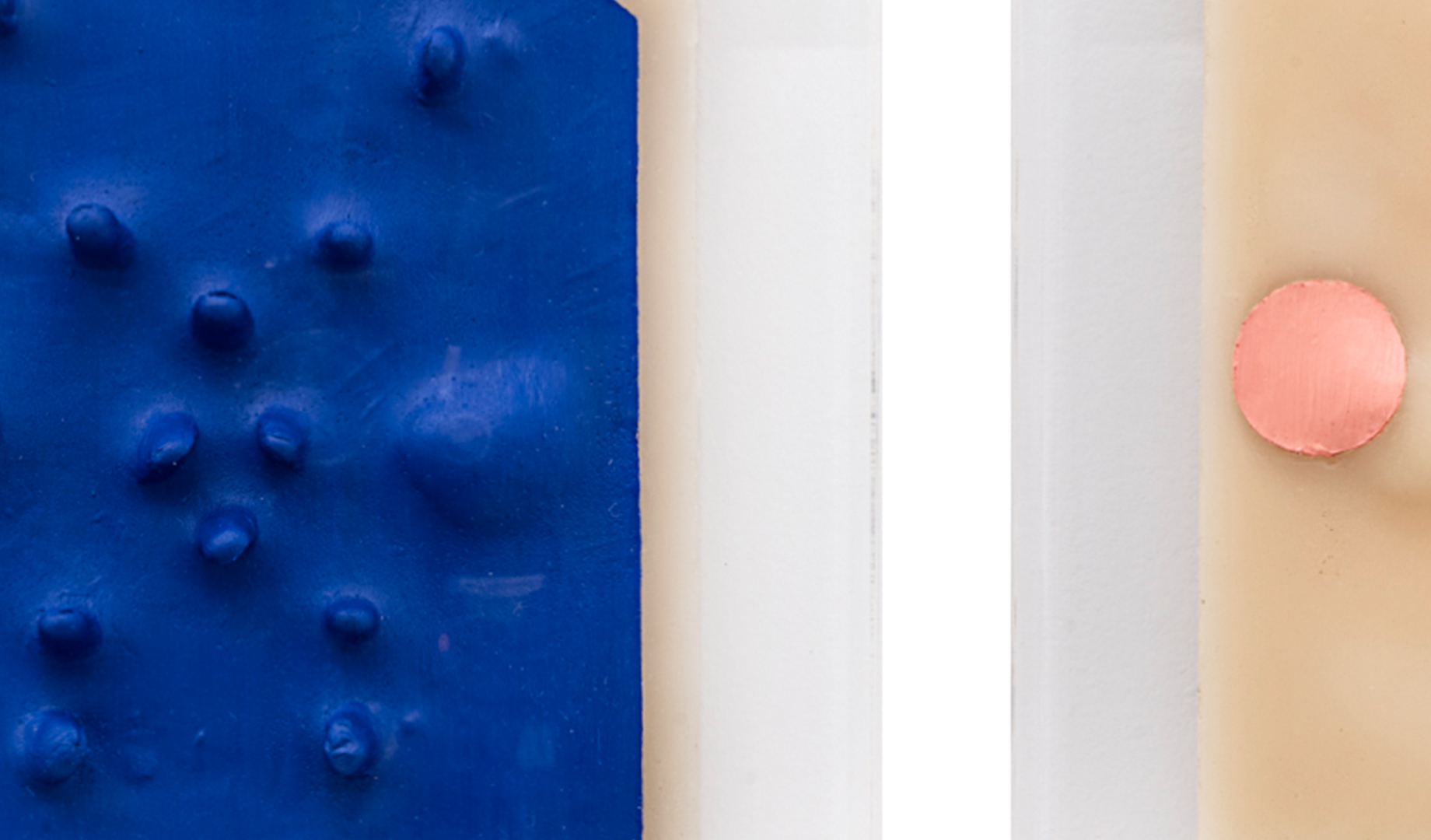
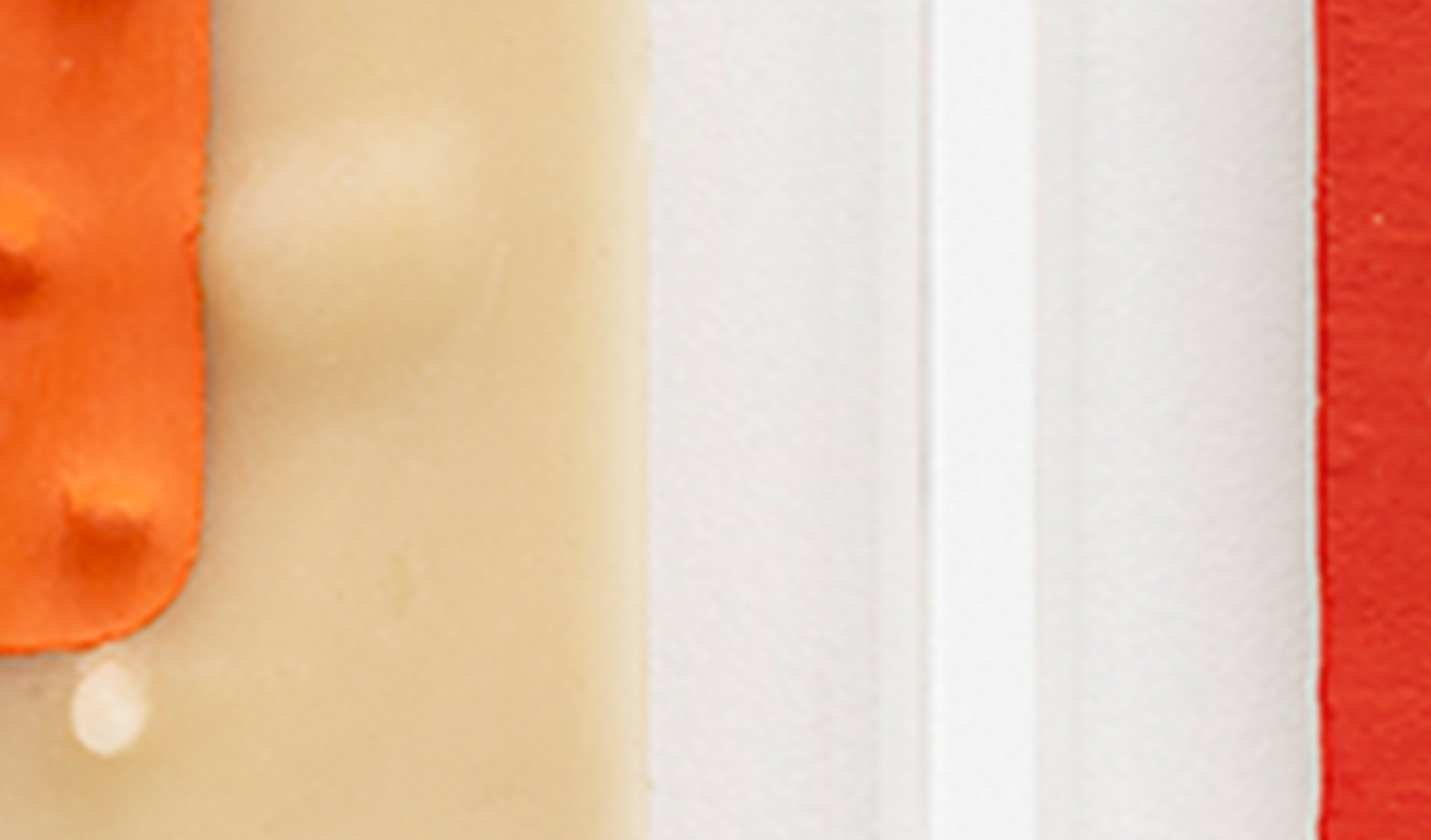
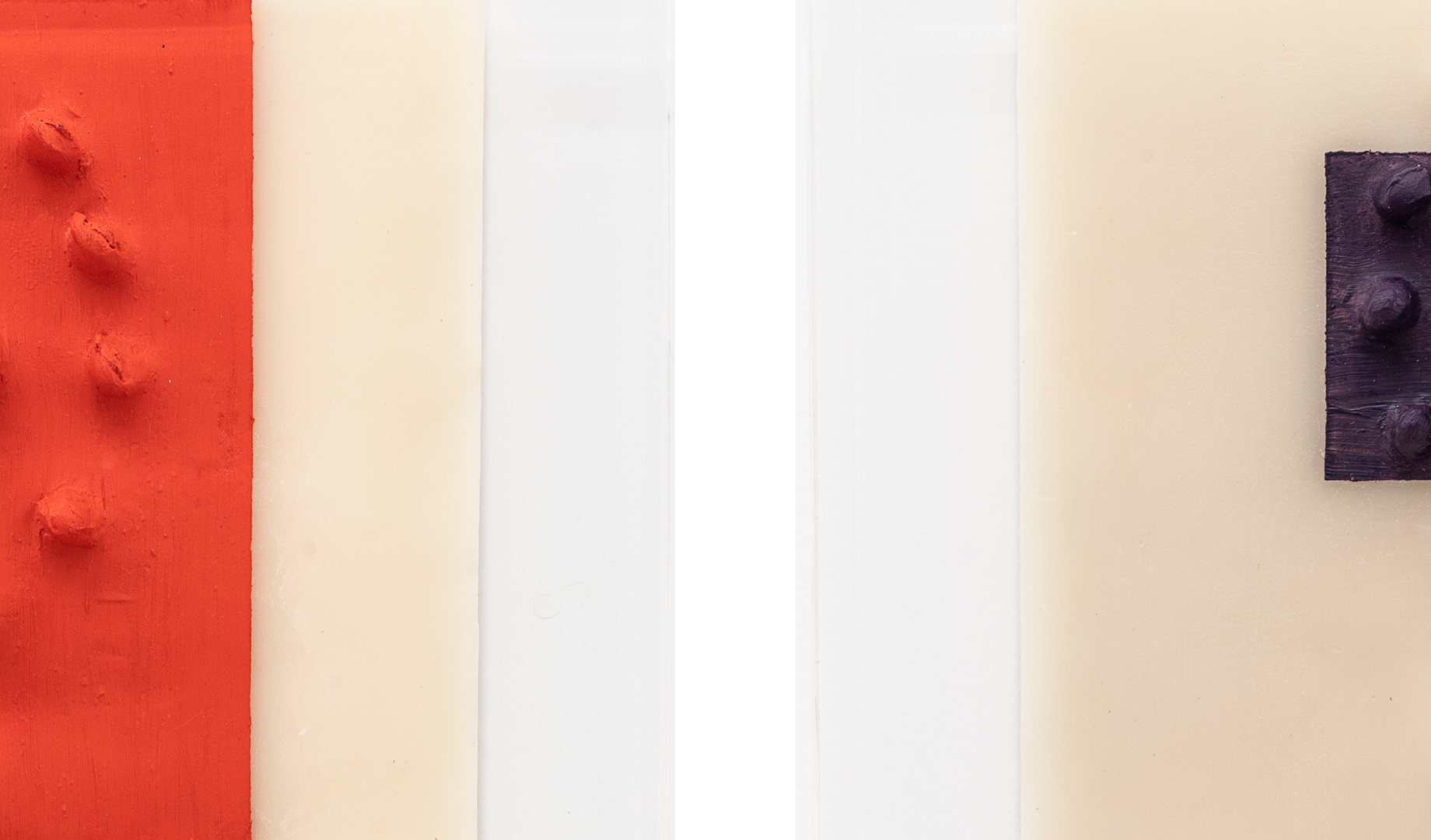
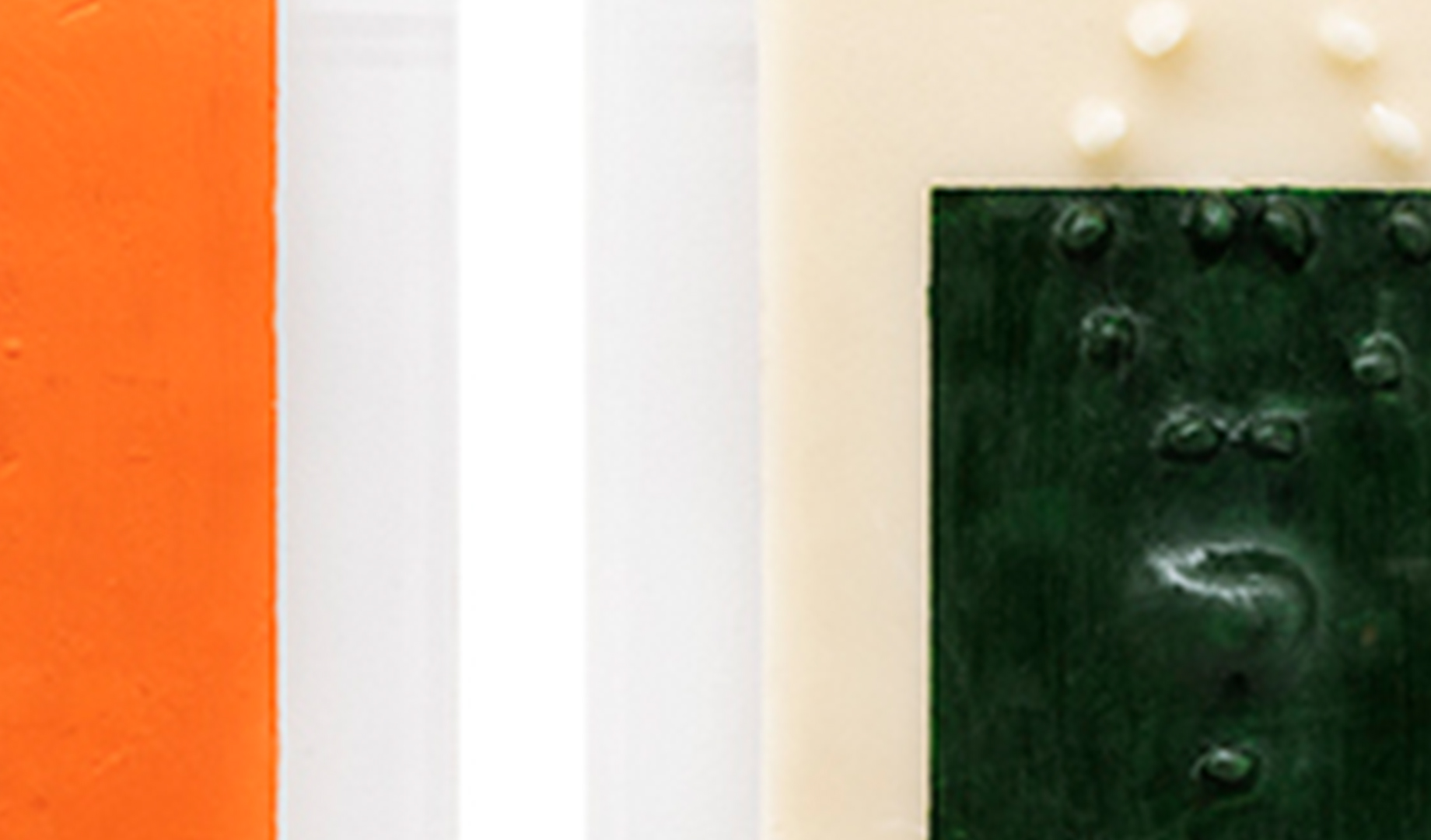
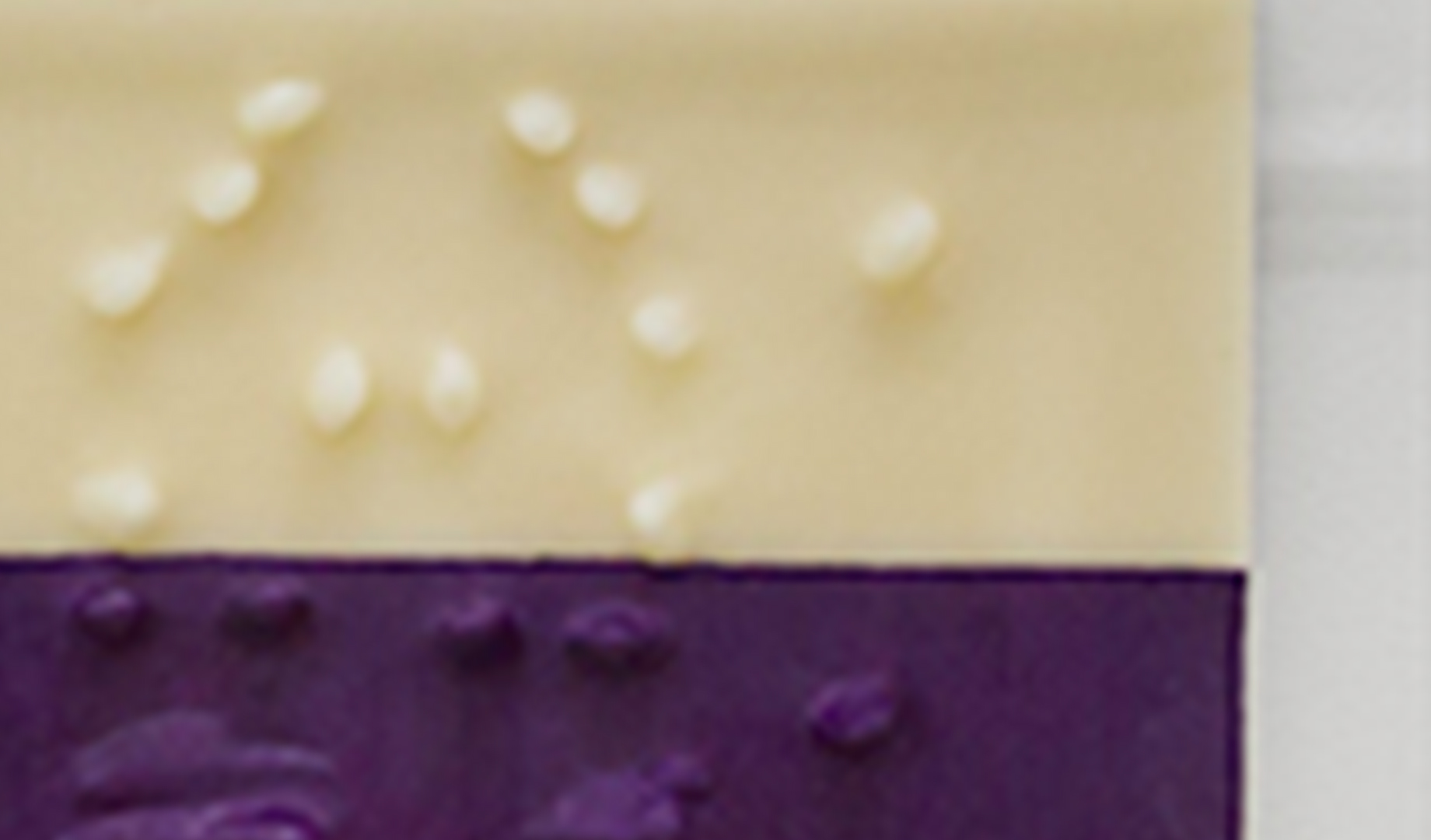
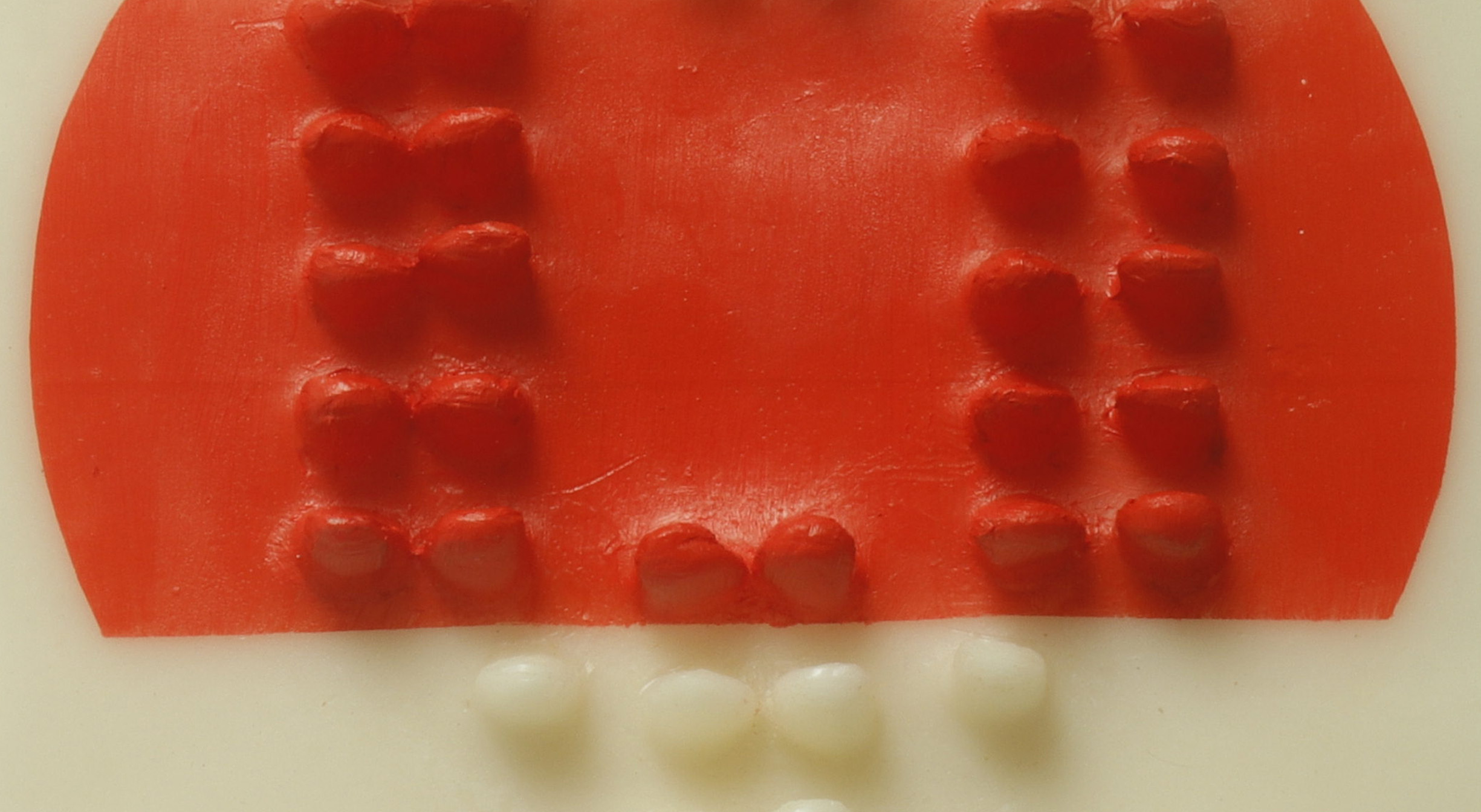
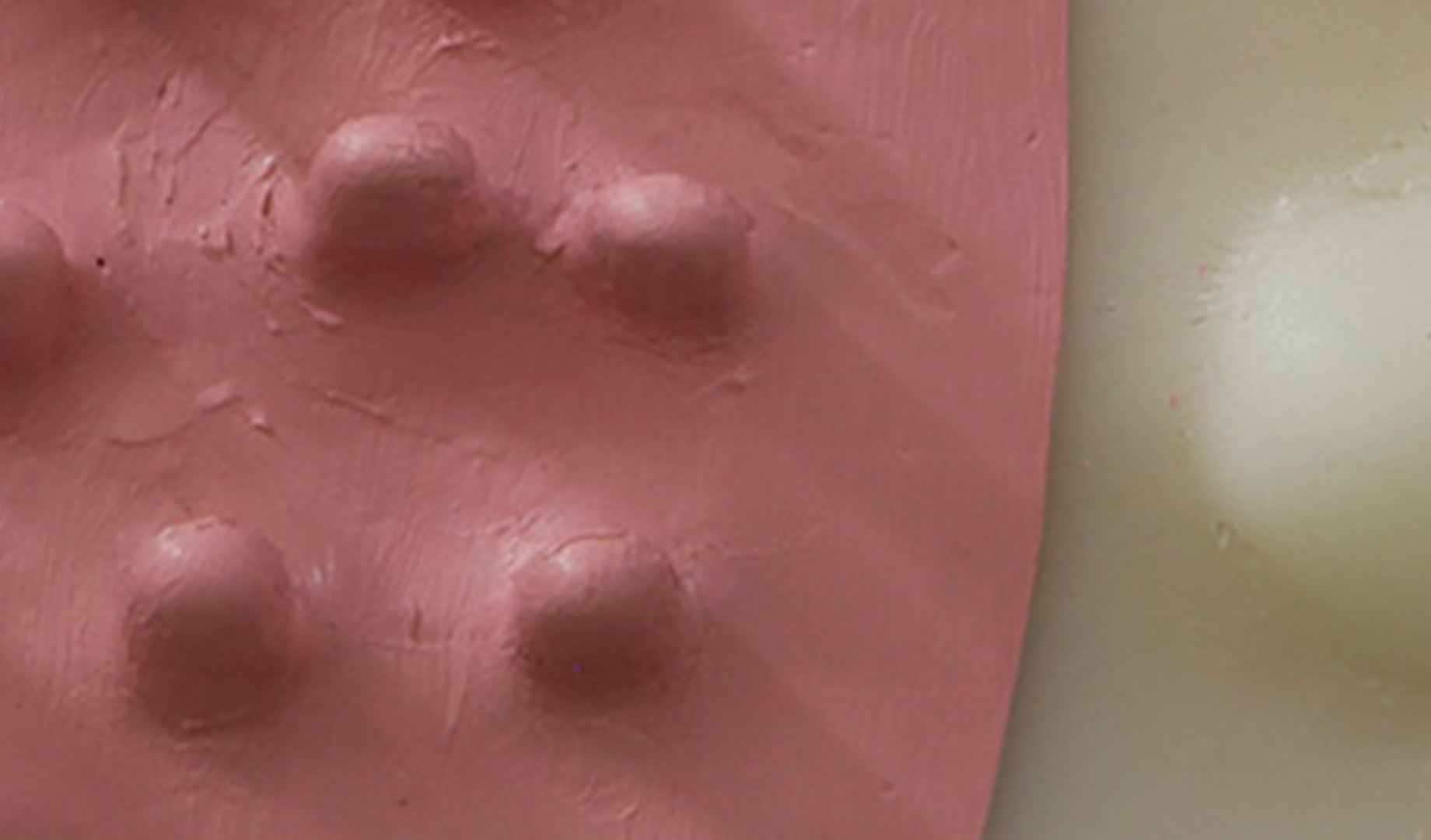
In the front rooms, several wax sculptures are on display, the surface of which refers to the texture of fabrics with small draperies, from which emerge shapes resembling little fingers and balls. In a diametrically inverse operation to that of the reflective works, as of the textiles they approach the space through: the translucency of the wax reveals interior layers of matter, inviting the viewer to immerse in its volume, scrutinise its nuances. This series marks the first time that Carvalhosa has explored small formats. Here again, some of the pieces were produced years ago, others recently; even if the colour sometimes gritty, or the worn surface of older works reveals its age, when exposing similar works made with a time gap Carvalhosa invites the viewer to immerse himself in a non-linear perspective where, like the Aleph, inhabit the beginning, the end and the middle.
Other works that compose the front rooms are porcelain sculptures whose diminutive scale refers to the works of wax. The material here is presented rough, unpainted; at times he employed a naturally darker variety. In their formlessness, they resemble entangled homemade noodles. The spatial issue that is so central to Carvalhosa’s work – a concern that may perhaps be related to his training as an architect – finds its peak here, since unlike all that the artist had done up to then, this body of work is entirely spatial, declining to use rectangular structures as a basis. More than that, the rounded volume that characterises them anticipates the rocky forms that have become recurrent in his aesthetics – and that are present here in the great installation of the show.
Whether through reflection, semi-reflection, internal or external volume, Carvalhosa’s practice recurrently deals with the way objects relate to their surroundings, reconfiguring space. On the subject, he comments, “the place of the work is between itself and ourselves”. The artist performs simple operations – though its execution is often laborious – where he creates strange situations for materials that are well known to the viewer. Anything is done so that nothing is done.
Posições alteradas
The earliest human shelters, based on assumptions and knowledge, were stone grottos, natural caves used by people or larger groups for protection against inclement weather. It is believed that the first materials used by man to build his own shelters some time later were stone and wood. The stone formed solid pile-up masonry walls, and wooden logs, spaced at intervals, held the straw thatching in place. Much later on, Greek columns made from marble pay homage to this rustic, natural early architecture, as the leaves that once crowned the wooden columns were sculpted onto stone – especially in the Corinthian capitals –, like non-whittled down remainders of the tree itself in the trunks of those primitive buildings that were once imagined. Thus being, once all technical restrictions have been overcome, art codifies this entire historical genealogy with “grace,” symbolically bridging nature and culture.
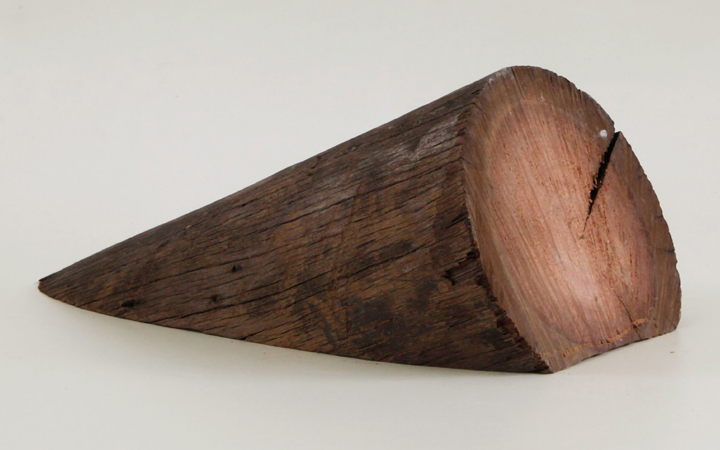
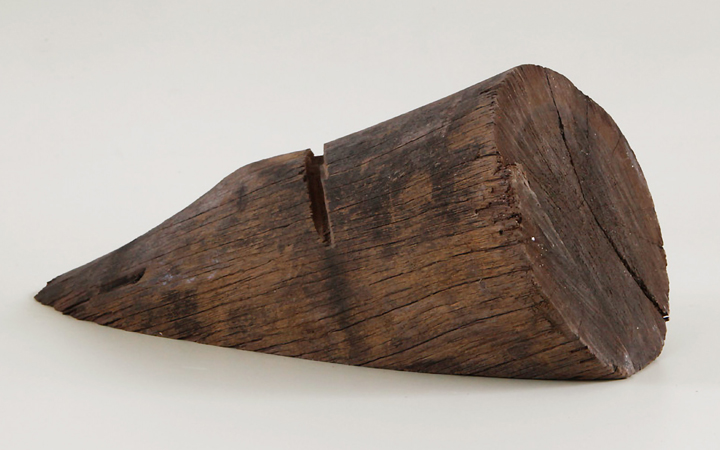
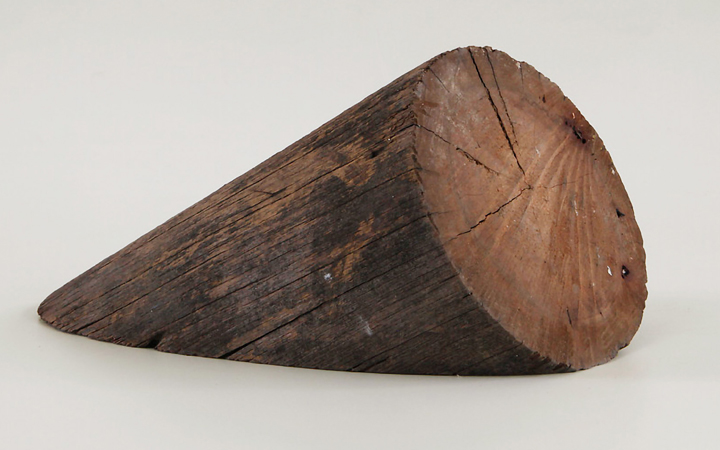
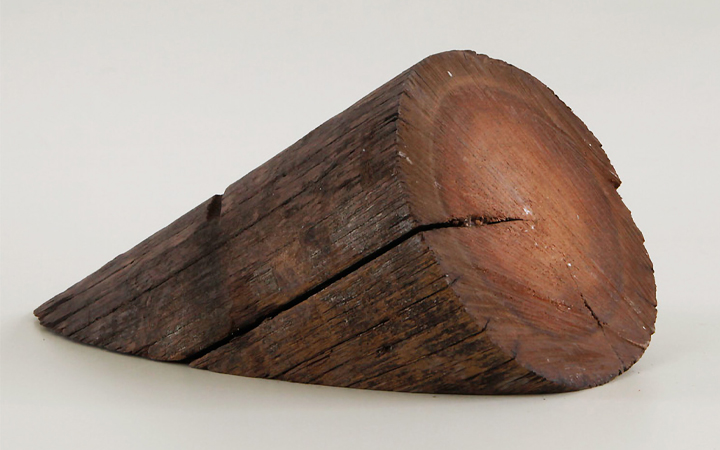
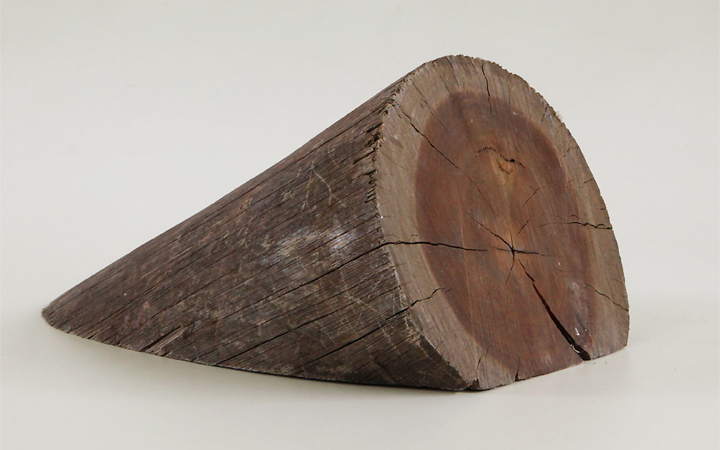
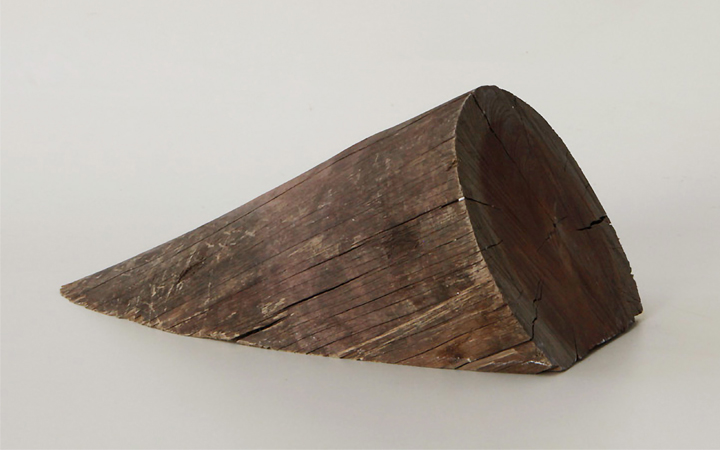
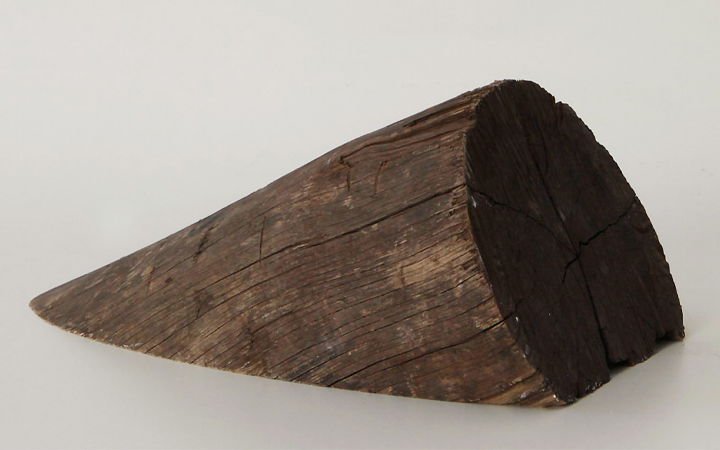
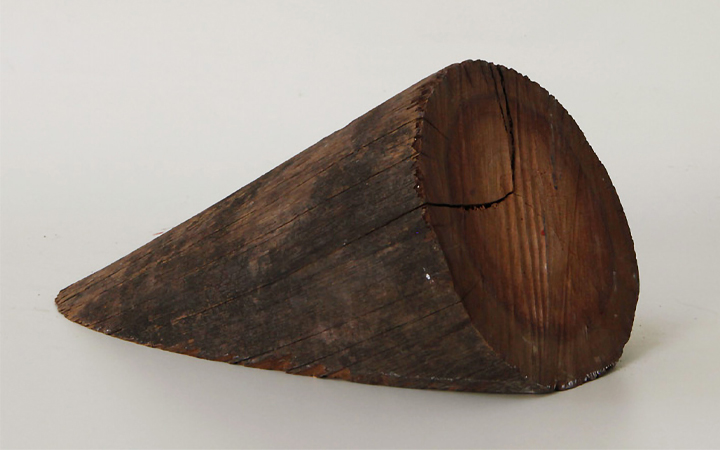
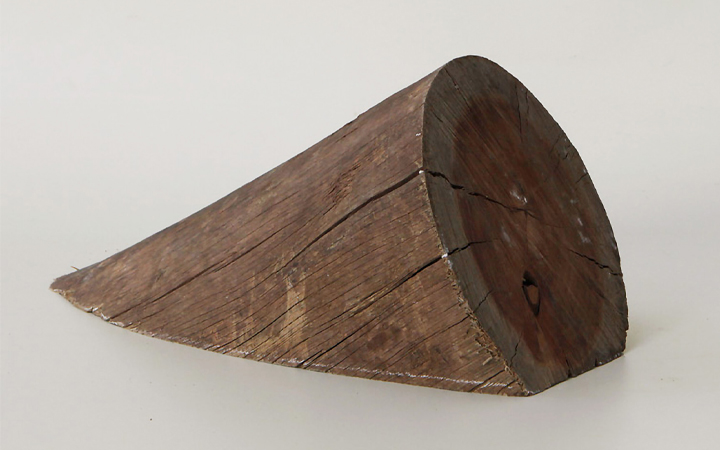
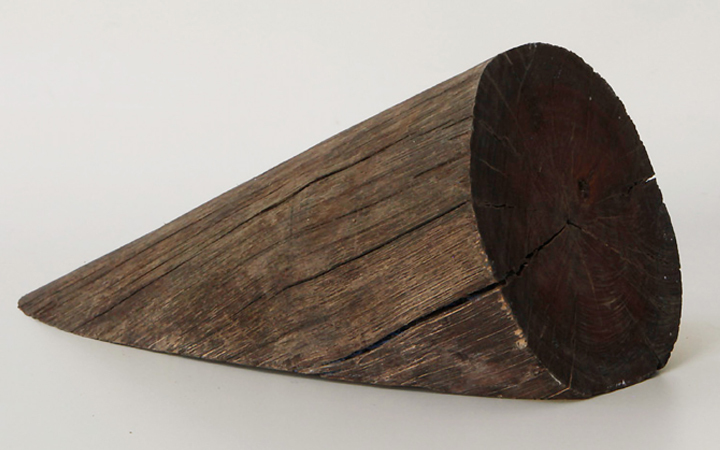
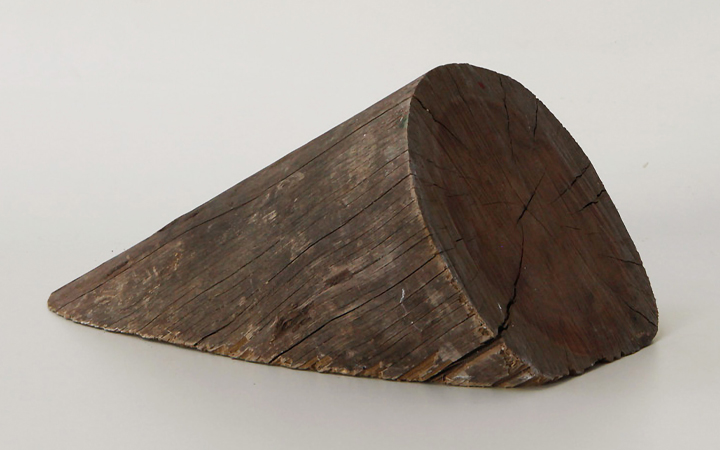
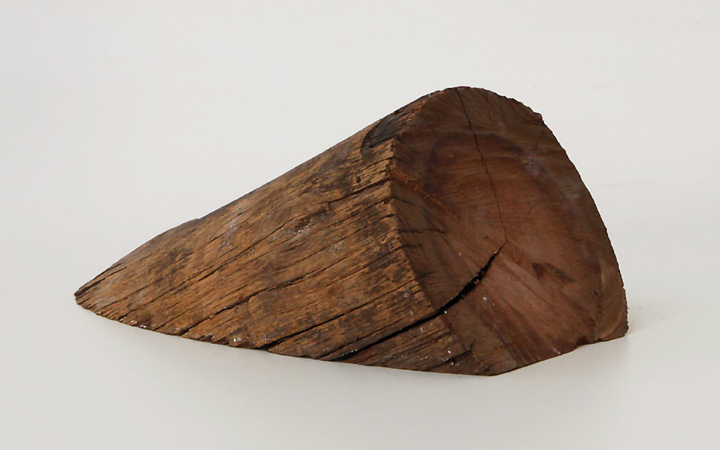
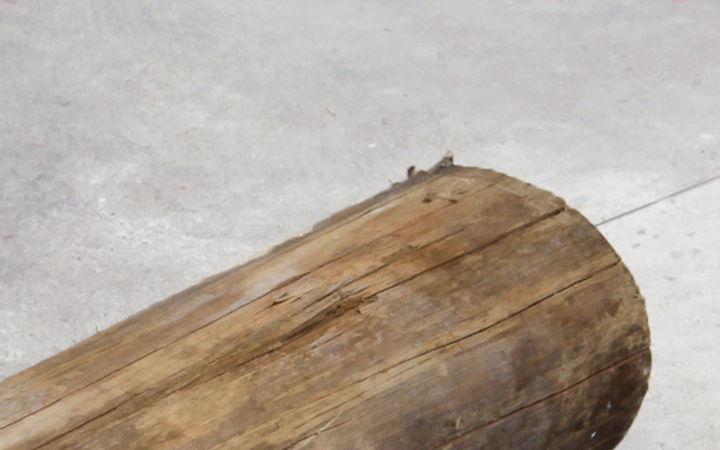
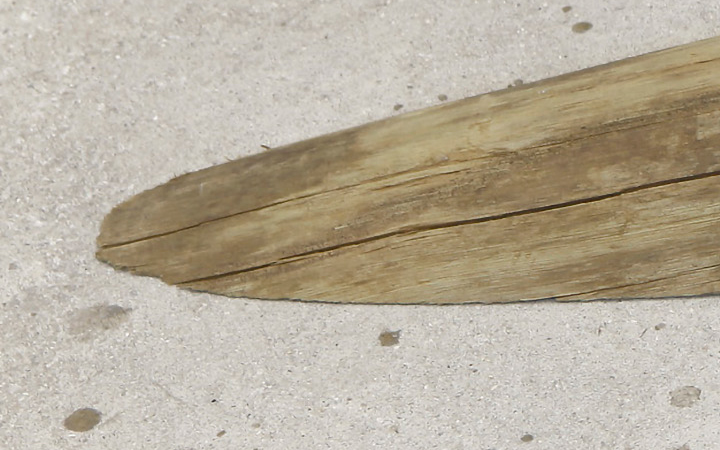
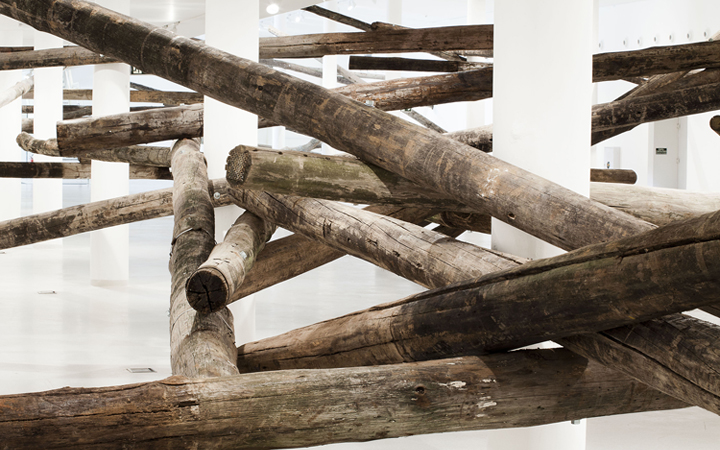
But why allude to this issue in a text about the works of Carlito Carvalhosa? Because it seems to me one of the crucial aspects of his work resides in the questioning of this symbolic transition, undoing its evolutionary linearity to the benefit of a more horizontal circularity. Hence the appearance, in exhibition venues, of time-worn wooden logs, painted or numbered. These logs that once were trunks have also been lighting posts on streets, and now reappear as works of art, in the form of intrusive elements that obstruct the halls, making it difficult for people to pass through. They are such intrusive elements that they even burst through the walls, going across them. This wooden forest, however, is far removed from other more expressionistic Brazilian art references, such as Frans Krajcberg or Henrique Oliveira, to name two examples from distant generations. In Carvalhosa’s case, there seems to be neither the evolution from nature into culture, as in the paradigmatic case of the Greek columns, nor an expressionistic return to natural presence that alludes to a state of potential return, albeit allegorical. This is, first and foremost, a silent, circular passage where things transmute without losing their name: wood.
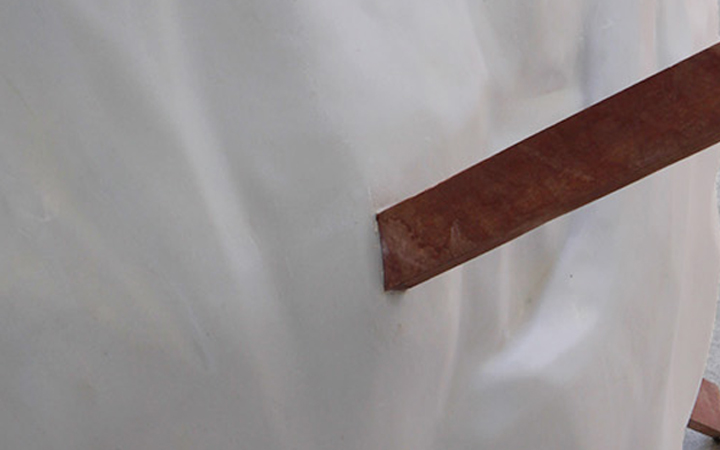
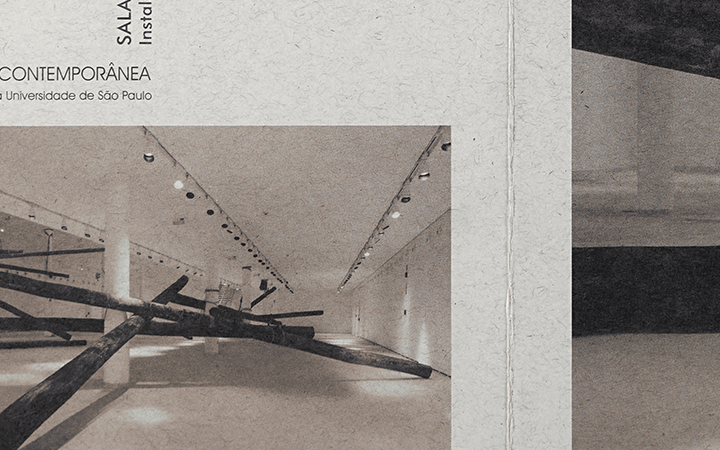
As Vilém Flusser explains, the Latin word “matter” results from the Romans’ attempt to translate the Greek term hylé, which originally means wood. Not wood in a broad sense, but the wood found concretely stockpiled at carpenters’ workshops, designating something amorphous in nature, as opposed to the notion of form (morphé). Therefore, for the Greek, Hylé is the amorphous world of natural phenomena, the material world behind which eternal forms are concealed. Matter is the upholstery, the perishable filling to the indestructible form, because that wood is bound to end someday, whereas the idea of a table or a chair, on the other hand, is certainly not. Going back to Carvalhosa’s works, what seems to be there, on the contrary, is the vicious circle of matter, which conserves itself despite the vulnerability of the form that informs it (trunk, lighting post, work of art etc.). Appropriation, usage, disposal, recycling. Once the various forms of practical existence of those wooden logs have been exhausted, they reappear as a work of art in which the forest has changed its meaning, lying horizontally and tipping into diagonals, often opposing the verticality of the building’s pillars (also cylindrical, but white), as was the case with the “Sala de espera” (Waiting room) exhibition held at USP’s Museum of Contemporary Art in 2013. Considering the medium’s boom and the environmental spatialization of artwork that took place for the past 50 years, these strange forests by Carlito Carvalhosa can be seen as dialogues with Mira Schendel’s Sarrafos. For aren’t these trunks/tilted posts that go through walls and balance themselves unstably akin to environment-scale prolongations of the wood strips that leap from within white canvases before sinking into them again?
Perhaps one of the main constants of Carvalhosa’s later works, one that is fairly present in this show, is the modification of the regular position of things. Trunks tilt, lighting fixtures are moved to the ground or the walls, and drinking and wine glasses stick to the floor or the walls. In other words, the vertical and horizontal directions become shuffled, which to an extent corresponds to the growing dissolution we experience between art and life. Ever since Robert Rauschenberg, in 1955, laced his bed, quilt and pillow with paint and raised them onto a vertical position – the contemplative position of art, abandoning the horizontality of day-to-day actions: sleeping, sitting, placing objects on the table –, leaning it onto the wall, this has become a central issue for art, incorporating the spectator into the artwork in a structural way. However, these pieces by Carvalhosa contain something surrealistic (Escher- or Magritte-like), in the way the ceiling, wall and flooring mutually contaminate one another, and in the way commonplace objects such as glasses end up elsewhere without losing their recognizable identities.
By the way, this very insistence in conserving the identity of things strongly sets Carvalhosa’s current output apart from the material, gestural expressionism that marked the production of the Casa 7 group, of which he was a member in the late 1980s and early 90s. For at least over ten years now, Carlito Carvalhosa has chosen to preserve, through a certain degree of literality, the external identities of objects in his work. Hence the marked expressive prudishness in his work, a case in point being the very title of this exhibition, precaução de contato (contact warning).
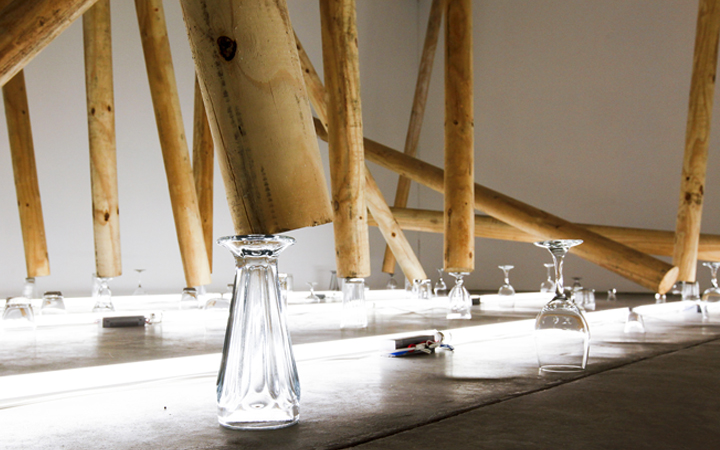
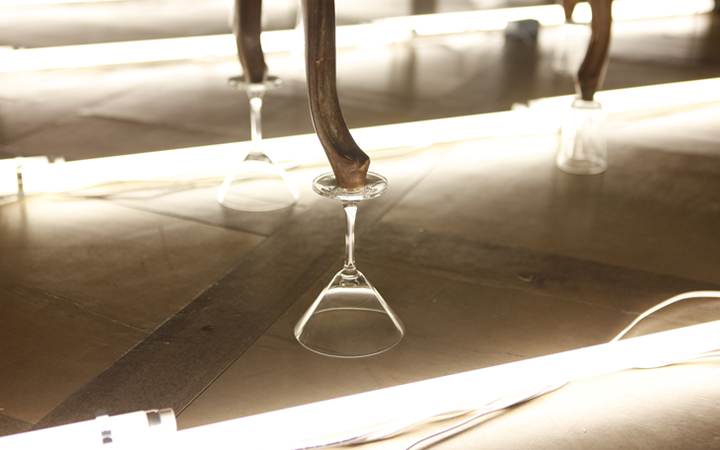
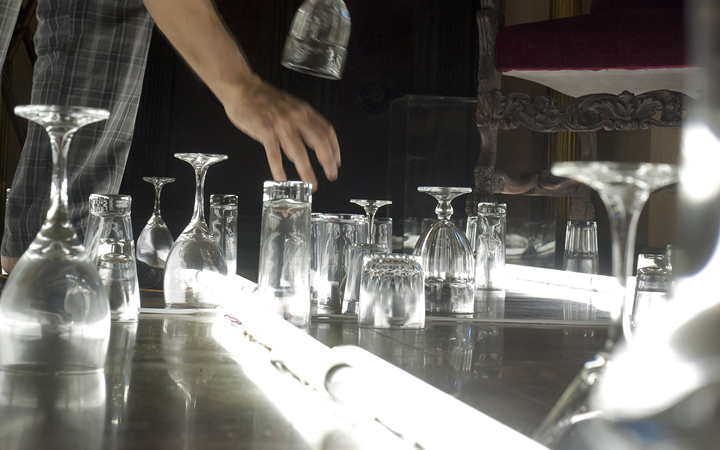
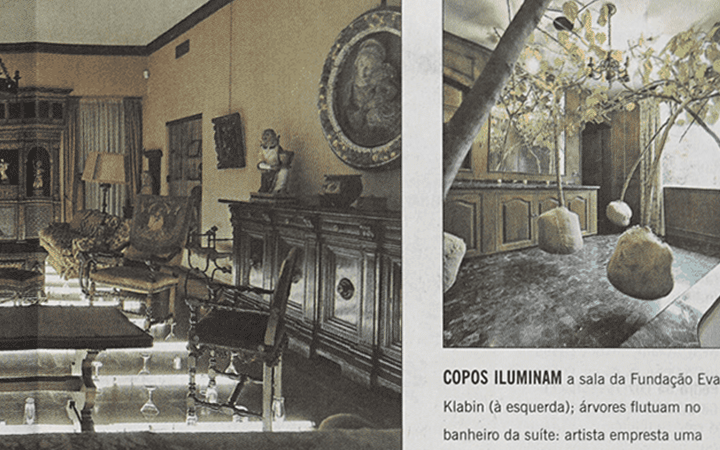
In the installation “Regra de dois” (2011), shown at Rio de Janeiro’s Fundação Eva Klabin, pieces of furniture made from dark, heavy, highly adorned wood, preexistent in those formerly domestic settings, are lifted off the ground by drinking and wine glasses that support them in a vertiginously unstable manner. An approximate comparison would be a building standing not on pillars – the equivalent of furniture legs – but on fragile glass walls or columns, in a clear tectonic paradox. In this installation, Carvalhosa further highlights the sense of ethereal suspension of the furniture by setting up lines of fluorescent lamps on the floor, creating a cold, immaterial halo that seems to eliminate the ground altogether, and all that is left is chairs and other low pieces of furniture, as well as drinking glasses, loose in space. In fact, the idea of contact here is reduced to a minimal dimension, whereas the objects keep their formal integrity intact.
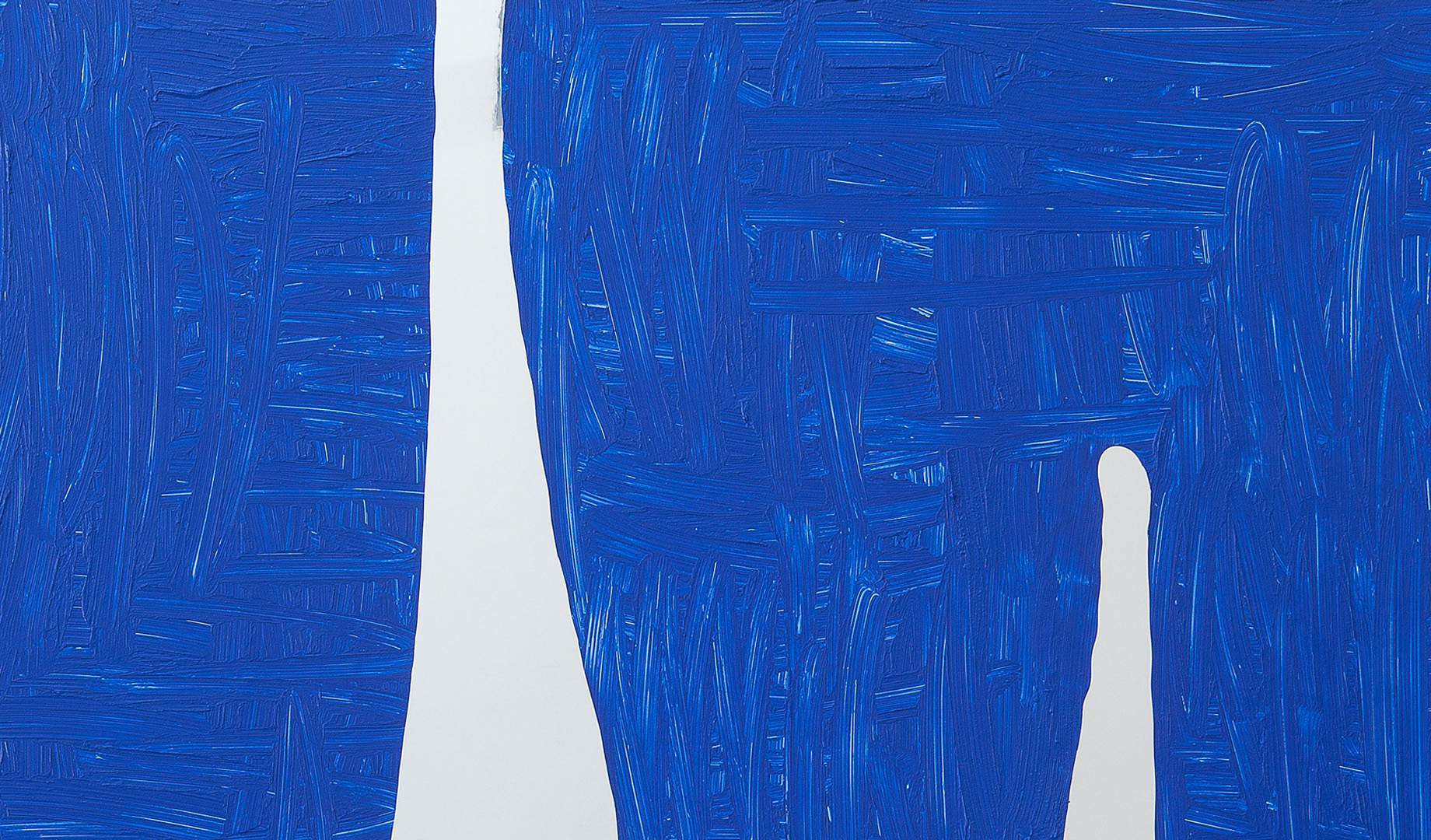
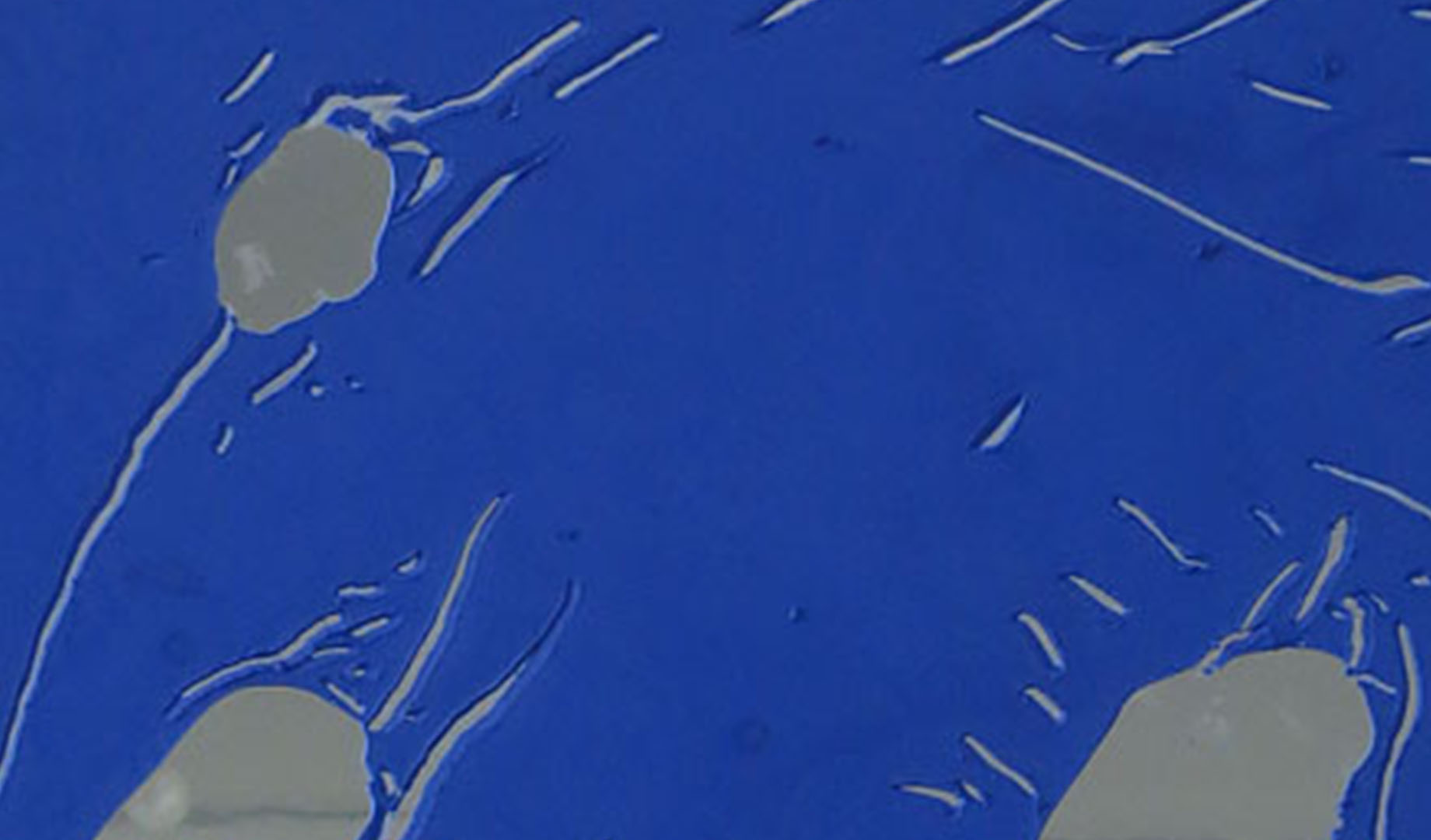
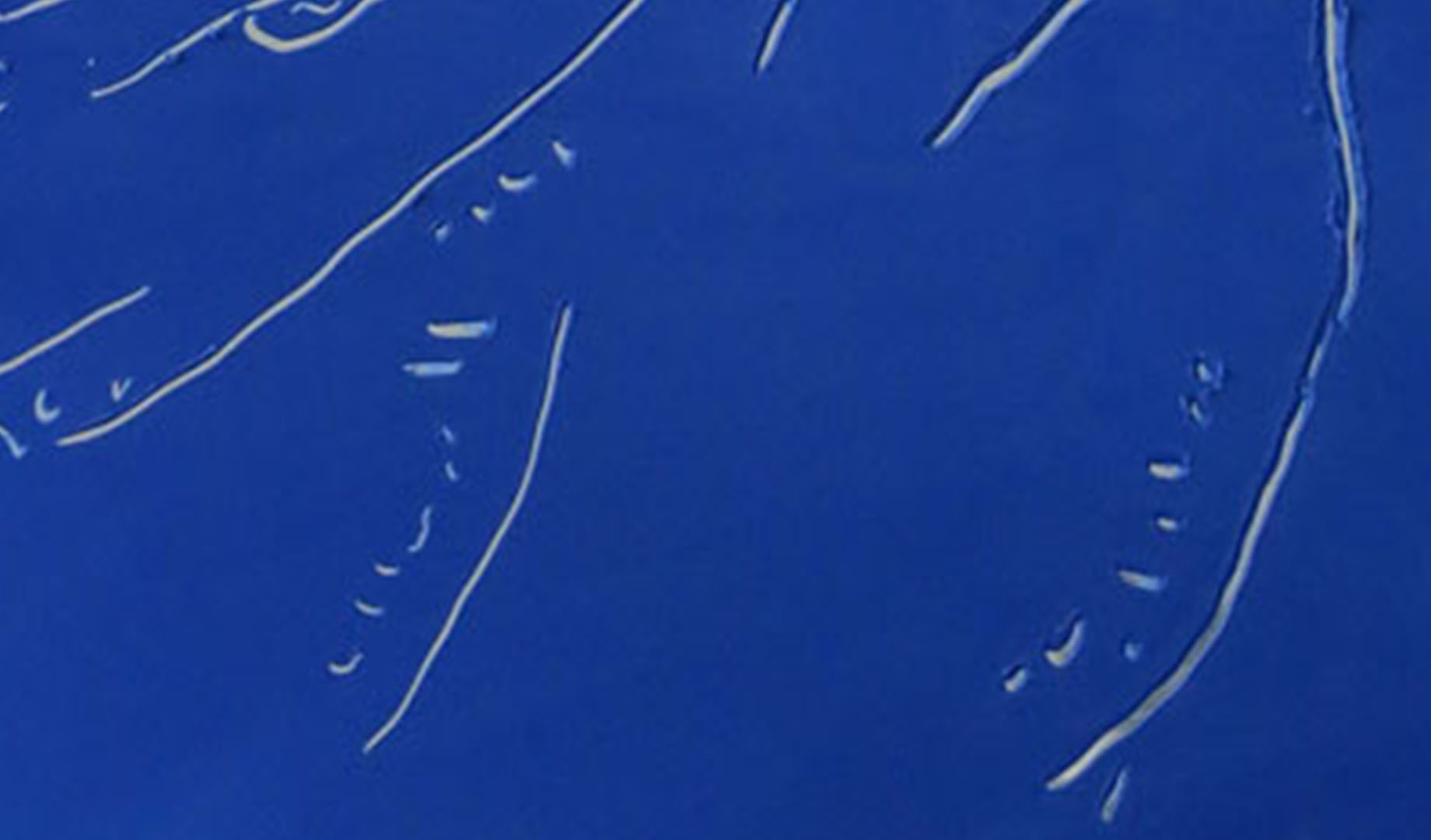
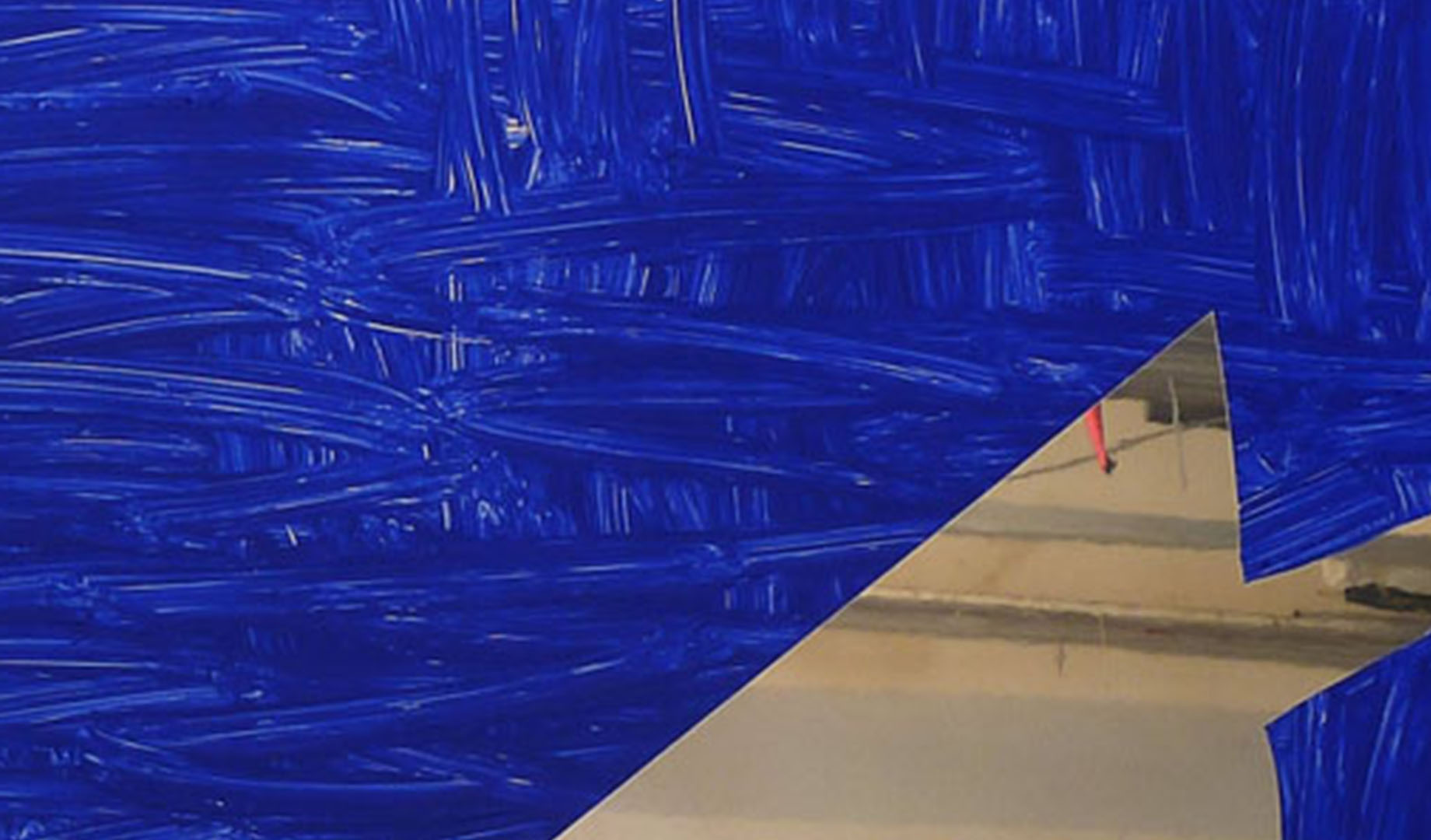
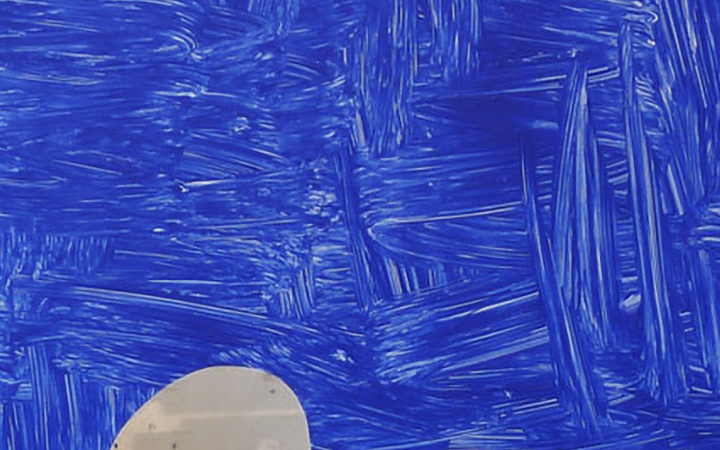
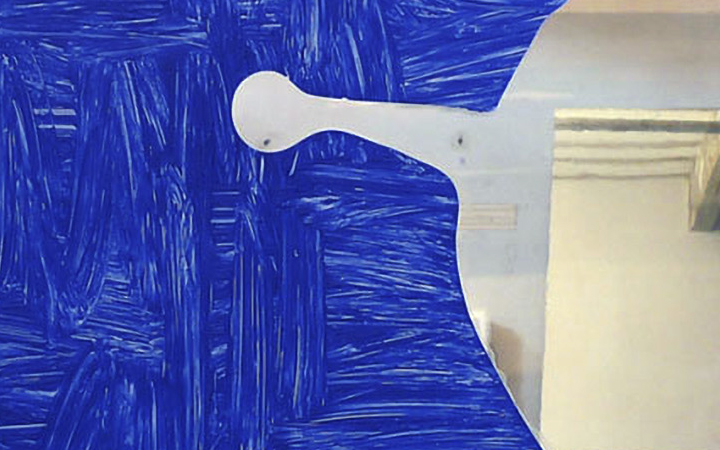
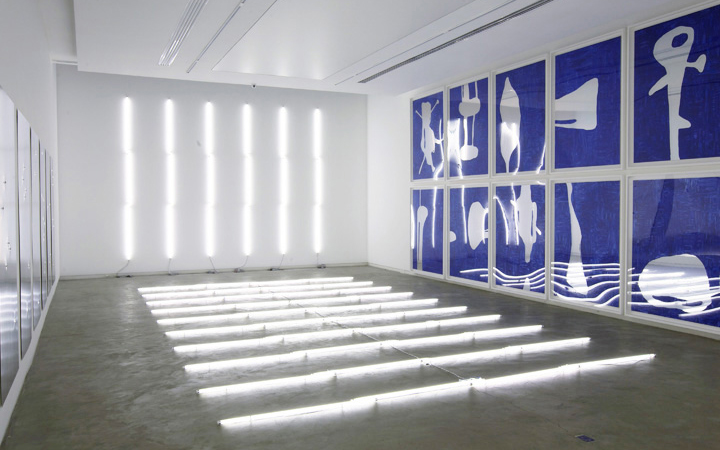
This same issue manifests in the paintings, albeit differently. Here, the oil paint glides smoothly over the mirrored aluminum sheets in an aversive contact that does not sediment itself. Carved out in negative, the designs are luminous reflective openings upon these blue masses. The contact warning here is also a reduction of connections, an allusion to a world where things (and people) no longer attach themselves to one another; they just glide and mutually reflect. A world where floor has become wall, wall has become ceiling and so forth. A world, therefore, where things glide and escape their habitual places, changing position, dodging constantly.
Do ar
For almost 3 decades, in the various places where I have lived, I have carried with me a painting in encaustic by Carlito Carvalhosa. At present, it is in my study at home, standing on my left in parallel to my line of sight. I am a night owl and like indirect light, with the exception of a table lamp. The painting, so to speak, is partially in the shade. It was painted on a wooden base used to make a door. Placed horizontally, its features change, but it still retains the thickness and dimensions of the wood which was entirely filled with yellow encaustic, albeit with the edges left without pigmentation. It is a precise yellow, without saturation, and has aged somewhat together with myself. In the painting, the years have lasted as if they bore witness to my own. Adorno says that it is not every day that a work of art opens to us. What has happened with Carlito Carvalhosa’s encaustic is no different. Indeed, for some time, the access to his art was blocked for a practical reason, due to the warping of the wood. Carlito picked up the encaustic, took it to his studio and criss-crossed its back with iron. He himself put it back on the wall and since then, it has been rigid. This was 25 years ago and three houses back.
To Adorno’s dictum we may add that works of art in a house tend to open to their residents even less than works outside the home. We get used to them and habit, with its routines, is not a reliable ally of art. Since the painting is currently not very well lit, I enjoy it even less. But in addition to these three conditions, the right time to which Adorno refers, the habit to be overcome at home and the reduced lighting, there is a fourth condition in the yellow encaustic of Carlito Carvalhosa which prevents it from opening to an aesthetic perception and drawing me away from everyday tasks. If we may say so, it was made in closed form. The encaustic is massive. There are some subtle vertical creases which divide it and for the remainder, there are scratches everywhere, albeit which are also subtle. The yellowness of the work is what predominates. It isn’t a painting that I can decide to look at and by using tricks that we learn over time, am able to “open” for my own pleasure. It has something of the stationary, of the contracted in its mass, so that it is not easy to appreciate. A yellow black hole. But then someone arrives, or I open the window more or I fiddle with the lights and suddenly all or part of the yellowness, a scratch, pulls me away from my everyday routine and becomes autonomous. Its scratches reign over the yellow like the first human scratches, or, on another occasion, like in the luminosity of the small yellow wall of Vermeer’s View of Delft described by Proust. Primitive or sophisticated to the extreme, the yellow glitters and emerges from its state of anaesthesia, gaining an aesthetic dimension which appeared to be eternally asleep.
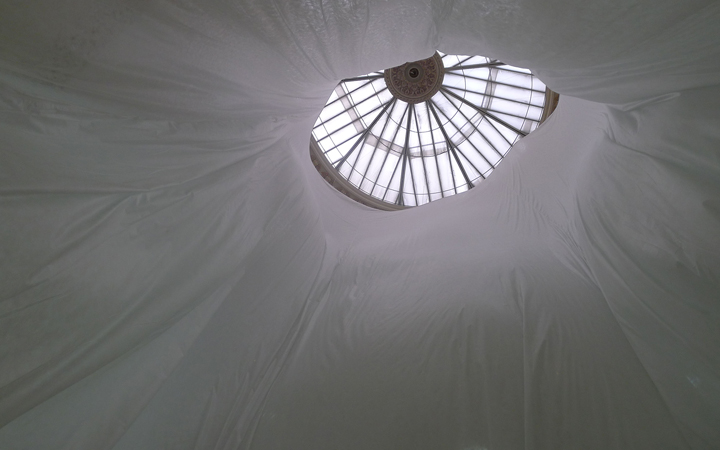
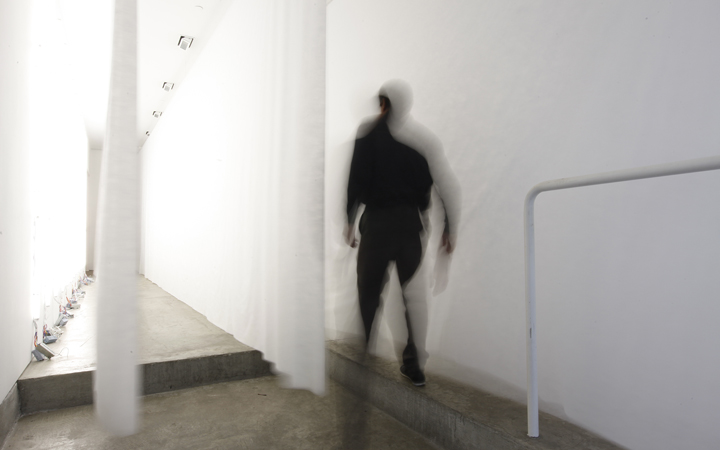
This counterpoint between the anaesthetic and the aesthetic is at the core of Carlito Carvalhosa’s poetics. I enter the gallery and there is a white tissue descending from the roof on my left which prevents me from accessing the gallery space and on the right, there is a mirror. What is this? Like in my encaustic, everything is anaesthetised. But I don’t know how many steps forward, or with which leg in the air and I don’t know, because everything was so rapid and suddenly, my movement airs the space and the tissue moves, lightly but no less slowly, as in an adagio. My memory is one of time in slow motion, in which there is time for me to insert right now, not the story of scratches and yellows in art, but this incomparable story of drapery and its movements in the history of art. And it is my body, for an instant, an unmeasurable instant, that drapes the space, in a type of profane and secular inversion, of the revelation of the body of a Greek god through the folds of the drapery which shows in it the body and its movements. A small but great epiphany. It moves ceaselessly, slowly, opening itself and rising to the space in my memory.
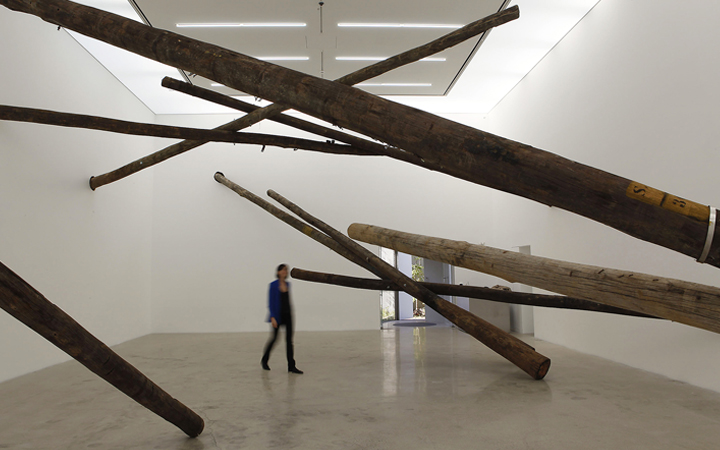
The intense aesthetic, which suddenly arises from the anaesthetised, can be described in many works by Carlito Carvalhosa. But I do not wish to go beyond a brief note. I am travelling. I’m not in São Paulo. I nevertheless receive photographs by e-mail of the exhibition in Seoul which Carlito Carvalhosa sent to me two days ago. In the space of the Kukje Gallery, large wooden trunks are laid out in a manner similar to that of the previous exhibition at the new Museum of Contemporary Art (MAC) of São Paulo. In the first photograph, I recognise the similarity of the exhibitions. With the pardon of repetition, everything is halted, inert and as if thrown into a place where it hardly fits. But as I look at the photographs, the situations change. It is not the light and slow raising of the tissue which strikes me as in the previous works which closed off the space through fabrics, but flashes, markings in the space and of the space, as if they had jumped out of the canvas of a painting by Malevich with many diagonals. Fluttering or marking, a delay or instant, in the same way, the aesthetic arrives and overcomes the anaesthetic. Is it possible that it won’t come? Evidently. It is always possible. And in the works of Carlito Carvalhosa, even more so. They take risks in being simple things more than is usual in contemporary art. But if the risk is overcome, like an arriving grace, the art crackles.
There is something new, even if the poetics is the same, in these two series of the more recent works by Carlito Carvalhosa. Not only the movements of the case, but also the moving through space with the body are required for the inert to gain life. There is something of the old “participation of the spectator” here. The expression, from the end of the 1950s and the start of the 1960s, is ambiguous. The spectator always took part in the art. But having discounted the ambiguity, the idea that the spectator is the author of the work is resumed, albeit subtly. The installations are present and sufficiently drawn for us to feel that the author is the artist. The role of giving art to an art, which in fact has already received it, is left to the spectator. This illusion of creating the movement of the cloth which moves slowly or of the trunks which mark each other in an instant is not entirely illusory, however, even if entirely prepared by the artist, without ideologies of the spectator-creator. This leaving of a part for the spectator, this giving him the aesthetic moment slightly more than usual, is a corollary of the anaesthetic aspect of the works. Taking from the work and from the artist to give to the spectator (even if this is entirely a decision of the artist) is, let’s say, a real illusion. My movements slowly raised the cloth. It was memorable. I was gentle. I left habitual time for a while. It lasted.
I return from my travels and following Carlito Carvalhosa’s suggestion, I go to see the new exhibition of trunks at the new MAC of São Paulo. I had not yet been able to see it and I catch the exhibition a day before it closes. What a welcome suggestion! The change in aspects of the same work, which I felt looking at the photographs of the exhibition in the Kujke Gallery, is present. But what I saw as flashes and markings was given to me by the succession of photographs which came in the e-mail. The changes in features, which are rapidly deleted and then re-emerge, came to me filtered through photographic language. Wandering through one of these exhibitions in the flesh is something else. I didn’t go to Seoul. I have never been to Seoul. I could only see the exhibition at the MAC live, in the same way that I did not see all of the assemblies of tissues surrounding the environments of Carlito Carvalhosa’s exhibitions. And now, it is no longer flashes or markings which I see, but an orchestration of trunks which reveals to those walking through the exhibitions an unveiling of things in space and with this, the space itself: heights, widths, depths. They reveal this to the walker and only to the walker. As in “Reveries of a Solitary Walker” by Rousseau, the succession of differences merge together, as if they were a long and uninterrupted travelling which obeys everything from the smallest movements and looks by me to the broadest and most extensive ones.
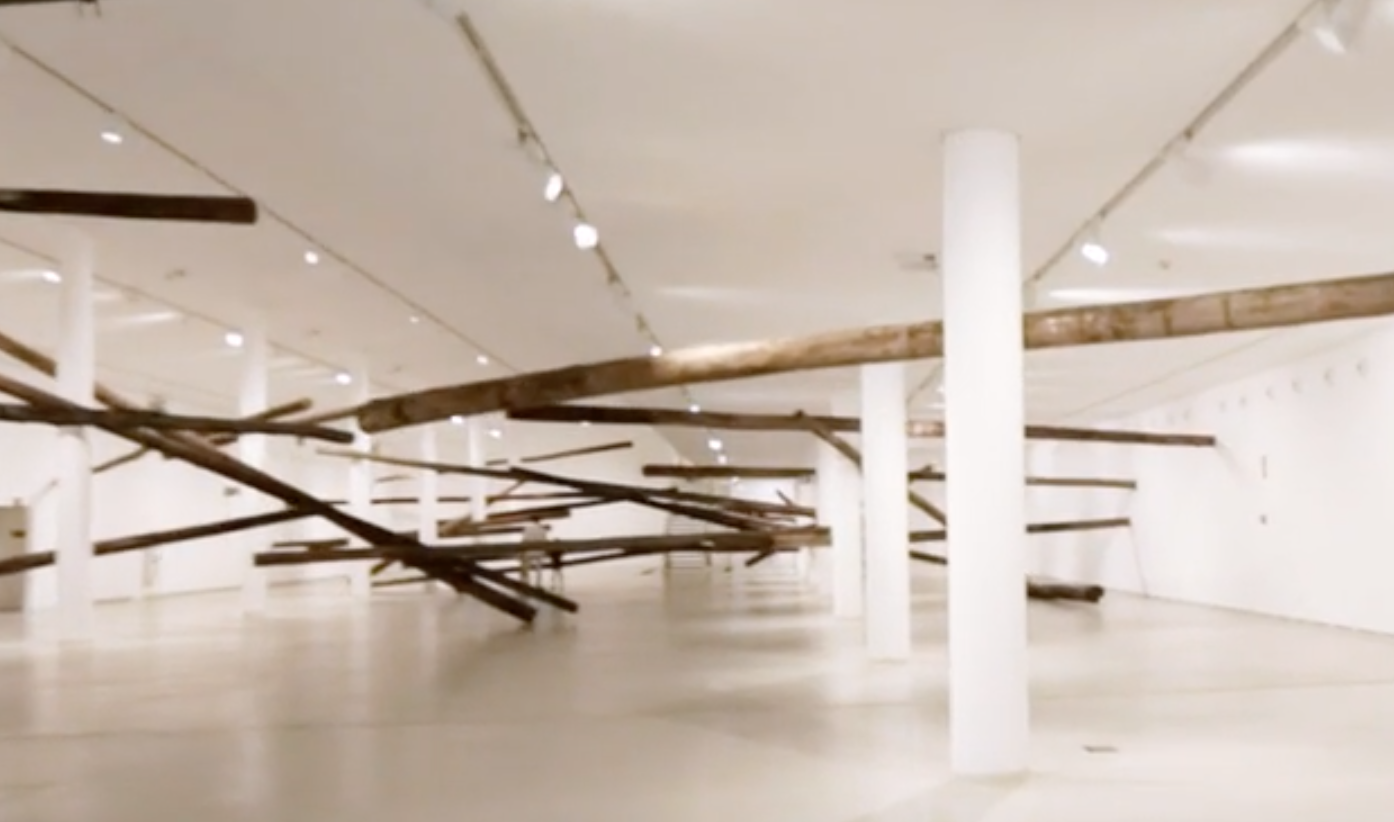
After having seen and reconstructed it in my memory, the exhibition recalls trunks from a felling arranged almost at random on the floor of a forest. There is even a more open stretch in the succession of trunks, as if it were a clearing. In the same way that there is an untransposable moment, in which we have to bow down in order to pass under a trunk and move on. Using Niemeyer’s pillars as a support, the trunks are arranged as if they were beams brought to the architecture of the already existing pillars. They are largely in a position closer to the horizon, albeit an inclined one. On each one of the many pillars a set number of trunks huddle together and are launched into the air and into space. This is not strictly speaking a felling. There are very few trunks which are actually supported on the ground. Only these are heavy. The others are light, they launched themselves into space. They lance the space. And everything happens, to a large extent, at the height of the spectator’s gaze. It is not strictly speaking a felling, since there is no floor. The situation in a forest is not replicated, except for the intertwining of the trunks. Arranged in the air, they are poetic, as one of the most beautiful titles of a book of Brazilian poetry is poetic, if the real felling which does not take place were the work of a rancher. As in the title by Drummond, it remains a work of someone who farms, but, as in the title, the work of a Rancher of the Air [Fazendeiro do Ar]. Lifted, not fallen, and raised for the third time. These used to be trunks of trees, and the physiognomy of each one, with the scratches and lumps of each one, even barks of the tree which each one once was, still retains the aspects of living wood, of its marks, its nodules, its smoothnesses.
Erected for the third time, because, in addition to the natural world, they retain the physiognomy of the posts which they once were. What was vertical in nature, which did not change much, which was torn from nature, still emulates it in the verticality of a post. Pieces of iron for conducting wires are everywhere. These are trunks, but were used as posts. This is a stance which the exhibition disassembles and reassembles in the air in a poetic way. A forest in the air, for each nucleus or bundle of trunks attached to a pillar, the trunks separate from each other, moving as we move. If there are works which illustrate the dialogical and no longer solipsistic relationship of the contemporary spectator with the contemporary artwork, this is definitely one of them. As we move around it, each bundle of trunks leaves the others static, untouched. The relationship between the anaesthetic and the aesthetic in the poetics of Carlito Carvalhosa gives us another key here to understand it. It translates into the relationship of far and near. It is at close hand that everything moves, that the section of a trunk in my face shows itself as if it were a form by Arp. Walking is necessary. Approaching is necessary.
And it is on walking in the space of the mezzanine above the exhibition that on looking sideways and downwards, we perceive how our horizontal shift causes a rise in each of the nearest nuclei of trunks, a half-opening, and the sum of the two movements is a kind of wave, a rising and falling of bundles, as if we were on the sea and not on dry land. Water, its waves, air, its launching into the air, land, the land of the trunks which once were, the elements combine as we move. It would merely remain to set fire to everything, if it were not for the fact that the trembling of the space, as we walk in the outlines of the trunks, establishes itself as something like a flame. And I confess here, that I did not expect to bring up the four elements. I already write in São Paulo and in my office. The encaustic painting by Carlito Carvalhosa is on my left. I throw the light which focuses on my desk towards the ceiling. With this indirect light, I approach the painting, inert and waiting for me. I move closer and everything begins to pulsate. Like the trunks, like the tissue, like something at hand, that we could touch, but which the gaze already touches in this counterpoint of the anaesthetic and aesthetic, of the far and of the near, and which is now a counterpoint of the tactile and of the visual. This air, which my body displaced and which raised the tissue in the gallery, which made me see it, is of a tactile nature. On seeing it, I perceived that through the air I touched it, the air. And I was touched.
A Queda Do Mundo (Sala de Espera)
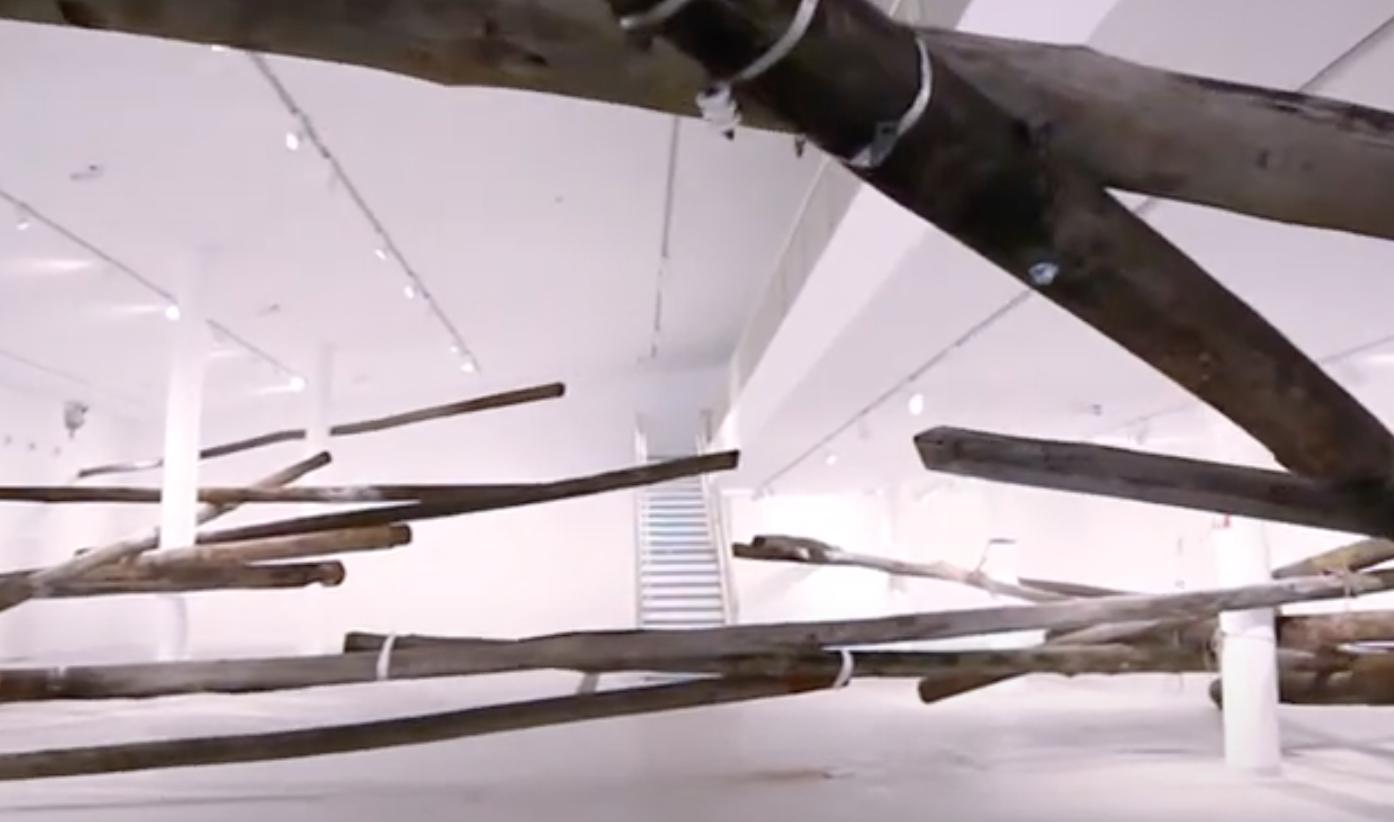
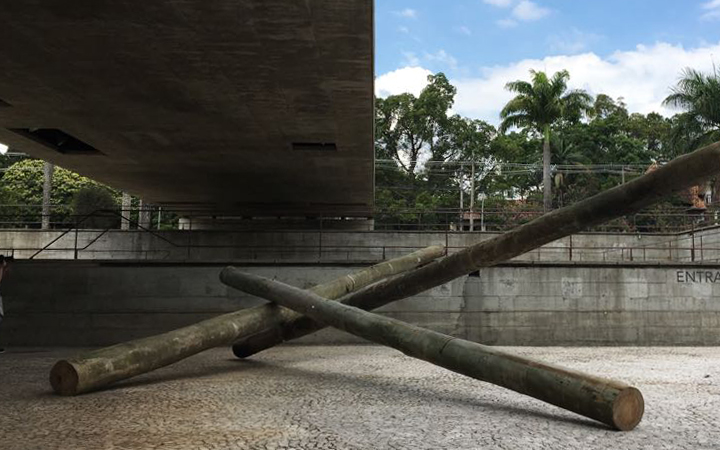
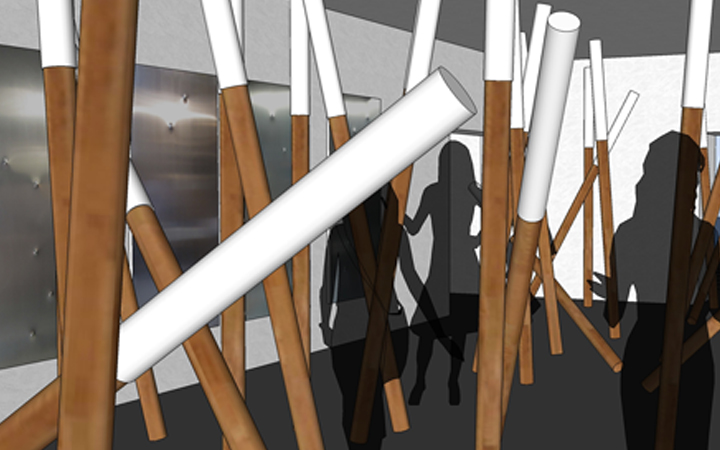
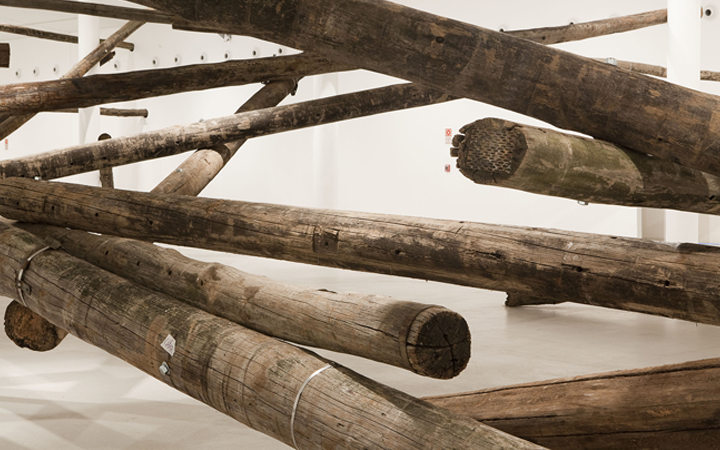
Under Niemeyer’s roof, which slides as a curve between the asymmetric walls of the annex to MAC Ibirapuera’s new headquarters, the posts are suspended from the columns. The first impression is of contrast: between the gentle descent from the ceiling and the abruptly interrupted fall of the trunks; between the rough and fissured logs and the immaculate and smooth whiteness of the walls; between the straight line and the curve, the continuous and the fragmented. In the abstract space of architecture, where even irregularity forms part of the thinking, the posts introduce fragments of real life: the iron plates on top, which defended them from the infiltration of rain; rusted remnants of clips that held the wires; the marks of time in the trunks, the wear and tear on the bases. But there are also exchanges: the posts pierce the walls with rough holes and attach themselves to the almost immaterial columns with conspicuous pins and nuts. They also cling to each other, as if trying to hold each other blindly while they collapse.
The majority of the posts have at least two points of support, on the ground, on columns or on the other posts; but the arrangement was determined on the basis of the spontaneous oscillation of the trunks. The wood does not have a homogeneous weight: these are dead trees, drying from the top down. The sap descends to the foot and petrifies there. Fissures open at the top, where the material is more rarefied. Fixed to a point, they incline on one side until they meet the ground or another post, which in turn determine their inclination.
Everything falls, not only in relation to external space but also internally. Scientists state that some solid bodies (e.g. glass) are actually very high density liquids, which flow with continuous motion, but remarkably slowly. Some of them would take longer than the age of the universe for their movement to become perceptible . Perhaps all materials are like this, liquids which flow downwards very, very slowly. With sufficient time, the world would ultimately be reduced to a small extremely dense and hard spherical drop.
Carlito Carvalhosa’s first three-dimensional works of the mid-1990s were hollow cylinders of wax which he left to wilt while they hardened, so as to generate unassertive, staggering, half-melted forms. At times, in order to ensure that the sculpture did not entirely fall apart, Carlito had to hold them with his arms, embracing the wax cylinder until it cooled sufficiently. In a catalogue for a 1995 exhibition at the Banco do Brasil Cultural Centre in Rio de Janeiro, there is such a picture of the artist, intertwined with the sculpture in an uncomfortable position, as if he were transmitting the upright condition of the human body to the wax, while at the same time receiving its softness and tendency to wilt. Indeed, many of Carlito Carvalhosa’s works suggest a possible fall. On some occasions, they are on the point of collapsing; on others, they give the impression that left to their own devices, they would continue flowing downwards forever. The work of the artist is thus to halt this fall. The question is when and how.
Falling, crumbling, collapsing are direct intransitive verbs: they belong to the realm of necessity. Building oneself up, raising oneself are reflexive acts of will. In order to achieve this, they demand that the I splits into a soul which orders and a body which obeys (counterevidence: when voluntary, downward movements also require a reflexive pronoun: to throw oneself, to precipitate oneself). The seventy posts at MAC Ibirapuera certainly do fall, but they may also be erecting themselves, as the artist himself has suggested in interviews. Indeed, we may imagine them in an upward movement, even if it demands some effort. The choice is ours, but the fact is that we do not know. In terms of perception, the work is perplexing: we cannot immediately determine whether things have stopped moving or whether it is our vision that has choked, like a slide stuck in a projector. Evidently, what we are seeing is just a moment extracted from a continuous motion, which sooner or later will be resumed.
In this way, the meaning of the work is not determined so much by a voluntary and decisive act, which opposes the passivity of materials, as the feeling that it is just a temporary gesture, after which nature should resume its course. And yet, paradoxically, this gesture becomes eternal, things are locked in an uncomfortable position for an indefinite time, which perhaps corresponds to the time of our presence, as in that child’s game in which players, when looked at, must remain immobile. The hope to which the title alludes seems to be theirs, not ours.
The paradox of the immobility of the transient is certainly not specific just to Carvalhosa’s work, but to all art, if not to every form. Every formalization is an act of haughtiness, and it is natural for it to disintegrate. In Carvalhosa’s works, the question seems to acquire a more intense restlessness, which makes it central. There are not many works by other artists in which it becomes as obvious that to formalize is to staunch a material which is seeping, to establish a horizontal cut in a descent which is slow, but which cannot be stopped forever. Carlito Carvalhosa’s work speaks of the uncomfortable coexistence of time and eternity.
The predominant materials used in the 1990s are already significant: wax, plaster, glass, a slippery white porcelain, literally bathed in light, grease trapped by glass, which prevents it from sliding. All are fluids which acquire form by solidifying, or which are kept “in shape” by external agents. Plasters, particularly prevalent at the end of that decade, demonstrate their liquid origin in the tameness of their surface, which is sensitive to the slightest crease in the mold. But they are then segmented by straight line cuts, and the segments are superimposed in skewed fashion, so that a part of the base of the blocks remains in balance. The elegance which could characterize each block of plaster, almost a classic drapery, is denied by this game of skewed cuts and superpositions. With a lightness of surfaces and weight of the volumes, solid and liquid coexist in the same body. What is most important to the argument which I am attempting to develop here is the precariousness of the supports, the eagerness with which, behind their quiet appearance, the upper blocks strive to reach the floor.
Moreover, the fact that this is a central issue for Carlito is evident in a slightly later work Favor não tocar [Please do not touch] (São Paulo, Centro Maria Antonia, 2004). In this, the gypsum block no longer rests on other blocks, but is stuck halfway up the pillars of the room. As far as I can recall, this is the first work in which the artist, an architect by training, deals with the structure of the architectural space. Indeed, the room, in a very old and heavily renovated building, is characterized by an excessive number of pillars relative to the area, arranged in disorderly fashion. On the other hand, a work of these dimensions would be too heavy for the structure of the building if supported directly on the floor. Placed in this way, as if it had become stuck as it fell, the block appeared to exercise (as it indeed exercised) a constant downward pressure, even more on account of its soft and almost gelatinous appearance: on this occasion there was no horizontal straight cut.
The relationship with the pillars evidently makes Favor não tocar a close relative of Sala de espera. In both cases, the pillars or columns establish a verticality which is abstract, since it is not directed. These open the rhythm within which the story runs, but they are not the story, but at most its frame. The story is everything which walks, stumbles, falls or rises between them. At the same time, when ideal space and real movement enter into contact, they contaminate each other. The columns are involved in the movement of plaster and the wood, but this is a paralyzed movement, suspended on the timelessness of the columns.
There is a painting by Raphael, the Deposition, which comes to my mind when I think of these installations. In it, Christ’s body is heavy matter loaded into a white sheet which, in its grave curve, recalls the plaster of Favor não tocar. Two figures support it: one, with a very human expression and movement twisted by the effort, attempts to go backwards up a stone step; the other, who is young and with firm legs, is the only one whose hair is ruffled and whose clothes are raised by a breeze, imperceptible to the others. This figure is customarily thought to be an angel. Surrounded by this breeze, which is his alone, he takes part in the story but at the same time, belongs to another place. Becoming human, the angel makes the whole scene divine, ensuring that the entire picture remains in balance between the ideal and the real. The columns of the MAC and the pillars of Maria Antonia take part in the work, but belong to another time. (Raphael’s picture is a work of his youth: the relationship between the two worlds still has something unresolved. At a later date, in the apartments of Julius II, the artist would learn how to make the transition without fissures, but it is the fissure which is of interest here).
New poems continue to be made from fragments of ancient verses.
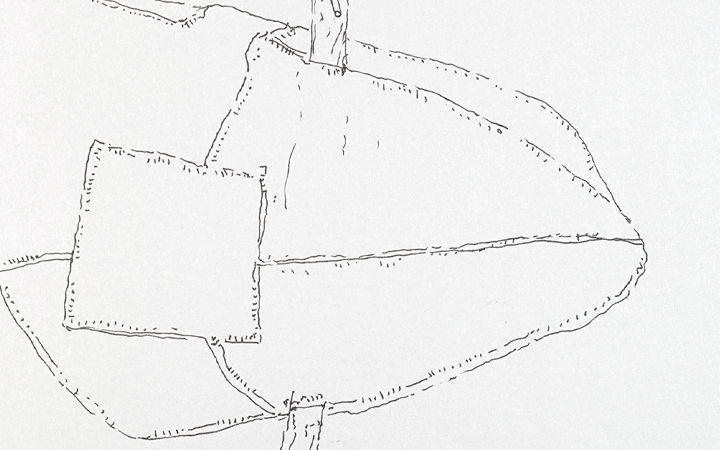
Suspension is the compromise between immobility and falling. From a certain point of view, it is only the starting point of the fall. From another, it takes on the task of carrying a body which has already fallen. In Já estava assim quando cheguei [It was already like that when I arrived] (MAM/RJ, 2006), a copy in plaster of Sugarloaf Mountain is hung upside down by wooden boards and cargo slings. In this case, the relationship with the architecture is complex: suspending itself from the rafters of the roof, the installation follows the structure of the building, which is entirely suspended from the same beams; it reproduces, in inverted form, a fragment of the landscape perceived through the windows as if these were a huge optical chamber; in its materials, it articulates the subtle interplay of the materials of which the room is made: concrete on the floor, exposed concrete on the walls, plaster on the ceiling and on the walls of the mezzanine. Perhaps it was the relationship between the plaster and concrete, with its visible marks of planks, which suggested the contrast to Carlito between the great white mass, similar to a thick drop which has just fallen away from the ceiling, and the wood which sustains it. But it is a fact that the sustaining structure is visible here for the first time and that the wood appears, if I’m not mistaken, for the first time, as an important element in the artist’s work.
Wood is an ambiguous material. While it is growing, it is a living thing. When it dies, it does not disappear: it becomes gross matter, like a stone. While alive, it has a sense of position and direction: its roots are sunk and its branches rise, without ever erring: it is impossible to plant a seed upside down. When dead, it maintains variable density and weight, but as if insane and directionless, as is the case of the posts in Sala de espera. Installations by Carlito Carvalhosa subsequent to Já estava assim quando cheguei play with the two aspects: posts suspended between living trees in the garden of the Museu da Casa Brasileira [Museum of the Brazilian house] (Você tem razão [You’re right], São Paulo, 2009); poles cluttering the halls of the Palácio da Aclamação in Salvador, but also living trees suspended in the entrance hall, feeding on the earth stuck to the roots through a jute bag (Roteiro para visitação [Visiting Schedule], 2010).
Wood, like the fabric, is fibrous and not homogeneous like gypsum and wax. Carlito Carvalhosa’s works with fabrics (starting from Apagador [Eraser], Salvador, Museum of Modern Art of Bahia, 2008) are contemporary, or even slightly earlier than those centered on the use of wood. Unlike the dead wood, in the fabric, the fibers are mutually supportive and constitute a weft. On descending, the cloths exhibit a self-control which transforms falling into fitting.
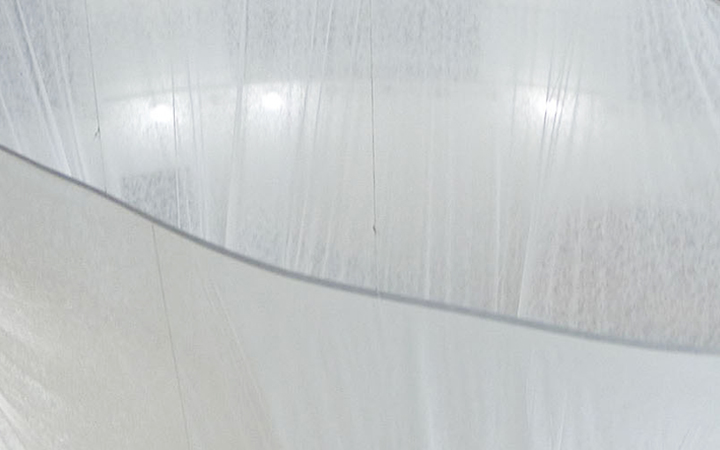
The cloth also insulates and is a curtain. It replaces the abstract space with another one, which is even more abstract, because even the hard consistency of the walls is abolished. It is a space made of breath and light. In order to ensure that there is nothing natural about the light, Carlito places fluorescent lamps behind the veils (Faz parte [It happens], São Paulo, Galeria Millan and Gabinete de Arte Raquel Arnaud, 2008; A soma dos dias [Sum of days], São Paulo, Pinacoteca do Estado, 2010; Sum of Days, MoMA, 2011, and others). The cloths are nevertheless fixed above and loose below: they also fall, even if they belong more to the air than to the earth.
Even when the lamps are not shrouded by curtains (e.g. in Melhor Assim [Better like that], São Paulo, cultural SOSO + Space, 2010), they do not illuminate the space, but abolish it. They transform spatial measures into time, into rhythmic scansions. Unlike what happens in the sculptures of Dan Flavin, they are not objectified light, but energy which fights against gravity, they blot out the walls and rise from the floor, like the installation at the Eva Klabin Foundation (Regra de Dois [Rule of Two], Rio de Janeiro, 2011), when a part of the house was flooded with light and the furniture was raised and supported on glass cups. The glass transmitted the light, but also denounced the fragility of that levitation, an alien abduction of the bourgeois, refined and pompous room. When they return to the ground, the items of furniture will not remember anything.
In modern art, the king of levitation was Calder. In Calder’s mobiles, the utopia of including movement in form, not by mechanical procedures, but by a kind of perfection of its nature, reaches its peak. Bodies explore their own weight in order to cease having weight and gravity is transformed into a system of equivalences in which everything, even if it changes position, remains where it is. There is no such illusion in Sala de espera. Weight and shape are irreconcilable poles between which we exist and only by recognizing the distance between the two of them can wait become significant and form expressive. To the pragmatic optimism of the American, Carlito Carvalhosa counterposes a certain Portuguese melancholy. Only the direction has changed: from the horizon, beyond which, for many centuries, there was nothing, to the center, which is also the end, of the earth, of this material which continues to flow and which the artist merely limits himself to holding for a while.
The reflection introduces a moment of immobility in the continuous motion. The interruption of the flow brings together spectators and things, with the same attitude of surprise. While Carlito Carvalhosa’s installations are sometimes seductive, unlike many recent installations, they do not exhibit any suggestion of playfulness. They are not an interaction but a pause. It is during this wait that the noise of the world, like a buzzing, can be heard, softly.
1I withdraw this information from Liliane Benetti’s doctoral thesis, Angles of a Slow Walk: Exercises of Containment, Reiteration, and Saturation in the Work of Bruce Nauman (São Paulo, ECA/USP, 2013), which in turn refers to Wallace V. Masuko, Henri Robert Marcel Duchamp: Erre (Master’s thesis, São Paulo, ECA/USP. 2012).
Sala de Espera
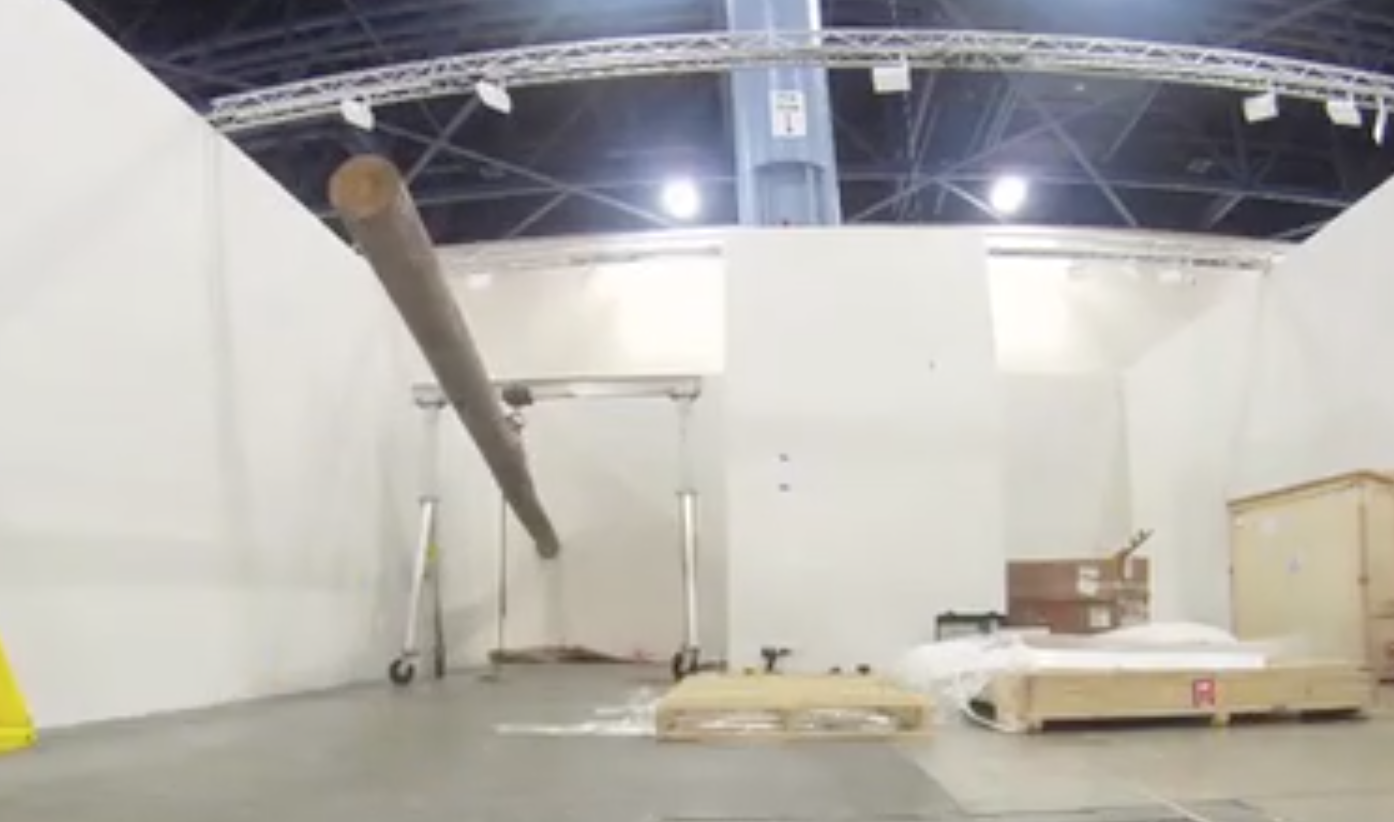
The work “Sala de Espera” [Waiting room] by Carlito Carvalhosa inaugurates the annex to the Museum of Contemporary Art of São Paulo (MAC-USP), in Ibirapuera Park in March 2013. The installation carries on a dialogue with various works of an institutional character, developed over several years by the artist, with developments shown in locations such as Salvador, Havana, New York, São Paulo and Rio de Janeiro, in which it offered the observer sensorial immersions of great delicacy and impact.
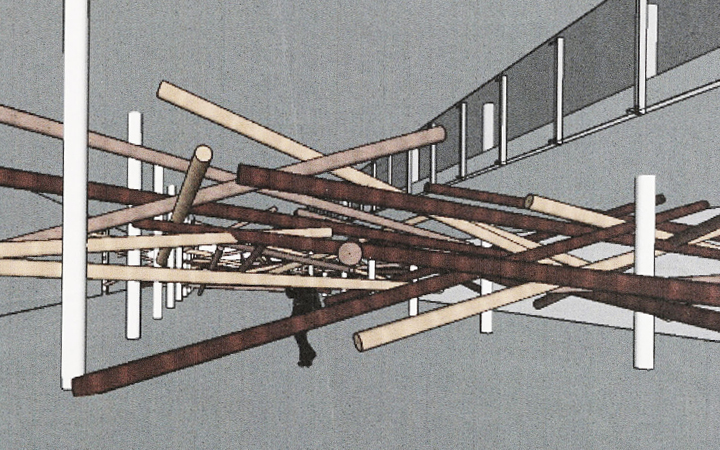
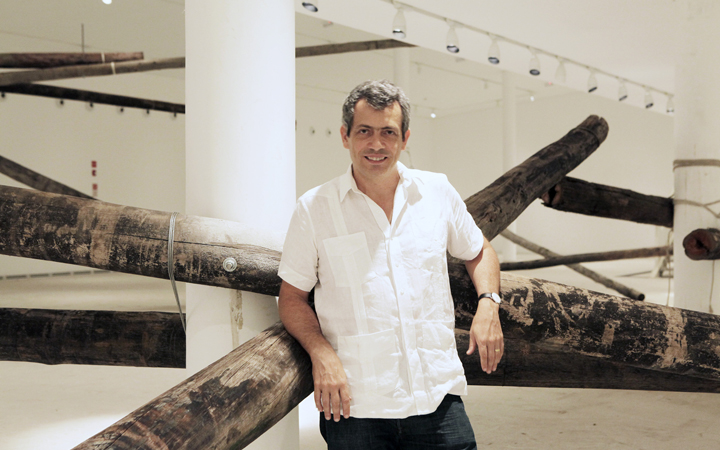
In “Sala de Espera”, the artist engages in subtle fashion with the broad, empty and pristine space designed in 1950 by Oscar Niemeyer, through a single, powerful material: wood. Around the clear successions of white columns, which support and lend a geometric precision to the space, he distributed some 80 posts, 9 to 12 m in length, which once served to hold up street lighting. This is not a rule-bound methodical composition. Its appearance instead refers to the organic, undisciplined character of forests, or to the tenuous equilibrium of matchsticks thrown casually in the children’s game of jackstraws. The whole creates a strange, provocative landscape, constructed in the horizontal plane. In the artist’s words, it is almost like a “supine forest”.
But similarities with the game stop there. The challenge proposed is not one of balance or of withdrawing a jackstraw without moving the others but of provoking observers, making them discover how a tangle of concrete and visual obstacles may cause a significant shift in our perception of the world. As the critic Fernando Cocchiarale summarizes, with these works, Carlito Carvalhosa does not intend “to encourage a slow observation of the possible aesthetic properties of the work, but to allow it to be grasped sensibly, with silent inflections”.1
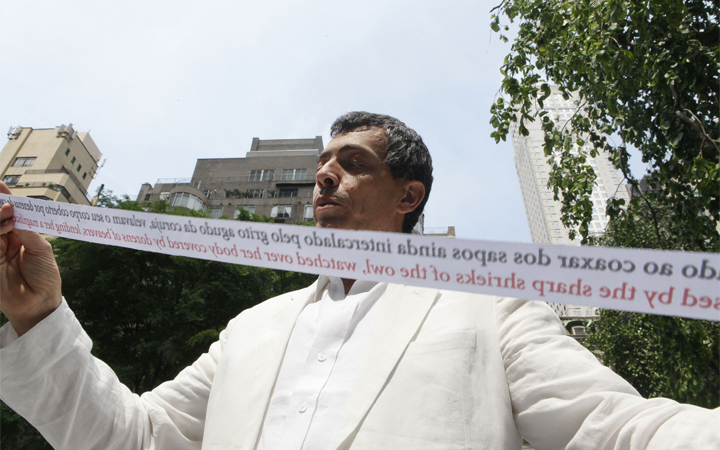
Since the start of his career, Carvalhosa has shown an interest in banal and neutral materials which often pass unnoticed and which appear to have emerged without any great effort or skill. This, for example, is the case of plaster, with which he constructed various sculptures and installations, such as the representation of Sugarloaf Mountain, with its top cut off and inverted, shown at the Museum of Modern Art of Rio de Janeiro (MAM-RJ) (Já estava assim quando cheguei [It was already like that when I arrived], 2006), which also carries a reference to the fact that the artist, originally from São Paulo, has been based in Rio for a decade or so. Or translucent fabrics explored in interventions, as was the case at MoMA (Sum of Days, 2011) and the 11th Havana Bienal (Vulgo, 2012). The whiteness, the veiled character and ambiguous nature of these materials form a vital part of the strategy of veiling/unveiling of what is hidden and imperceptible, since it has become naturalized in the institutional spaces activated by the works.
In the same way, the old posts punctuate and provide a reference for the scene. These had already emerged in his work in a reduced form in an intervention realized in 2010, at the Palácio da Aclamação in Salvador, Bahia, suspended beside a large live aroeira tree in the central span of the neoclassical palace. Apparently, there is little in common between this intervention and the one in the annex designed by Niemeyer as a complement to the building now occupied by the MAC and which for decades was the headquarters of the São Paulo Traffic Department (Detran). Both nevertheless arrived at relatively similar results, albeit via opposing paths: they gain the attention of the observer, they underline less visible aspects of these locations and create an intriguing confusion of time and space. “It is curious that both the Italian palace in Salvador and this modernist hall point to something which isn’t there”, the artist points out. “In 1900, they sought a past, in 1950, a future”, he notes ironically, highlighting the natural vocations of these places, which are subverted by his interventions.
In the case of the annex to the MAC, which shall henceforth become an important experimental space for contemporary art, the situation is even more peculiar. At the same time that it has a completely typical configuration of modernist architecture from the mid-20th century, “the first time that I saw the space it seemed to me an ideal world, with its multiplying columns”, the artist recounts, it still has no reference as a museum space. As the title of the exhibition states, it is “pending”. Its vastness, the ideal character of its columns, the immaculate purity of the whiteness point to something which has not yet occurred. For this reason, instead of watching over what had become imperceptible due to the effect of time, it has brought the history deposited in the posts into this still sterile space.
In the face of a place which resembles a blank sheet of paper, Carvalhosa acts as draughtsman, with great simplicity, establishing a dialogue which is both impertinent and seductive at the same time. Impertinent because it cuts, denatures the rule of the vertical columns, disorganises and restructures them in a chaotic interplay of trunks which still bear the mark of time, and carry a long trajectory, embedded in their color and texture, from tree to post, from post to waste wood… also because they deliberately disrespect the margins of the “paper”, refusing to be contained by its limits, pouring out of the frame of the internal walls, insofar as is permitted, since the Ibirapuera complex is a listed architectural property. It is seductive because the gaze, and the body, feel themselves attracted to exploring the multiple configurations of this drawing constructed in space.
São Paulo, March 2013
Lugar Comum
Ingles Pragráfo um Lorem ipsuim sit ammet Pragráfo um Lorem ipsuim sit ammet Pragráfo um Lorem ipsuim sit ammet Pragráfo um Lorem ipsuim sit ammet Pragráfo um Lorem ipsuim sit ammet Pragráfo um Lorem ipsuim sit ammet
Ingles Parágrafo dois Lorem Ipsum Parágrafo dois Lorem IpsumParágrafo dois Lorem IpsumParágrafo dois Lorem IpsumParágrafo dois Lorem IpsumParágrafo dois Lorem IpsumParágrafo dois Lorem IpsumParágrafo dois Lorem IpsumParágrafo dois Lorem IpsumParágrafo dois Lorem IpsumParágrafo dois Lorem Ipsum
Ingles Parágrafro 3 lra lra ral Parágrafro 3 lra lra ral Parágrafro 3 lra lra ral Parágrafro 3 lra lra ral Parágrafro 3 lra lra ral Parágrafro 3 lra lra ral Parágrafro 3 lra lra ral Parágrafro 3 lra lra ral Parágrafro 3 lra lra ral Parágrafro 3 lra lra ral Parágrafro 3 lra lra ral Parágrafro 3 lra lra ral
Para estar onde nunca estivemos
I.
“What do you play the flute for, Olympos? Why music in solitude? There is no shepherd nor goatherd to hear it, nor is there a Nymph in his absence that would happily dance to the rhythm of your music.“
So Philostratus swore to the adolescent whose beauty goes beyond the passion of the satyrs, while sleeping, and his sweat mixed with the smell of grass on which his body rested.
Why the harmony of breath that diminishes the sounds of the song, while the young Olympos, as a Narcissus facing the mirror of water, blows? Why the image turned into skin, stuck to grooved trails? Why music in abandonment, dormancy, death?
Like a premonition by Narcissus, with whom images are born in order to be extinguished immediately
in their primordial instant, painting 21 of the icons of Philostratus describes a licentious and silent scene of holocaust: Olympos will be raised up, magnificent and naked, on the grasslands of desire and will majestically and indolently play his flute on the banks of a pristine lake, in order to just blow the unexpected canto of the song on the skin of the water and also see his own image shake, which others desire, and deform in the wrinkled surface that his breath moves and destroys.
A few lines before the true Narcissus, Olympos foreshadows, and has already seen the beauty of the image come undone in the folds that deform it, while its contours are shipwrecked on the draping of its liquid and exasperating density.
II.
Only the ignorant arrogance of the present has been able to sell us the idea of modernity as a scene in which, for the first time, the image dies.
Only the epidermal certainty of the present, which because of it would discover the world every time, can make us forget that the appearance of the image will always be declined upon its expiration; the emergence of art with its agony; the drive to erect the monument with the ephemeral duration of the experience that it celebrates or exorcises; the gaze of what we want to reach with the distance its image imposes upon us.
In order to name this distant object, eventually, the ancients conceived the maze of drapery, because the body is too visible, and what it breathes into desire and into life is camouflaged in its edges and sweating. What it breathes into: breath, the soul that has no form and has, maybe, every form. Then the obsessive dispersion of outer membranes that cover—let us think about fragments of Hellenistic sculpture, silent robes—canvas and drapery, clothing, vestments, linens, blankets, coats, transparent waves of silk in the wind served as an alphabet to say, with every movement, a truth, and with every gesture a revelation.
III.
Ever since I have thought about the work of Carlito Carvalhosa—white liquescences that wave by chance, painted mirrors where instead of Olympos’ face we see the wave of his breath turned into a stone of colors, written word in the solitude of an invisible whip; Sugarloaf Mountain inverted in the mausoleum of the museum; an uprooted tree in the sky of the great halls of convivium and pageantry—I think only of shrouds that multiply their folds facing the breath of the footsteps, the noise, the solitude, the music, the immense coverings in order protect the architecture from our habitual animal customs.
What, then, is music for in abandonment; why the image in the flesh wound of the waters? Why erect the glorious adolescent with his flute? Why hide the sublime Nymph behind its cloths?
If we are only left with the image’s agony, if there is no art of the monument or of the body as representation; if the image is multiplied in the vanity of its pornographic exchanges—not just in pornography, which still retains an ability of impulsive and momentary convocation, but in its sophistic aesthetic market—what do these white curtains tell us, these trees suspended from their roots, these murky mirrors?
That it is a space, any space, like a body that we inhabit; that in the severity of its durable inscription on the world is hidden the elusive multiplicity of the air that embodies it, and the hermetic numeral of its silence and echoes, that we did not hear when we saw, that only an epidermis that entirely covers can, as in those nymphs, as in that boy, herder of good goats, as in that flying Zephyr, decipher.
Why music in solitude? Why the sails with hoisted masts? To go through them, a niche of our body before it was there. To be where we have never been.
Procure saber
Published in Concinnitas magazine, december 2011
“Transforming the absence of light of the Casa Eva Klabin into the principal issue”1 of Regra de dois [Rule of two], an installation realized in April 2011 in Rio de Janeiro, was the objective of the artist from São Paulo, Carlito Carvalhosa.
Living at night and sleeping during the day is one of the characteristics which feeds the particular biography of the collector, Eva Klabin, and in the house in which she lived on the Lagoa [Lagoon] in Rio de Janeiro, the windows are still shut like iron curtains, closed to reality. This is a “suspended space”, “outside time” and outside Doctors’ curation largely rests on this narrative and constitutes the operational fact for artists selected to stage interventions here since 2004: an exercise in confrontation between the works and the world of Eva Klabin, which is surprisingly persistent in the curatorial circuit in Rio, with participants including José Damasceno (2004), Chelpa Ferro (2005), Paulo Vivacqua (2006), Anna Bella Geiger (2006), Rui Chafes (2007) and Cláudia Bakker (2007).
I shall briefly deal with the role of space in the work of Carvalhosa and in the practice of curatorship, before moving on to the subjectivity which the artist produced in Regra de dois. Finally I shall consider the extent to which the curatorial narrative takes part in the activation of this subjectivity.
Already in the first paintings which he exhibited at the end of the 1980s 2, but principally starting from the intervention with blocks of asphalt in an abandoned area of the West Zone of São Paulo,3 we perceived that Carlito Carvalhosa is interested in the relationship between space and the act of construction. Mobilized by the artist, construction is a process of reordering the world in front of us, it is the sustaining of chaos and hence an activity of differentiation in the face of nature. Initially through asphalt blocks and later through plaster (e.g. Gibraltar, 2000, CAPC Bordeaux, France), through porcelain sculptures (e.g. Carlito Carvalhosa, Gabinete de Arte Raquel Arnaud, 1997), through mirrors (e.g. Melhor assim [Better like that], Soso +, São Paulo, 2010) or through sound (e.g. Sum of days, Pinacoteca do Estado de São Paulo), etc., a conception of sculpture4 as construction, as a gesture of adding to and subtracting from the void runs through his work. American post-minimalism is hence fertile ground for observing the work of Carlito Carvalhosa, specifically in the “erotic or emotive alternative” to minimalism, as noted by the critic of the movement, Lucy Lippard. It is thus possible to discern the line leading to the postmodern exercise which, from the 1970s onwards, shuffles minimalist and post-minimalist lessons and expands the object of sculpture to the reality around it, appropriating an ever greater diversity of scales, meanings and materials. Consequently, it includes the memory and subjectivity of the spectator in the experiencing of the works.
Although we can have an experience with certain works of Carvalhosa similar to what Richard Serra mentioned when he referred to Judd’s objects − “Judd’s work is to be looked at, first and foremost”, there is a diversion by someone who thinks of a place in two ways, as a phenomenological and a retinal fact. Perhaps there is an equation in play between physical aspects, such as size, scale, light, temperature, architecture, etc. and individual or collective aspects of the experience and memory of the observer. In this sense, the block of asphalt in an abandoned area of São Paulo or the set of trees suspended in the main span of the Palácio da Aclamação, in Salvador, Bahia,5 are demonstrations of this permanent dynamic between the gaze and the imagination, relating to expectation and elaboration.
For this very reason, the use of space in Carvalhosa’s installations is ambiguous, vacillating permanently between contemplation and experience, between distance and approximation, between optic and haptic. The defining coordinates of a place are constantly permuted into a continuous fair play, as if the idealism of modern sculpture and the expanded field of sculpture, the peaceful coexistence between the observer/work paradigm and the observer/work/place paradigm could cohabit simultaneously.
Regra de dois, the installation at the Casa-Museu Klabin, takes up various issues which the work of Carlito Carvalhosa has been presenting for some time.
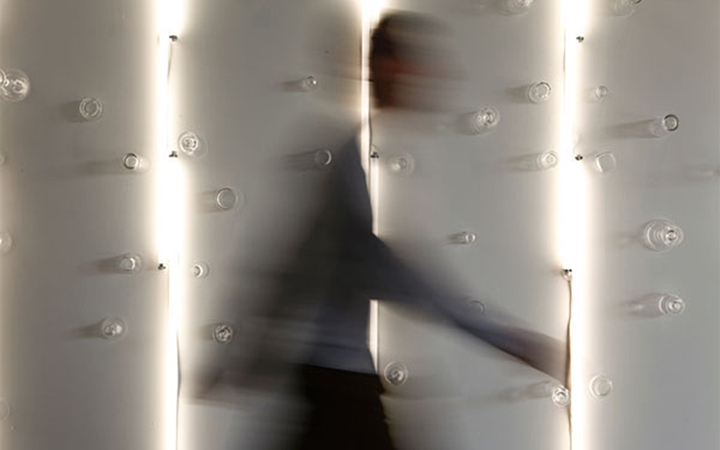
In short, this is an installation of ordinary materials, cups, glass, neon, trees, which establishes a route through the two floors of the house, moving through the common and private spaces. The walk relates to the intervals of these places and makes the experience happen simultaneously. It is a measure of time which is already found in other works, such as Apagador [Candle snuffer] (Chapel of Nossa Senhora da Conceição, Solar do Unhão, 2007), Faz parte [It’s part of it] (Galeria Millan, 2008), or A soma dos dias [Sum of days] (Pinacoteca do Estado de São Paulo, 2010), in which the observer is led to coordinate the evolution of the body in its time, with this appearing to constitute a pretext for Carlito’s interventions to be something more than simple objects arranged in space, more than “mere” heirs of sculpture.
The interplay between the light (as well as its fictional uses) and the collection of Eva Klabin’s artistic and decorative objects will constitute the new place which Carvalhosa conceives, establishing a certain method for questioning the effects which he intends to create. We can suggest that his installation unfolds into four specific ideas: levitation, surface, prohibition and dreams, which observers will experience during their journey through the house.
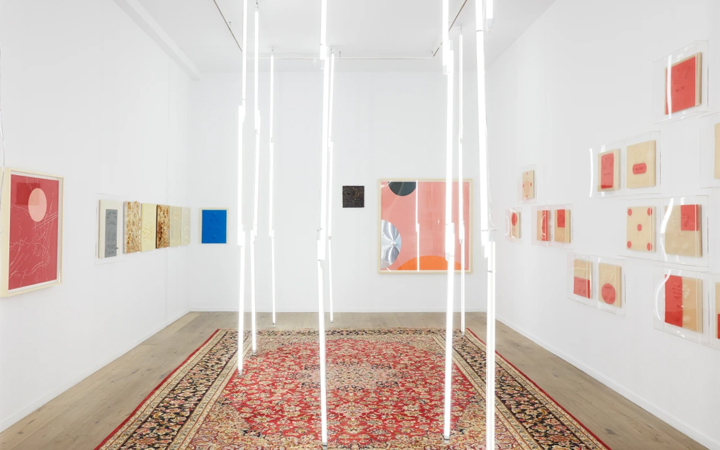
The first space that we enter is the Sala Renascença [Renaissance Room], where Regra de dois becomes more expressive. Carvalhosa has arranged the entire furniture of this room on glass cups of various dimensions and forms. The room ‘levitates’ a few centimeters above the ground and the floor is an immense white neon light6 on which we step. A pure blow, a pure visual wound which blinds us. Here, as in the rest of the house, we are surrounded by objects from the collection, from various periods and of different origins.
Although the question of collecting is one of the premises of this curatorship and may indeed have challenged the artist, what “appears” to us in the installation (equally important in Carvalhosa’s work) is what Coleridge calls a willing suspension of disbelief. Objects which we know to belong to reality have suddenly dissolved their habitual properties and are transmuted. A ditch of imponderables is dug between us and them, which threatens familiar logics. In order to produce this effect, Carvalhosa has arranged his objects in an order absolutely symmetrical to the one in which the collector Eva Klabin has arranged hers, causing unforeseen confrontations between the light of the trivial glasses and, for example, a painting by Tintoretto. “A symmetrical order unifies glass cups and the objects existing in the room. Distinct cups in symmetrical positions become equal through their function and not their appearance. Order is an element of suspension from one thing to another: the place waiting for and dissolving the objects.”7
Poor materials which become rich and profane, which become sacred, in a paradoxical process, the forms of which systematically reject pre-established cultural meanings. As the critic Rodrigo Naves observes, there is an “absolute lack of empathy” which allows the coexistence in his works of “plastic qualities which should not coexist with each other and because they are grouped together in this way, endanger our perception, since it is practically impossible to accommodate them in the same object”.8 Like the artist’s great amorphous (blind) masses of plaster with which we are familiar, the coexistence of the glass of the cups with the furniture of the room generates a “lack of empathy” between force and lightness and, I would add, simultaneously manipulates and neutralizes.
The second moment happens in the space opposite the Sala Inglesa [English Room], with the artist covering its principal wall with the neon light mentioned above, with an increasing gain for our perception. Light functions as a ‘surface’, but also as black matter which swallows everything around it, dissolving the layers of history and the knot of temporalities which dwells there. The wall becomes averse to any logic of exhibition and subverts the idea of a directed gaze, the museological ‘offering of something to be seen’ which is inherent to any presentation of objects.
Also on the ground floor, between the dining room and the Sala Chinesa [Chinese Room], Carvalhosa has erected a ‘barrier’ of light which prevents the passage between the two spaces. A physical barrier which we cannot cross but which allows us to see beyond it, like in certain suspended neon installations by Dan Flavin, which appear to us to be places without space, due to the excessive light.
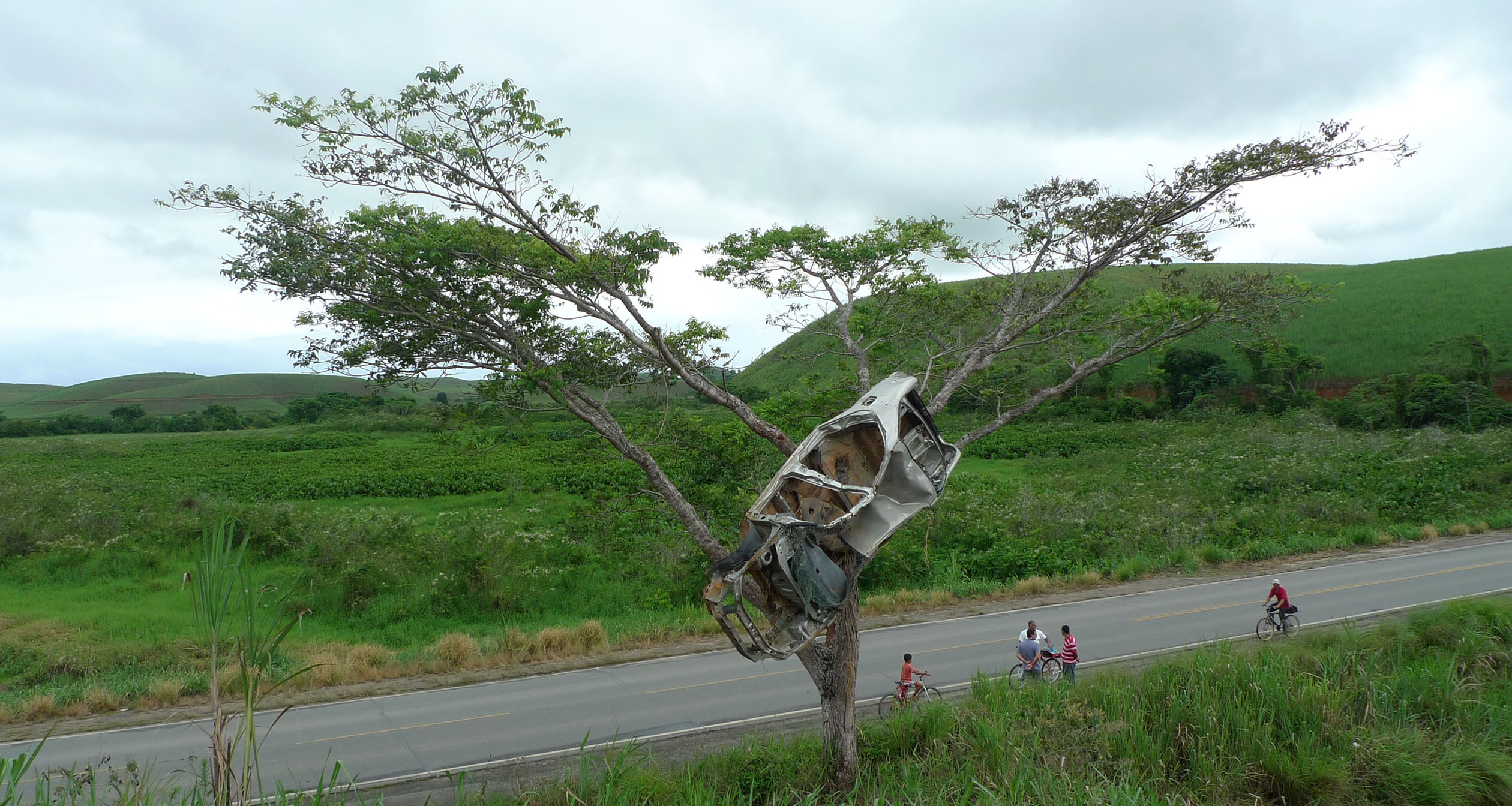
On the upper floor and ending the route, Carvalhosa resolves the installation in a direction which goes from the materiality of the objects to the production of an ‘open’ image that is almost cinematographic. The light is low, somber, almost dark. Before us, four trees are suspended in Eva Klabin’s bathroom. Eloquent, but nothing more. The effect is disconcerting, but its meaning is easily delineated, not because there is nothing to say, but perhaps because in this case, language is not a priority. The work causes a kind of recoiling in us (epoché) which opens the way to a non-verbal state, in an experience very similar to the one that Carvalhosa wished to offer on the Maragoji Road (Maceió-Recife), when he recorded something impossible such as a car under a tree. “Imagining that this is art, in this case, pacifies our understanding. What can that be?”,9 he asks.
To what degree does Regra de dois respond to the curatorship? Perhaps, in the case of Carvalhosa’s installation, Klabin’s narrative has served as a pretext, but not as a premise.
There is a dialogue which we can glimpse with Doctors’ curatorial narrative and which is linked to Eva Klabin’s singular history, but I think that the subjectivity of Carlito Carvalhosa’s proposal is intensified by the continuity of his works. A priori, his entire oeuvre contains the idea that space (any space) is open to an interplay of superdeterminations in which the artist and the observer manipulate memory, perceptions and temporalities; or the idea that aesthetic experience does not speak, is aphasic, but nevertheless gives the floor to language. Questions such as temporality, space or the status of objects are already present in Carvalhosa’s work in a form which is more radical than the narrative of the curatorship.
But if the point of departure is Márcio Doctors’ work, and this is already his 13th choice, we see that the mark of authorship which he gave to the Projeto Respiração [Breathing Project] is reinforced with a consistent line of research based on Benjamin’s notion of historical past, present and future ‘becoming’.
Returning to curatorship, this essential noise which allows us to experience other narratives that give meaning to the creative impulse, it often takes on a belief in the specificity of space and in the adjustment between the place and the work (or between the place and the artist). Curators will inevitably take risks when they choose artists instead of projects, since results may evade expectations. Carlito Carvalhosa affirms that “the idea of making a thing especially for a place does not exist. Things always get out of place”. The place for the artist and the place for the curator are not one and the same.
Rio de Janeiro,2011
1 O Globo, 25.4.2011. Second Section
2 Subdistrito Comercial de Arte, São Paulo.
3 Carvalhosa’s intervention took place in the abandoned Matarazzo factory in Água Branca, in the West Zone of São Paulo. Artecidade – a cidade e as suas histórias [Cityart – the city and its histories], curated by Nelson Brissac Peixoto, 1997.
4 Although references to architecture and to contemporary architects arise in critical texts, e.g. Espelhos graxos [Greasy mirrors], by Paulo Venancio Filho, on the exhibition Carlito Carvalhosa, at the Gabinete de Arte Raquel Arnaud, São Paulo, 2002.
5 Roteiro para visitação, Programa Ocupas, Curator: Daniel Rangel, Palácio da Aclamação, Salvador, Bahia, 2010.
6 This particular understanding of the light was attempted at the Soso + Gallery, in Melhor assim, São Paulo, 2010.
7 E-mails exchanged with Carlito Carvalhosa.
8 Naves, Rodrigo, Óleo sobre água [Oil on water], in Carlito Carvalhosa, São Paulo: Pubs. Cosac&Naify, 2000.
9 E-mails exchanged with Carlito Carvalhosa.
Regra de dois
Text written for the Respiração Project, featuring Carlito Carvalhosa’s exhibition – Regra de Dois (Rule of Two), at the Fundação Eva Klabin, in Rio de Janeiro, RJ, Brazil
The Eva Klabin Foundation is a space in suspension. Out of time: a time of waiting. A time between the life of the person who inhabited it and the time of the visitor who follows the steps of its owner through the house — with its full drawers, neatly arranged cupboards, and working kitchen — which now lies empty. The servants talking, the whispered gossip, the unrevealed secrets of Eva’s dreams. This has all gone. The house has closed in on itself, isolated from the surrounding noise and the traffic, withdrawn into its own world, as though it no longer belonged to the reality around it. Everything is as it was when people lived in the house, but the emptiness that has been installed, of the age that disappeared with its owner, is now an unreal reality that envelops and imprisons it in a fantasy of absence. It is absence that now inhabits the house, stiffened into order by the act of collecting.
When first confronted with the collection and the house, Carlito Carvalhosa said that he felt that there should be — although he could not detect it — a tension between the distinct nature of the objects and the order imposed by the collector, because everything appeared the same. I wonder whether his first impulse was not to perceive the presence of absence. The objects are still there, but the life that surrounded them is not. The order is striking — like a spatial incarnation of the void — establishing a peaceful harmony, which, like a great eraser, expunges any differences that might stand out. There is a foundational disproportion in the imagination of the visitor between how the eyes perceive the objects and the house and the image-memory that he or she takes away. It is the absence of life that imprints the reality with a cinematic sensation. The house is a film because it occupies the void left by those who inhabited it. It is a waiting for a time that never comes, because it has placed itself outside of time. Carvalhosa was keenly alert to this,d also become supports for some of the main pieces of furniture in the Renaissance Room, whose floor is strewn with a carpet of fluorescent lights, creating a sensation of suspension, almost levitation. With light and glasses, the artist intensifies the sensation of real unreality elicited by the absence of life that imbues this house, transforming it into a kind of depository for forms. The act of the artist, like that of a conjuror, introduces light — the element that is most lacking in the house — bringing back the fluidity of the intangible materials, which is the power capable of questioning the permanence of form.
Carlito Carvalhosa brings light to other settings in an intense manner: to the English Room and the passage between the Dining Room and the Chinese Room, as if he wanted to blind people with the excess of light, breaking down the depth of the space and allowing us to experience the flow of time within our own bodies more intimately. This artist has no romantic illusions about form. He is interested in discovering the connections that the surface of matter can establish in the depths of the world, as an always possible point in the depth of the universe, conceived as layers of surfaces. This leads him to another way of making form seem provocatively strange: by introducing nature into a world that is hostile to it, dominated and overrun by the world of culture, as he did at the Palácio da Aclamação, in Salvador.
In the last section of the tour around Evan Klabin’s house museum, we are confronted by a forest. Again the view is blocked. This work explicitly tells us that, as in a forest, the depth of space is gained by passing through layers of visible surfaces, which the mass of foliage does not allow us to do. In the face of the power of nature, the intensity of form is unable to bring peace, as in the collection, in which the difference is tamed and dissolved by the feeling of aggregation the collector has imposed upon it. Carlito Carvalhosa offers us his rule: the “rule of two”, creating a passage between the potency of art and the nature in what they have in common, by treating forms as interstices, as something that is happening in between, showing us the cracks in the world.
Rio de Janeiro, April 2011
Entre oxalá e exu
Texto escrito sobre a exposição Apagador realizada no Solar do Unhão, Museu de Arte Moderna da Bahia (MAM BA), em 2011.
Oxalá é o pai dos orixás, responsável por modelar os homens com a massa de inhame pilado. Divindade da paz, que se veste de branco e tem como dia a sexta-feira, Oxalá é adorado através de diversos rituais e obrigações. Um destes rituais acontece durante a festa de Oxalá em um momento onde todos os orixás e pessoas iniciadas passeiam pelo barracão do terreiro sob um grande manto branco, o “Alá de Oxalá”, louvando o orixá e recebendo seu axé sob o toque lento dos atabaques. Um sentimento de paz e serenidade toma conta das pessoas que ficam sob o “Alá de Oxalá”.
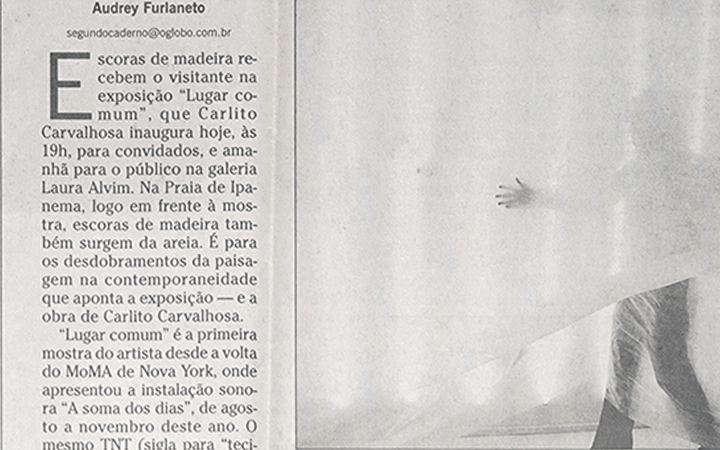
Foi este mesmo sentimento que tive ao adentrar a instalação “Apagador” no Museu de Arte Moderna da Bahia, edificação do século XVI, por onde passaram inúmeros escravos vindos da África. Todas as salas da Capela do MAM estavam ocupadas com enormes volumes brancos de tecido, que iam do teto ao chão, próximos às paredes. Para percorrer o trabalho era necessário caminhar pelos estreitos corredores, se roçando entre as cortinas e a parede, e depois entrar na obra, passando por baixo dos panos e, dessa forma, se posicionando no centro de grandes espaços diáfanos, cubos brancos, formados pelos tecidos.
No interior da instalação não somente a arquitetura da Capela se apagava, mas também, os sentimentos ruins e preocupações, levando o espectador a um estágio de contemplação e de paz muito similar ao provocado pelo ritual de Oxalá. Esta sensação era potencializada por estarmos em uma igreja, que em Salvador também é local de adoração aos Orixás, devido ao sincretismo baiano. Epababá!! Exêê!
Exu é o orixá mensageiro, que abre os caminhos. Apesar de ser o mais jovem entre as divindades do Candomblé, conquistou o direito de ser o primeiro a comer e deve ser agradado antes de todos. Exú mora nas encruzilhadas, come galo, dendê, toma cachaça, gosta de dinheiro, de festas e uma de suas árvores sagradas é a Aroeira. A exposição “Roteiro para Visitação”, contava com três grandes trabalhos distribuídos pelos espaços do primeiro andar do Palácio da Aclamação. O local que já foi morada de governadores fica localizado em uma encruzilhada no centro de Salvador.
O primeiro trabalho era justamente uma enorme Aroeira, suspensa a 2 metros do chão no meio do imponente Hall de entrada do Palácio. Juntamente com esta magnífica árvore, dois postes de luz suspensos, de 9 metros cada, transformavam o conjunto numa espécie de tridente, ferramenta que pertence a Exú.
O impacto visual e a densidade poética desta peça ocuparam o Palácio da Aclamação por longos sete meses, número de Exú. Após este período, a árvore foi replantada no jardim da parte exterior do Palácio, onde se encontra até hoje. Uma árvore, que normalmente nasce, cresce e morre fincada a terra por raízes e da própria terra se alimenta, colocada suspensa em um local nobre, quase celestial. Isto é obra de Exú, o mensageiro que atua entre o Céu e a Terra!
O segundo trabalho foi feito na Sala de Banquetes, ocupada por três longas mesas de madeira de lei, adornada por lustres de cristais e decorada por afrescos. Postes que já foram aroeiras e depois serviram para iluminar os caminhos, como faz Exu, se transformaram em uma espécie de cruz caída, que atravessava com violência poética de um lado a outro a arquitetura do edifício, transpassando janelas e portas, contrastando com a nobreza dos móveis e objetos decorativos.
O último trabalho era na varanda e no Salão Nobre do Palácio, que funcionou no passado como local de festas, bailes, velórios de autoridades, entre outras atividades regidas por Exu. Do chão ao teto centenas de barrotes de madeira formavam uma floresta seca, sem folhas, em relação com o entorno do prédio e seu jardim.
No meio dessa sala, um enorme e imponente lustre de cristal resiste imponentemente aos “espetos” fincados na opulência histórica e visual daquele espaço. Como nos bonecos de vodu, espetados, exorcizando os próprios resquícios elitistas da criação do artista, colocando-o em contato com o essencial da arte, abrindo seus caminhos para o mundo. Laroyê! Mojubá!
Os Orixás regem tudo. Oxalá, assim como Exu, são os únicos orixás que todas as pessoas possuem. Mesmo quem não tem a percepção desse fato, tem os Orixás no caminho.
Salvador, Fevereiro de 2011.
[/trp_language]
Text written about the “Apagador” exhibition held at Solar do Unhão, Museu de Arte Moderna da Bahia (MAM BA), in 2011
Oxalá is the father of the Orixás, responsible for molding men out of manioc dough. Divinity of peace always dressed in white, his day is Friday. Oxalá is worshipped through various rituals and obligations. One of these rites takes place during the Oxalá Festival, when the Orixás and the initiates parade around the terreiro, place of worship in Candombé tradition, under a large white mantle, the Alá de Oxalá, giving praise and receiving the Orixá’s axé (vital force) to the slow beat of the percussion. Those huddled beneath the Alá de Oxalá are taken over by a sensation of peace and serenity.
That was exactly the feeling I got upon entering the installation Apagador at the Museum of Modern Art in Bahia, which occupies a 16th-century building where countless slaves were trafficked after being shipped over from Africa. Each of the rooms in the Museum’s Chapel was filled with enormous white fabric volumes draped from the ceiling to the floor, only inches away from the walls. To get around the work, you had to walk these narrow corridors and slip in under the sheets, immersing yourself within the large, diaphanous spaces created by these white cubes of fabric.
Inside the installation it is not only the architecture of the Chapel that is erased, but also the viewer’s
ill-feelings and worries, resulting in a stage of contemplation and peace similar to that evoked in the ritual of Oxalá. This sensation is heightened by the fact that the venue is a church, which in Salvador—thanks to Bahian syncretism—is also a place for the worship of the Orixás. Epababá!! Exêê!
Exu is the messenger Orixá, an opener of paths. Though the youngest of the Orixás, he has earned the right to eat first and be pleased before all others. Exu lives at crossroads, eats chicken and palm oil, drinks cachaça, and has a special fondness for money and parties. His sacred trees include the Aroeira, (pepper tree). The exhibition Roadmap for Visitation features three large works distributed across the first floor of Aclamação Palace. The place, formerly the Governor’s residence, sits at a crossroads in downtown Salvador.
The first work was a huge Aroeira, suspended two meters off the floor in the middle of the imposing Entrance Hall. Alongside this magnificent tree was a pair of ten-meter-long posts, also suspended, transforming the set into a sort of trident, Exu’s tool.
The visual impact and poetic density of the piece inhabited Aclamação Palace for seven long months; seven is also Exu’s number. At the end of the exhibition, the tree was replanted in a garden in the Palace grounds, where it still stands today. A tree, which would normally seed, grow and die in the earth, and feed from roots embedded in the earth, is here hung above the ground in a noble, almost celestial hall. This must be a work of Exu, the messenger who acts between Heaven and Earth!
The second piece was done in the Banquet Hall, filled by three long hardwood tables, adorned with crystal chandeliers and decorated with
frescoes. Lampposts, which were once trees and later illuminated paths, form a sort of fallen cross that cuts violently through the architecture, breaching walls and windows, contrasting starkly with the nobility of the furnishings and décor.
The last of the three works was on the veranda and the Ceremonial Hall, once a venue for official balls, soirées and funerals, among other activities governed by Exu. Hundreds of ceiling-high beams formed a dry, leafless forest dialoguing directly with the building’s grounds and gardens.
In the middle of this hall, an enormous and imposing crystal chandelier holds out against the “lances” driven into the historical and visual opulence of the space. Jabbed like a voodoo doll, exorcizing the ghosts of the artist’s own elitist up-bringing, putting him in touch with that which is essential in art, opening paths to the world. Laroyê! Mojubá!
The Orixás govern all. Oxalá and Exu are the only pair in the pantheon that everybody has. Even if we don’t realize it, there are always Orixás along the way.
Salvador, February 2011